

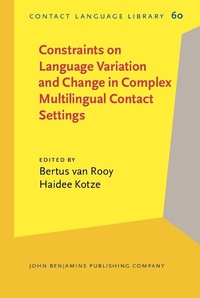
Constraints on Language Variation and Change in Complex Multilingual Contact Settings
A Study in Generative Morphology of English and Polish
1st Edition
Published on 15. July 2024
299 pages
978-90-272-4696-7 (ISBN)
Description

Constraints on Language Variation and Change in Complex Multilingual Contact Settings explores an innovative proposal: that linguistic similarities identified in different forms of contact-influenced varieties of language use (including translation, native and non-native varieties of English, and language use of bilinguals more generally) can be accounted for in a coherent framework grounded in the notion of 'constrained communication'. These varieties have hitherto been studied in independent scholarly traditions, especially translation studies and world Englishes, leaving the potential underlying unity underexplored, both conceptually and empirically. The chapters collected in this volume aim to develop such a unified perspective by drawing on corpus data across a range of languages and language varieties, with a focus on written language, a neglected data source in research on multilingual contact settings. The findings point to shared general characteristics across individual contact settings, which result from (probabilistically conditioned) manifestations of the same deeper regularities - constraints - present in diverse language-contact settings.
More details
Other editions
Additional editions

Bertus van Rooy | Haidee Kotze
Constraints on Language Variation and Change in Complex Multilingual Contact Settings
Book
06/2024
John Benjamins Publishing Co
€161.93
Shipment within 10-15 days
Content
- Intro
- Table of contents
- Chapter 1 Introduction
- 1. Introduction
- 2. Theoretical grounding of the constrained communication framework
- 3. The constraints and varieties analysed in this book
- 4. Methods for studying constrained communication
- 5. Conclusion
- Acknowledgements
- References
- Chapter 2 Afrikaans influence on genitive variation in South African English?
- 1. Introduction
- 2. Diachronic comparative corpus analyses
- 2.1 Corpora/datasets
- 2.2 Comparing genitive variation in WSAfE and BrE
- 2.3 Comparing genitive variation in WSAfE and Afrikaans over time
- 2.4 Zooming in on inanimate possessors
- 3. Discussion
- 3.1 Convergence of WSAfE and BrE?
- 3.2 Levelling of colonial lag?
- 3.3 Additional constraints on genitive choice?
- 3.4 Americanisation of WSAfE?
- 4. Conclusion
- Acknowledgements
- Chapter 3 Language contact and change through translation in Afrikaans and South African English
- 1. Introduction
- 2. Factors conditioning (change in) genitive use in Afrikaans and South African English
- 3. Methodology
- 3.1 Corpus design
- 3.2 Time frames, registers and word counts
- 3.3 Data extraction and annotation
- 3.4 Linguistic variables
- 3.4.1 Animacy of the possessor and the possessum
- 3.4.2 The principle of end weight
- 3.4.3 Final sibilance
- 3.5 Statistical analysis
- 3.5.1 Random forest analysis
- 3.5.2 Conditional inference tree
- 3.5.3 Logistic regression modelling
- 4. Results
- 4.1 Random forests analysis
- 4.2 Conditional inference tree analysis
- 4.3 Logistic regression analysis
- 4.4 Interpretation of results
- 5. Conclusion
- Appendix 1
- Appendix 2
- Appendix 3
- Chapter 4 Investigating the complementiser that in the verb complementation of Black South African English
- 1. Introduction
- 2. The that/Ø-alternation and constrained language production
- 3. Variables conditioning the that/Ø-alternation
- 4. Methodology
- 4.1 Corpora
- 4.2 Data extraction and coding
- 4.3 Statistical analysis
- 5. Discussion of findings
- 5.1 Overall frequencies of the that- and Ø-complementisers across corpora
- 5.2 Factors that condition the that/Ø-alternation in BSAfE and WSAfE
- 6. Conclusion
- Acknowledgements
- Appendix 1
- Appendix 2
- Chapter 5 Lexical use in spoken New Englishes and Learner Englishes
- 1. Introduction
- 2. New Englishes and Learner Englishes
- 2.1 The continuum between New Englishes and Learner Englishes
- 2.2 HKE and MCE
- 3. Corpora of New Englishes and Learner Englishes and the communicative constraints they reflect
- 3.1 The corpora
- 3.2 Communicative constraints
- 4. Automatic measures of lexical complexity
- 4.1 Automatic analysis
- 4.2 Results of the automatic analysis
- 5. Manual analysis of lexical choices in the picture description
- 5.1 Manual annotation
- 5.2 Results of the manual analysis
- 6. Discussion
- 7. Conclusion
- Funding
- Acknowledgements
- Chapter 6 The effect of directionality on lexico-syntactic simplification in French&&English student translation
- 1. Introduction
- 2. Theoretical background
- 2.1 Translation directionality in CBTS
- 2.2 The construct of simplification in bilingual language production
- 2.2.1 Simplification/simplicity and translation
- 2.2.2 Simplification/complexity and L2/FL production
- 3. Data and methodology
- 3.1 Data description
- 3.2 Linguistic analyses
- 3.3 Statistical analyses
- 4. Results
- 4.1 Lexico-syntactic simplicity in translations into L1 French and FL English
- 4.2 Lexico-syntactic simplification in target texts
- 5. Discussion and conclusion
- Funding
- Acknowledgements
- References
- Appendix 1. English source texts used in the study
- A. Ken Loach responds angrily to Belgian PM in antisemitism row
- B. Belgian lawmakers want an end to German pensions for Nazi collaborators
- C. Belgium hands powers to caretaker PM to fight Covid-19 after 15-month stalemate
- Appendix 2. French source texts used in the study
- D. Le Canada est-il l'Eldorado rêvé pour les Belges?
- E. Les Belges restent sur Facebook, malgré les scandales à répétition
- F. Une app pour dépister le coronavirus depuis chez soi
- Appendix 3. Linear mixed-effects simplicity models
- Mean sentence length
- Random effects
- Fixed effects
- Root lemma-token ratio
- Random effects
- Fixed effects
- Lexical density
- Random effects
- Fixed effects
- Core vocabulary coverage
- Random effects
- Fixed effects
- Appendix 4. Linear mixed-effects simplification models
- Mean sentence length
- Random effects
- Fixed effects
- Root lemma-token ratio
- Random effects
- Fixed effects
- Lexical density
- Random effects
- Fixed effects
- Core vocabulary coverage
- Chapter 7 The complex case of constrained communication
- 1. Introduction
- 2. Collocations as signals of constrained language use from a multilingual perspective
- 2.1 Variation and cross-linguistic comparability
- 2.2 Locating constrainedness effects
- 2.3 Collocations in focus
- 3. Data and method
- 3.1 Data used
- 3.2 Method
- 3.2.1 A cross-linguistically comparable feature set
- 3.2.2 Methodological workflow
- 3.2.3 Keyness analysis and factor solutions
- 4. Results
- 4.1 English Dimension 1
- 4.2 Finnish Dimension 1
- 4.3 Italian Dimension 1
- 5. Discussion
- 6. Conclusion
- References
- Appendix
- Corpora used
- Chapter 8 Comparing contact effects in translation and second language writing
- 1. Introduction
- 1.1 Shared tendencies in L2 writing and translation
- 1.2 The present study
- 2. The dataset
- 3. Analysis
- 4. Discussion
- 5. Conclusion
- Funding
- Acknowledgements
- References
- Chapter 9 Conclusion
- 1. Introduction
- 2. Individual constraint dimensions
- 2.1 Language activation
- 2.2 Modality and register
- 2.3 Text production
- 2.4 Task expertise
- 2.5 Language proficiency
- 3. Constraint interaction
- 4. Constrained varieties and languages
- 5. Insights into method
- 6. Future research
- 7. Conclusion
- References
- Index
