

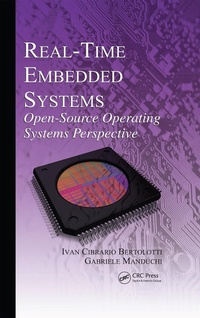
Real-Time Embedded Systems
Open-Source Operating Systems Perspective
Published on 19. December 2017
534 pages
978-1-4398-4161-7 (ISBN)
Description

From the Foreword:
"...the presentation of real-time scheduling is probably the best in terms of clarity I have ever read in the professional literature. Easy to understand, which is important for busy professionals keen to acquire (or refresh) new knowledge without being bogged down in a convoluted narrative and an excessive detail overload. The authors managed to largely avoid theoretical-only presentation of the subject, which frequently affects books on operating systems.
... an indispensable [resource] to gain a thorough understanding of the real-time systems from the operating systems perspective, and to stay up to date with the recent trends and actual developments of the open-source real-time operating systems."
-Richard Zurawski, ISA Group, San Francisco, California, USA
Real-time embedded systems are integral to the global technological and social space, but references still rarely offer professionals the sufficient mix of theory and practical examples required to meet intensive economic, safety, and other demands on system development. Similarly, instructors have lacked a resource to help students fully understand the field. The information was out there, though often at the abstract level, fragmented and scattered throughout literature from different engineering disciplines and computing sciences.
Accounting for readers' varying practical needs and experience levels, Real Time Embedded Systems: Open-Source Operating Systems Perspective offers a holistic overview from the operating-systems perspective. It provides a long-awaited reference on real-time operating systems and their almost boundless application potential in the embedded system domain.
Balancing the already abundant coverage of operating systems with the largely ignored real-time aspects, or "physicality," the authors analyze several realistic case studies to introduce vital theoretical material. They also discuss popular open-source operating systems-Linux and FreRTOS, in particular-to help embedded-system designers identify the benefits and weaknesses in deciding whether or not to adopt more traditional, less powerful, techniques for a project.
"...the presentation of real-time scheduling is probably the best in terms of clarity I have ever read in the professional literature. Easy to understand, which is important for busy professionals keen to acquire (or refresh) new knowledge without being bogged down in a convoluted narrative and an excessive detail overload. The authors managed to largely avoid theoretical-only presentation of the subject, which frequently affects books on operating systems.
... an indispensable [resource] to gain a thorough understanding of the real-time systems from the operating systems perspective, and to stay up to date with the recent trends and actual developments of the open-source real-time operating systems."
-Richard Zurawski, ISA Group, San Francisco, California, USA
Real-time embedded systems are integral to the global technological and social space, but references still rarely offer professionals the sufficient mix of theory and practical examples required to meet intensive economic, safety, and other demands on system development. Similarly, instructors have lacked a resource to help students fully understand the field. The information was out there, though often at the abstract level, fragmented and scattered throughout literature from different engineering disciplines and computing sciences.
Accounting for readers' varying practical needs and experience levels, Real Time Embedded Systems: Open-Source Operating Systems Perspective offers a holistic overview from the operating-systems perspective. It provides a long-awaited reference on real-time operating systems and their almost boundless application potential in the embedded system domain.
Balancing the already abundant coverage of operating systems with the largely ignored real-time aspects, or "physicality," the authors analyze several realistic case studies to introduce vital theoretical material. They also discuss popular open-source operating systems-Linux and FreRTOS, in particular-to help embedded-system designers identify the benefits and weaknesses in deciding whether or not to adopt more traditional, less powerful, techniques for a project.
More details
Series
Language
English
Place of publication
Baton Rouge
United States
Publishing group
Taylor & Francis Inc
Target group
College/higher education
Computer and electronics engineers, as well as Masters-level students, who want to fully understand and apply real-time operating systems.
Illustrations
134 s/w Abbildungen, 24 s/w Tabellen
24 Tables, black and white; 134 Illustrations, black and white
File size
6,03 MB
ISBN-13
978-1-4398-4161-7 (9781439841617)
Copyright in bibliographic data and cover images is held by Nielsen Book Services Limited or by the publishers or by their respective licensors: all rights reserved.
Schweitzer Classification
Other editions
Additional editions
Ivan Cibrario Bertolotti | Gabriele Manduchi
Real-Time Embedded Systems
Open-Source Operating Systems Perspective
Book
03/2017
1st Edition
CRC Press
€124.80
Shipment within 10-20 days
Ivan Cibrario Bertolotti | Gabriele Manduchi
Real-Time Embedded Systems
Open-Source Operating Systems Perspective
Book
01/2012
1st Edition
CRC Press
€314.80
Shipment within 15-20 days
Persons
Bertolotti, Ivan Cibrario; Manduchi, Gabriele
Content
Introduction
I: Concurrent Programming Concepts
A Case Study: Vision Control. Real-Time Concurrent Programming Principles. Deadlock. Interprocess Communication Based on Shared Variables. Interprocess Communication Based on Message Passing. Interprocess Communication Primitives in POSIX/Linux. Interprocess Communication Primitives in FreeRTOS. Network Communication. Lock and Wait-Free Communication.
II: Real-Time Scheduling Analysis
Real-Time Scheduling Based on the Cyclic Executive. Real-Time, Task-Based Scheduling. Schedulability Analysis Based on Utilization. Schedulability Analysis Based on Response Time Analysis. Task Interactions and Blocking. Self-Suspension and Schedulability Analysis.
III: Advanced Topics
Internal Structure of FreeRTOS. Internal Structures and Operating Principles of Linux Real-Time Extensions. OS Abstraction Layer. Control Theory and Digital Signal Processing Primer.
I: Concurrent Programming Concepts
A Case Study: Vision Control. Real-Time Concurrent Programming Principles. Deadlock. Interprocess Communication Based on Shared Variables. Interprocess Communication Based on Message Passing. Interprocess Communication Primitives in POSIX/Linux. Interprocess Communication Primitives in FreeRTOS. Network Communication. Lock and Wait-Free Communication.
II: Real-Time Scheduling Analysis
Real-Time Scheduling Based on the Cyclic Executive. Real-Time, Task-Based Scheduling. Schedulability Analysis Based on Utilization. Schedulability Analysis Based on Response Time Analysis. Task Interactions and Blocking. Self-Suspension and Schedulability Analysis.
III: Advanced Topics
Internal Structure of FreeRTOS. Internal Structures and Operating Principles of Linux Real-Time Extensions. OS Abstraction Layer. Control Theory and Digital Signal Processing Primer.
