

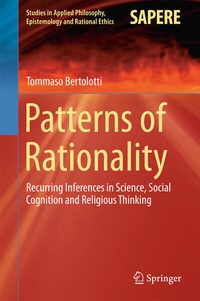
Patterns of Rationality
Description

This book proposes an applied epistemological framework for investigating science, social cognition and religious thinking based on inferential patterns that recur in the different domains. It presents human rationality as a tool that allows us to make sense of our (physical or social) surroundings. It shows that the resulting cognitive activity produces a broad spectrum of outputs, such as scientific models and experimentation, gossip and social networks, but also ancient and contemporary deities. The book consists of three parts, the first of which addresses scientific modeling and experimentation, and their application to the analysis of scientific rationality. Thus, this part continues the tradition of eco-cognitive epistemology and abduction studies. The second part deals with the relationship between social cognition and cognitive niche construction, i.e. the evolutionarily relevant externalization of knowledge onto the environment, while the third part focuses on what is commonly defined as "irrational", thus being in a way dialectically opposed to the first part. Here, the author demonstrates that the "irrational" can be analyzed by applying the same epistemological approach used to study scientific rationality and social cognition; also in this case, we see the emergence of patterns of rationality that regulate the relationships between agents and their environment. All in all, the book offers a coherent and unitary account of human rationality, providing a basis for new conceptual connections and theoretical speculations.
More details
Other editions
Additional editions
Content
Introduction.- Part I Science and Strategic Cognition.- Part II Cognitive Niches and Social Cognition: Using Knowledge as a Tool.- Part III The Eco-Cognitive Epistemology of Counterfactual Beliefs.
