

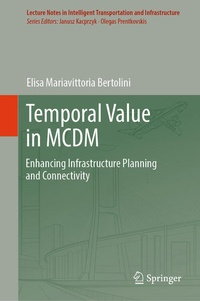
Temporal Value in MCDM
Description

This book outlines a process for planning transportation systems, employing qualitative methods to explore the balance between various considerations, and highlighting power asymmetries among key stakeholders. It serves as a decision support tool, complementing the usual techniques used in multi-criteria analysis (MCA). The book delves into the dynamics of territorial governance within a group decision-making context.The proposed tool provides a rational approach to addressing the main challenges that arise in the territorial context, promoting greater consensus among all parties involved in the decision-making process. The methodology allows for a deep appreciation of the contribution of decision analysis frameworks in the territorial scenario, particularly in group decision-making settings, where the literature on participatory MCA is rather sparse. To achieve a practical synthesis of the stakeholders' positions and to enrich the multi-criteria framework, the book introduces a tool for systematic analysis of stakeholder behaviour. Without this tool, the MCA analysis would be incomplete for providing adequate decision support.The multi-criteria techniques underpinning the analysis, such as the Simple Additive Weighting (SAW), simplified Simos method, and the MACTOR case-based method, facilitate the identification of strategic directions based on criteria and parameters reflective of the relevant territorial framework.This outcome was achieved through successive evaluations of increasing complexity. Initially, the performances over short, medium, and long-term periods were considered separately, based on the alternatives and criteria identified by the stakeholders, including both economic and welfare aspects. Subsequently, a method was developed to coherently compare the performances of various alternatives over different timescales, aggregating the values into a single measure while also accounting for the duration of effects across these periods.This approach leads to a greater awareness of the temporal significance of decisions, understanding how impacts vary over time and how these should be carefully assessed. This understanding helps overcome the difficulties associated with balancing long-term visions with immediate needs. As evidenced by the results, considering the time factor in evaluations alters both the values and, in some cases, the aggregated outcomes in the Alternatives/Stakeholders matrices. This highlights the necessity of incorporating temporal preference elicitation into the MCA model to accurately reflect their influence on decision-making.
More details
Other editions
Additional editions
Person
Elisa Bertolini is a research fellow at the University of Trieste, specializing in decision-making support for transport, planning, and logistics. Her PhD in Civil-Environmental Engineering and Architecture from the University of Trieste focused on the strategic assessment of cross-border transport scenarios, addressing the multidimensional challenges of evaluating multiple alternatives across various criteria.Building on this foundational research, Elisa has developed expertise in multicriteria evaluation methodologies. She has explored both single-criterion and multi-criteria approaches, with a particular focus on rationalizing the decision-making process for policymakers based on their stated priorities. Elisa's work also delves into group decision-making dynamics, examining how the interests, preferences, and judgments of multiple stakeholders can be aggregated into collective decisions. By investigating potential alignments and oppositions, she is able to provide valuable support for collaborative decision-making.Through her collaborations with ALIA ss studio and her involvement in European projects, Elisa has developed a robust understanding of how to integrate economic, social, and environmental aspects into sustainable infrastructure choices. Her research continues to explore innovative approaches to rationalize decision-making processes for policymakers, particularly in the context of transportation and logistics planning at community, national, and regional levels.
Content
Introduction.- Strategic Choices in Territorial Development.- Review of Decision Support Methodologies in Literature.- Participation in Territorial Governance: A Group Decision-Making Context.- Methodological approach.- The Working Group.- Ranking of Alternatives Based on Individual Preferences.
