

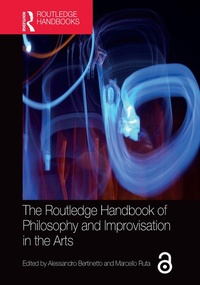
The Routledge Handbook of Philosophy and Improvisation in the Arts
1st Edition
Published on 22. July 2021
756 pages
978-1-000-39784-0 (ISBN)
Description

Over the last few decades, the notion of improvisation has enriched and dynamized research on traditional philosophies of music, theatre, dance, poetry, and even visual art. This Handbook offers readers an authoritative collection of accessible articles on the philosophy of improvisation, synthesizing and explaining various subjects and issues from the growing wave of journal articles and monographs in the field. Its 48 chapters, written specifically for this volume by an international team of scholars, are accessible for students and researchers alike.
The volume is organized into four main sections:
I Art and Improvisation: Theoretical Perspectives
II Art and Improvisation: Aesthetical, Ethical, and Political Perspectives
III Improvisation in Musical Practices
IV Improvisation in the Visual, Narrative, Dramatic, and Interactive Arts
Key Features:
Treats improvisation not only as a stylistic feature, but also as an aesthetic property of artworks and performances as well as a core element of artistic creativity.
Spells out multiple aspects of the concept of improvisation, emphasizing its relevance in understanding the nature of art.
Covers improvisation in a wide spectrum of artistic domains, including unexpected ones such as literature, visual arts, games, and cooking.
Addresses key questions, such as:
- How can improvisation be defined and what is its role in different art forms?
- Can improvisation be perceived as such, and how can it be aesthetically evaluated?
- What is the relationship between improvisation and notions such as action, composition, expressivity, and authenticity?
- What is the ethical and political significance of improvisation?
The volume is organized into four main sections:
I Art and Improvisation: Theoretical Perspectives
II Art and Improvisation: Aesthetical, Ethical, and Political Perspectives
III Improvisation in Musical Practices
IV Improvisation in the Visual, Narrative, Dramatic, and Interactive Arts
Key Features:
Treats improvisation not only as a stylistic feature, but also as an aesthetic property of artworks and performances as well as a core element of artistic creativity.
Spells out multiple aspects of the concept of improvisation, emphasizing its relevance in understanding the nature of art.
Covers improvisation in a wide spectrum of artistic domains, including unexpected ones such as literature, visual arts, games, and cooking.
Addresses key questions, such as:
- How can improvisation be defined and what is its role in different art forms?
- Can improvisation be perceived as such, and how can it be aesthetically evaluated?
- What is the relationship between improvisation and notions such as action, composition, expressivity, and authenticity?
- What is the ethical and political significance of improvisation?
Reviews / Votes
"Practically everyone who has lately thought theoretically about improvisation has contributed to this volume, and just about everything one ever wanted to know about improvisation but dared not hope to see answered is here addressed. Suffice it to say that the editors have here done an incalculable service to this burgeoning field of research."Jerrold Levinson, University of Maryland
More details
Series
Edition
1. Auflage
Language
English
Place of publication
London
United Kingdom
Publishing group
Taylor & Francis Ltd
Target group
College/higher education
Product notice
Reflowable
Illustrations
21 Line drawings, black and white; 23 Halftones, black and white; 44 Illustrations, black and white
File size
8,13 MB
ISBN-13
978-1-000-39784-0 (9781000397840)
Copyright in bibliographic data and cover images is held by Nielsen Book Services Limited or by the publishers or by their respective licensors: all rights reserved.
Schweitzer Classification
Other editions
Additional editions
Alessandro Bertinetto | Marcello Ruta
The Routledge Handbook of Philosophy and Improvisation in the Arts
Book
01/2023
1st Edition
Routledge
€68.10
Shipment within 10-20 days
Alessandro Bertinetto | Marcello Ruta
The Routledge Handbook of Philosophy and Improvisation in the Arts
Book
07/2021
1st Edition
Routledge
€331.00
Shipment within 15-20 days
Persons
Alessandro Bertinetto is Professor of Philosophy at the University of Turin in Italy and coordinator of ART-Aesthetics Research Turin (Philosophical Seminar). He has been an Alexander von Humboldt Fellow and a member of the Executive Committee of the European Society for Aesthetics. His most recent books are Eseguire l'inatteso. Ontologia della musica e improvvisazione (2016) and Estetica dell'improvvisazione (2021).
Marcello Ruta studied music (classical piano) in Milan and Trieste and obtained his PhD in philosophy in 2010 at the University of Strasbourg and his Habilitation in 2017 at the University of Bern. He is the author of Schopenhauer et Schelling, philosophes du temps et de l'eternite (2014) and co-editor (with Alessandro Arbo) of Ontologie musicale: perspectives et debats (2014).
Marcello Ruta studied music (classical piano) in Milan and Trieste and obtained his PhD in philosophy in 2010 at the University of Strasbourg and his Habilitation in 2017 at the University of Bern. He is the author of Schopenhauer et Schelling, philosophes du temps et de l'eternite (2014) and co-editor (with Alessandro Arbo) of Ontologie musicale: perspectives et debats (2014).
Content
Introduction 1. Improvisation as Normative Practice 2. Improvisation as Resonance 3. Improvisation as Creative Performance 4. Material and Improvisation in the Formative Process 5. Ontology of Improvisation and Jazz 6. Improvisation and Orientation 7. Improvisation and Action Theory 8. Improvisation, Actions, and Processes 9. Rethinking Realtimeness in Improvisation 10. Appreciating Improvisations as Art 11. Transformative Aesthetics: When the Unforeseen Emerges 12. Improvisation as Spontaneous Creation versus "Making Do" 13. Improvisation as Aesthetic Appearance 14. The Expressivity of Musical Improvisation 15. Jazz Improvisation, Authenticity, and Self-Expression 16. Manyness in Music Improvisation 17. Forms of Improvisation and Experimentalism 18. Improvisational Phronesis 19. Improvisation's Ethical and Epistemological Challenge 20. Street Art and the Politics of Improvisation 21. Improvisation and Political Emancipation 22. Competing Ontologies of Musical Improvisation: A Medieval Perspective 23. Improvisation and Essential Ornamentation in Vocal Music (1600-1900) 24. Freedom and Form in Piano Improvisation in the Early 19th Century 25. Improvisation and Authenticity in Early 20th Century Western Music 26. Improvisation and Composition: A Schoenbergian View 27. Repeatability versus Unrepeatability in Free Improvisation 28. The Risk of Improvised Music: An Ethnographic Approach 29. Empathy in Improvisation 30. Improvisation in Pop-Rock Music 31. "Improvisation" in Play: A View Through South Indian Music Practices 32. Improvisation in Arab Musical Practices 33. Dance Improvisation as Experimental Inquiry 34. The Springs of Action in Buto Improvisation 35. Stage Improvisation in the Commedia dell'Arte 36. Performance Art and Improvisation 37. Improvisation, Stand-up, and Comedy 38. Improvisation, Machines, Cinema 39. Improvisation and Poetry 40. Improvisation in Painting 41. Improvisation in Sculpture 42. Improvisation and Artistic Photography 43. Improvisation and Installation Art 44. Installed Improvisation: The Case of Erwin Redl 45. Improvisation in Design Processes 46. Urban Improvisations 47. Improvisation in Cooking and Tasting 48.Creativity and Improvisation in Games
