

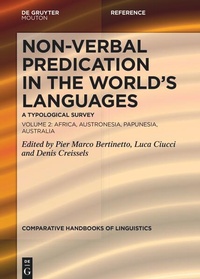
Non-verbal Predication in the World's Languages
Description

The notion of predication is usually associated with the lexical class of verbs. However, the predicate function may also be expressed by Noun / Adjective / Adverb / Quantifier Phrases:
a. John is a doctor. b. The man is old. c. The boys are in the garden. d. Sam's friends are many.
Natural languages do, with respect to non-verbal predication, what they are expected to do in any compartment of grammar: they sharply diverge in their behavior.
This book offers a wide typological overview of how languages deal with non-verbal predication (henceforth: NVP). After the pioneering works by Hengeveld (1992) and Stassen (1997), no other work has attempted to provide a comprehensive overview of this pervasive syntactic phenomenon. Hence, the need for this book.
The introductory chapter highlights the main features to be considered:
- the lexical and morphosyntactic nature of the predicate.
- the morphological expression of NVP.
- the semantic types of NVP.
The bulk of the book consists of a collection of papers, written by well-known specialists, targeting different languages or language families, thus offering a rich array of typological data.
This book will be of interest to typologists, syntacticians of any theoretical creed, and students of linguistics at large.
More details
Other editions
Additional editions
Persons
Content
- Intro
- List of the Authors
- Acknowledgments
- Contents
- Crucial issues in non-verbal predication: A questionnaire
- Part II: Case studies
- Africa
- 22 Non-verbal predication in Maltese
- 1 Introduction
- 2 The basics of Maltese morphosyntax
- 2.1 The structure of verbal clauses
- 2.2 Verbs
- 2.3 Nouns and noun phrases
- 2.4 Adjectives
- 2.5 Non-verbal predication in Maltese
- 3 Juxtaposition of noun phrases and prepositional phrases
- 3.1 Nominal predication
- 3.1.1 Identity
- 3.1.2 Inclusion
- 3.1.3 Inverse-possessive predication
- 3.1.4 Ostension
- 3.2 Adjectival predication
- 3.2.1 Adjectival predication with the argument left unexpressed
- 3.2.2 Adjectival predication with an overt argument
- 3.3 Adverbial predication
- 3.3.1 Spatial uses
- 3.3.2 Non-spatial uses
- 3.4 Predicative use of numerals
- 4 The pronominal copula
- 4.1 Nominal predication
- 4.1.1 Identity
- 4.1.2 Inclusion
- 4.1.3 Inverse-possessive predication
- 4.2 Adjectival predication
- 4.3 Adverbial predication
- 4.3.1 Spatial uses
- 4.3.2 Non-spatial uses
- 4.4 Predicative use of numerals
- 4.5 Other uses of the negative copula
- 5 The locative copula qieghed
- 5.1 Adverbial predication
- 5.1.1 Spatial uses
- 5.1.2 Non-spatial uses
- 5.2 Predicative use of numerals
- 5.3 Other use of the locative copula
- 6 The verbal copula
- 6.1 Nominal predication
- 6.1.1 Identity
- 6.1.2 Inclusion
- 6.1.3 Inverse-possessive predication
- 6.2 Adjectival predication
- 6.3 Adverbial predication
- 6.3.1 Spatial uses
- 6.3.2 Non-spatial uses
- 6.4 Predicative use of numerals
- 7 The locative copula fi
- 7.1 Inverse-locational predication
- 7.2 Metaphorical uses
- 8 The adverbial copulas
- 8.1 Inverse-locational predication
- 8.2 Existential utterances
- 8.3 Predicative use of numerals
- 8.4 Presentational utterances
- 9 Predicative possession
- 9.1 Transpossessive predication
- 9.2 Physical, emotional and mental states predication
- 9.3 Presentational utterances
- 9.4 Other use of the predicative possession
- 10 Conclusion
- Abbreviations
- References
- 23 Non-verbal predication in Nilotic
- 1 Introduction
- 2 Syntactic strategies
- 2.1 Southern Nilotic
- 2.2 Eastern Nilotic
- 2.3 Western Nilotic
- 3 Issues in the semantics of non-verbal predication
- 3.1 Contingent versus permanent states
- 3.2 Locational and possessive structures
- 4 A comparative perspective on non-verbal predication in Nilotic
- Abbreviations
- References
- 24 Non-verbal predication in Cushitic
- 1 Introduction
- 2 Nominal predication
- 2.1 Juxtaposition
- 2.2 Predicative nominal inflection
- 2.3 Between predicative forms and copulae
- 2.4 Non-verbal predication with a copula
- 2.5 Negative nominal predication
- 2.6 Interrogative nominal predication
- 3 Adjectival predication
- 3.1 Adjectival predication with a copula
- 3.2 "Adjectives" and verbal adjectival predication
- 3.3 Adjectival negative predication
- 3.4 Adjectival predication with quasi-copulae and derived verbs
- 4 Non-verbal predication based on numerals and adverbial expressions
- 5 Locational predication
- 6 Non-verbal predication and possession
- 7 The historical scenario
- 8 Typological considerations and conclusions
- Appendix 1: List of languages in examples, internal classification and ISO 639-3 tags
- Abbreviations
- References
- 25 Non-verbal predication in Mandinka and other Mande languages
- 1 Introduction
- 2 Non-verbal predication in Mandinka
- 2.1 The basics of Mandinka morphosyntax
- 2.1.1 The structure of verbal clauses
- 2.1.2 TAM-polarity marking in verbal clauses
- 2.1.3 Nouns and noun phrases
- 2.2 General remarks on non-verbal predication
- 2.2.1 Verbal and non-verbal copulae
- 2.2.2 Variants of the non-verbal copulae
- 2.2.3 Non-verbal copulae and verbs
- 2.3 Nominal predication
- 2.3.1 General characteristics of nominal predication
- 2.3.2 Nominal predication with an unexpressed argument
- 2.3.3 Nominal predication with an overt argument
- 2.3.4 Inverse-possessive predication as a particular use of nominal predication
- 2.3.5 Special uses of the nominal copula
- 2.3.5.1 Comitative predication
- 2.3.5.2 The predicative use of numerals
- 2.3.6 Nominal predication and the verb ke´ 'happen, occur, be'
- 2.4 Adverbial predication
- 2.4.1 General characteristics of adverbial predication
- 2.4.2 Locational predication
- 2.4.3 The expression of pure existence
- 2.4.4 Non-spatial uses of adverbial predication
- 2.4.5 The construction X be´ Y la´
- 2.4.6 The construction X be´ Y bu´lu'
- 2.4.7 The expression of age
- 2.4.8 The expression of similarity
- 2.4.9 Adverbial predication and progressive aspect
- 2.4.10 Be´ as an auxiliary in verbal predication
- 2.4.10.1 Be´ combined with the ri´?-form of verbs
- 2.4.10.2 Be´ combined with the ka^?-form of verbs
- 2.4.10.3 Be´ combined with the la´-form of verbs
- 2.4.11 Adverbial predication and the verb ta'ra´ 'find, be found'
- 2.5 Ostension and the emergence of a new copula
- 2.6 The question of adjectival predication
- 2.7 Clauses including neither verbs nor non-verbal copulae
- 3 Cross-linguistic variation across Mande in the domain of non-verbal predication
- 3.1 The question of adjectival predication
- 3.2 Coding strategies in non-verbal predication
- 3.2.1 Juxtaposition
- 3.2.2 Predicative inflection
- 3.3 Copulae
- 3.4 Inclusion and identity
- 3.5 Locational predication and existence
- 3.6 Predicative possession and non-verbal predication
- 3.6.1 Plain-possessive predication
- 3.6.2 Inverse-possessive predication
- 3.7 Cross-linguistic variation in the nominal predication constructions
- 3.7.1 The ARG COP PRED+adp pattern
- 3.7.2 The PRED COP ARG+adp pattern
- 3.7.3 The PRED ARG+adp pattern
- 3.7.4 The ARG COP PRED pattern
- 3.7.5 The ARG PRED COP pattern
- 3.7.6 The ARG PRED pattern
- 4 Conclusion
- Abbreviations
- References
- 26 Non-verbal predication in Cuwabo (Bantu)
- 1 Introduction
- 2 Some basics on Cuwabo morphosyntax
- 2.1 The structure of verbal clauses
- 2.2 Nouns and noun phrases
- 2.3 The augment tone
- 2.4 On adjectives
- 3 Formal strategies of non-verbal predication in Cuwabo
- 3.1 Type I: Verbal and non-verbal copulae
- 3.1.1 Copula verb li
- 3.1.2 Semi-copula verb kála
- 3.1.3 Class-inflected pro-copulae
- 3.2 Type III: Predicative inflection constructions
- 3.2.1 Subtype IIIb: High-Tone Deletion (HTD)
- 3.2.2 Subtype IIIa: Cliticization of subject indexes + copula
- 3.3 Types IV: Combination of Types I and III
- 3.3.1 li + HTD
- 3.3.2 kála + HTD
- 4 Nominal predication
- 4.1 Quantification
- 4.2 Ostension
- 4.3 Coordinated NPs
- 4.4 Possessive predication
- 4.4.1 Plain-possessive predication
- 4.4.2 Inverse-possessive predication
- 5 Adverbial predication
- 5.1 Locational predication
- 5.1.1 Plain-locational predication
- 5.1.2 Inverse-locational predication
- 5.2 Non-spatial uses of adverbial predication
- 5.2.1 Temporal adverbial predication
- 5.2.2 Manner adverbial predication
- 5.2.3 Similative adverbial predication
- 6 Negation
- 6.1 kahíye~kahíyo
- 6.2 Locative-existential ka-sp-hí=loc
- 6.3 Negated possessive predication
- 7 Other interesting aspects of non-verbal predication
- 7.1 Stage-level vs. individual-level properties
- 7.2 Information structure
- 7.3 The insertion of clauses in complex constructions
- 8 Conclusion
- Abbreviations
- References
- 27 Non-verbal predication in Ju
- 1 Introduction
- 2 Non-verbal predicate constructions
- 2.1 Constructions with a single noun phrase
- 2.1.1 Particle tsèm
- 2.1.2 Particle kòm
- 2.1.3 Particle má
- 2.2 Constructions with two noun phrases
- 2.2.1 Copula verb e
- 2.2.2 Copula verb o(a)
- 2.2.3 Omission of copula verb o(a) after má
- 2.2.4 Copula verb ge(a)
- 2.2.5 Negative copula verb kora
- 3 Summary
- Abbreviations
- References
- Austronesia, Papunesia, Australia
- 28 Non-verbal predicates in Oceanic languages
- 1 Non-verbal predicates in Oceanic languages: Introduction
- 2 Verbal predicates
- 3 Adjectival predicates
- 3.1 Adjectives vs. verbs: similar but different
- 3.2 When adjectives inflect for TAM
- 3.3 Two separate word classes: The case of Teanu
- 4 Nominal predicates
- 4.1 Standard noun predicates
- 4.1.1 A preliminary note on equative vs. ascriptive predicates
- 4.1.2 Direct noun predicates
- 4.1.3 Anchored noun predicates
- 4.2 TAM-inflected noun predicates
- 4.2.1 A copula for TAMP-marked clauses?
- 4.2.2 TAMP-inflected noun predicates in Mwotlap
- 4.2.3 A hidden copula?
- 4.3 Copulas and their rarity among Oceanic languages
- 4.3.1 The lack of copula, a strong tendency in the Pacific
- 4.3.2 The different types of Oceanic copulas
- 5 Numeral predicates
- 6 Possessive predicates
- 7 Adverbial and locative predicates
- 7.1 Locative predicates
- 7.2 Non-locative adverbial predicates
- 7.3 Similative predicates
- 8 Existential and plain-possessive predicates
- 8.1 Existential predicates
- 8.2 Negative existentials
- 8.3 Plain-possessive predicates
- 8.4 When existentials and ascriptives are coexpressed
- 9 Ostensive predicates
- 10 Conclusion
- Abbreviations
- References
- 29 Non-verbal predication in Formosan languages
- 1 Introduction
- 1.1 Defining non-verbal predication
- 1.2 The Formosan languages: brief characterization
- 1.3 Organization of this chapter
- 2 Structural properties
- 2.1 Distinctions between nouns and verbs at the root level vs. word level
- 2.1.1 Distinctions at the root level
- 2.1.2 Distinctions at the word level
- 2.2 Structural properties of non-verbal vs. verbal predication
- 2.2.1 Similarities between non-verbal and verbal predication
- 2.2.2 Dissimilarities between non-verbal and verbal predication
- 2.3 Missing lexical categories
- 3 Nominal predication
- 3.1 Structure of nominal predication
- 3.1.1 Juxtaposed NPs
- 3.1.2 Occurrence of a copula
- 3.2 Negative clauses
- 3.2.1 Same negator in nominal and verbal clauses
- 3.2.2 Different negator in nominal and verbal clauses
- 3.3 Complex non-verbal constructions
- 4 Locative predication
- 5 Possessive predication
- 6 Concluding remarks
- Abbreviations and conventions
- References
- Online resources and open data
- 30 Non-verbal predication in three families of Papunesia: Teiwa, Tidore and Mian
- 1 Introduction
- 2 Non-verbal predication in Teiwa (Timor Alor Pantar family)
- 2.1 The basics of Teiwa morphosyntax
- 2.2 Teiwa word classes
- 2.3 Nominal predicates in Teiwa
- 2.4 Possessive clauses in Teiwa
- 2.5 Adjectival predicates in Teiwa
- 2.6 Predicates expressing quantification in Teiwa
- 2.7 Predicates expressing location in Teiwa
- 3 Non-verbal predication in Tidore (North Halmahera family)
- 3.1 The basics of Tidore morphosyntax
- 3.2 Tidore word classes
- 3.3 Nominal predicates in Tidore
- 3.4 Adjectival predicates in Tidore
- 3.5 Predicates expressing quantification in Tidore
- 3.6 Predicates expressing location in Tidore
- 4 Non-verbal predication in Mian (Ok family, Trans New Guinea)
- 4.1 The basics of Mian morphsyntax and Mian word classes
- 4.2 Nominal predicates in Mian
- 4.3 Adjectival and adverbial predicates in Mian
- 4.4 Predicates expressing quantification in Mian
- 4.5 Predicates expressing location in Mian
- 5 Concluding remarks
- Abbreviations
- References
- 31 Non-verbal predication in Nungon
- 1 Introduction
- 2 Syntactic types of non-verbal predication in Nungon
- 2.1 Nominal predication
- 2.2 Adjectival predication
- 2.3 Topicalized demonstrative as a linker in verbless clauses
- 2.4 Adverbs as predicates
- 2.5 Muuno as negative existential predicate and as negator
- 2.5.1 Negated non-verbal predicates
- 2.6 Temporal setting, further marking, and relativizing of Nungon verbless clauses
- 2.6.1 Temporal setting of verbless clauses
- 2.6.2 The attention-commanding suffix -(w)a on non-verbal predicates
- 2.6.3 Verbless clauses as headless relative clauses
- 2.6.4 Adjectivizing of verbless clauses
- 2.7 'Being' and 'becoming' with the verbs to- and yo-
- 3 Semantic types of non-verbal predication in Nungon
- 3.1 Identity and inclusion predication
- 3.2 Quantification in non-verbal predication
- 3.3 Adverbial non-verbal predication
- 3.4 Possession and non-verbal predication
- 4 Illocutionary force
- 5 Conclusion
- Abbreviations
- References
- 32 Non-verbal predication in Ngumpin-Yapa languages (Australia)
- 1 Introduction
- 2 Ngumpin Yapa languages
- 2.1 Overview of morphosyntax in Ngumpin-Yapa languages
- 2.1.1 Word classes in Ngumpin-Yapa languages
- 2.1.2 The structure of verbal clauses
- 3 Morphosyntax of non-verbal predication
- 3.1 Copula constructions involving inflecting verbs
- 3.2 Nominal predication
- 3.3 Non-verbal predication involving coverbs
- 3.4 Non-verbal predication involving non-subject arguments
- 3.5 Modal/propositional predication
- 4 Semantic types
- 4.1 Nominal predication
- 4.1.1 Identity statements
- 4.1.2 Inclusive predication
- 4.2 Adverbial predication
- 4.2.1 Locational
- 4.2.2 Ecological zone
- 4.2.3 Purposive
- 4.2.4 Comparative
- 4.2.5 Possession
- 4.2.5.1 Proprietive predications
- 4.2.5.2 Appositional possession
- 4.2.5.3 Suffixal possession
- 4.2.5.4 Prominent internal possession
- 4.2.6 Negation and non-verbal predication
- 4.2.6.1 Negative predicative nominal
- 4.2.6.2 Privative
- 4.3 Coverbal predication
- 5 Conclusion
- Abbreviations
- References
- Part III: Conclusion and prospects
- 33 Non-verbal predication: Results and perspectives
- 1 Preliminaries
- 2 Nouns and adjectives in predicative function
- 2.1 On the availability of adjectives and their behavior
- 2.2 Morphological features of nominal and adjectival predicates
- 3 Construction types: distribution, restrictions, origin
- 3.1 Types of construction: their distribution and competition
- 3.2 Subtypes IIIa and IIIb: their distribution and competition
- 3.3 Verbal marking on non-verbal predicates
- 4 Semantic issues
- 4.1 Inclusion vs. identity predication and the definiteness/specificity parameter
- 4.2 Contingent vs. permanent qualification of non-verbal predicates
- 4.3 Information structure and constituent order
- 5 Further lexical or phrasal categories in predicative function
- 5.1 Lexical-class restrictions on non-verbal predicates
- 5.2 Adverbial predication
- 5.2.1 Adverbial predication as a non-universal notion
- 5.2.2 Adverbial predication and functional types of predication
- 5.2.3 Functional overlaps between adverbial predication and nominal / adjectival predication
- 5.3 Quantificational predication
- 6 Functional domains
- 6.1 Locational predication
- 6.1.1 Locational predication between verbal and non-verbal predication
- 6.1.2 Plain-locational predication and inverse-locational predication
- 6.1.3 Locational predication and existential predication
- 6.1.4 Locational predication and predicative possession
- 6.1.5 Inverse-locational predication and inclusion predication
- 6.2 Possessive predication
- 6.2.1 Verbal strategies in plain-possessive predication: transitive 'have' verbs and other bivalent verbs of possession
- 6.2.2 Verbal strategies in plain-possessive predication: possessive clauses projected by proprietive verbs
- 6.2.3 Non-verbal strategies in plain-possessive predication: proprietive nouns or adjectives in predicative role
- 6.2.4 Non-verbal strategies in plain-possessive predication: case-marked NPs or adpositional phrases referring to the possessee in predicative role
- 6.2.5 Non-verbal strategies in plain-possessive predication: case-marked NPs or adpositional phrases referring to the possessor in predicative role
- 6.2.6 The modified-possessee type of plain-possessive predication
- 6.2.7 Possessive interpretation of a topic adjoined to an existential clause
- 6.2.8 Inverse-possessive predication
- 6.2.9 Comparison with previous accounts of the typology of predicative possession
- 6.3 Similative predication
- 7 Ostensive predication
- 8 Syntactic issues
- 8.1 Negation
- 8.2 Syntactic markers within the clause
- 8.2.1 Overt flagging on the nominal predicate
- 8.2.2 The marking of the subject in non-verbal predication
- 8.2.3 Discourse markers in nominal predication
- 8.3 Non-verbal predication in dependent clauses
- 8.4 Illocutionary force and non-verbal predication
- 9 Types of copula and their origin
- 9.1 Different types of copula
- 9.2 Copula and auxiliary function
- 9.3 On the origin of copula elements
- 10 Prospects for further investigation
- Abbreviations
- References
- Subject index
- Language index
