

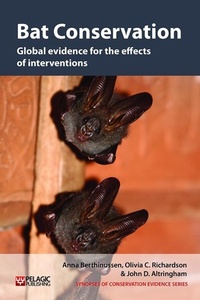
Bat Conservation
Global evidence for the effects of interventions
Published on 16. May 2014
120 pages
978-1-907807-91-6 (ISBN)
Description

This book brings together scientific evidence and experience relevant to the practical conservation of bats. The authors worked with an international group of bat experts and conservationists to develop a global list of interventions that could benefit bats.
For each intervention, the book summarises studies captured by the Conservation Evidence project, where that intervention has been tested and its effects on bats quantified. The result is a thorough guide to what is known, or not known, about the effectiveness of bat conservation actions throughout the world.
Bat Conservation is the fifth in a series of Synopses that will cover different species groups and habitats, gradually building into a comprehensive summary of evidence on the effects of conservation interventions for all biodiversity throughout the world.
By making evidence accessible in this way, we hope to enable a change in the practice of conservation, so it can become more evidence-based. We also aim to highlight where there are gaps in knowledge.
Evidence from all around the world is included. If there appears to be a bias towards evidence from northern European or North American temperate environments, this reflects a current bias in the published research that is available to us. Conservation interventions are grouped primarily according to the relevant direct threats, as defined in the International Union for the Conservation of Nature (IUCN)'s Unified Classification of Direct Threats (www.iucnredlist.org/technical-documents/classification-schemes).
For each intervention, the book summarises studies captured by the Conservation Evidence project, where that intervention has been tested and its effects on bats quantified. The result is a thorough guide to what is known, or not known, about the effectiveness of bat conservation actions throughout the world.
Bat Conservation is the fifth in a series of Synopses that will cover different species groups and habitats, gradually building into a comprehensive summary of evidence on the effects of conservation interventions for all biodiversity throughout the world.
By making evidence accessible in this way, we hope to enable a change in the practice of conservation, so it can become more evidence-based. We also aim to highlight where there are gaps in knowledge.
Evidence from all around the world is included. If there appears to be a bias towards evidence from northern European or North American temperate environments, this reflects a current bias in the published research that is available to us. Conservation interventions are grouped primarily according to the relevant direct threats, as defined in the International Union for the Conservation of Nature (IUCN)'s Unified Classification of Direct Threats (www.iucnredlist.org/technical-documents/classification-schemes).
Reviews / Votes
This volume, Bat Conservation, is the fifth in the Synopses of Conservation Evidence series and it is linked to the online resource - www.conservationevidence.com. Other editions in the series include Bee, Bird, Farmland and Amphibian Conservation. This is an excellent review with synopses of ecology practices and implementation for bat conservation which covers cases across continents. It is likely to be of interest to practitioners and students who would like to see evidence of plans and actions. Other editions for different species groups and habitats in this series of Conservation Evidence will be published by Pelagic Publishing. -- Alan Linsdell * Mammal News * This book presents what conservation evidence exists about bats, their threats and conservation measures. Interventions are listed as one of 12 specific topics. For example, there are six different interventions for 'human disturbance - caving and tourism' ((e.g. maintain micro-climate, use of cave gates, etc.). Each intervention is assessed to gauge if evidence exists to substantiate effects.It provides a stark insight into the lack of scientific research (or survey work that remains unpublished) about how humans affect bats. This publication also serves as a useful 'wake-up call' to bat surveyors and researchers, identifying which interventions are lacking scientific evidence. This is very helpful in directing future bat research. Quite often though, ecological judgements have to be made without adequate scientific evidence. In practice, these will be made with whatever knowledge is available, whether this is from academia or informed by non-academic findings or surveys.
Due to the book's strong scientific research content, I found this book quite 'dry', but it certainly delivers what it aims to achieve. The small font gives a 'text heavy' appearance (for an A5 sized book). Relevant illustrations or photos could have helped to break-up text on specific topics where there are good examples for the evidence of effects. As a result, this book would appear more suitable for university students. However, I would buy this book as a very useful base-line reference source for bat conservation.
Pelagic Publishing is congratulated in taking forward publications to the benefit of the bat community. -- David Patterson * Scottish Bats * The book is aimed at land managers and practical conservationists, with 10 chapters devoted to particular categories of threats to bats (agriculture, wind turbines, pollution, fire, etc.), within which specific dangers are addressed (including all the 'usual suspects' such as pesticides, artificial lighting and disturbance to hibernacula for example). For each threat, the various widely suggested mitigations are listed, then the literature has been scanned to find robust evidence for whether or not they were effective. There are no words wasted here in the very business-like text. This disciplined approach is welcome and perhaps long overdue, given the resources that have been poured into bat conservation over the past 30 years. -- Pat Morris * Zoological Journal of the Linnean Society *
More details
Series
Language
English
Place of publication
Exeter
United Kingdom
Target group
Professional and scholarly
ISBN-13
978-1-907807-91-6 (9781907807916)
Copyright in bibliographic data and cover images is held by Nielsen Book Services Limited or by the publishers or by their respective licensors: all rights reserved.
Schweitzer Classification
Other editions
Additional editions
Anna Berthinussen | Olivia C. Richardson | John D. Altringham
Bat Conservation
Global evidence for the effects of interventions
Book
05/2014
1st Edition
Pelagic Publishing
€40.20
Shipment within 10-15 days
Persons
Anna Berthinussen is a post-doctorate researcher at the University of Leeds, currently working on a Defra-funded study of the interactions between bats and roads. She holds degrees in bat ecology and conservation (PhD) and Zoology (BSc), both from the University of Leeds. She has published several scientific papers and contributed to book chapters on bats, and has a keen interest in wildlife conservation.
Olivia Richardson is a conservation ecologist who has recently been working as a Research Assistant and an ecological consultant. She holds degrees in Biodiversity and Conservation (MSc) and Biology (BSc with Honours), both from the University of Leeds. She is a former British Ecological Society Education, Training and Careers committee member and Undergraduate Fellow alumni. Her
research interests include bat conservation, urban ecology, citizen science and applied ecology and its translation into policy and practice.
John Altringham is Professor of Animal Ecology & Conservation at the University of Leeds. He works primarily on the ecology and conservation of bats, but has broad interests in conservation. In the past he has studied animals as diverse as tunas and tarantulas. He is the author of numerous scientific papers and reports, and three books on bats, the most recent being Bats, from evolution to conservation, published by OUP in 2011. He is a scientific advisor to the National Trust and other conservation organisations.
Olivia Richardson is a conservation ecologist who has recently been working as a Research Assistant and an ecological consultant. She holds degrees in Biodiversity and Conservation (MSc) and Biology (BSc with Honours), both from the University of Leeds. She is a former British Ecological Society Education, Training and Careers committee member and Undergraduate Fellow alumni. Her
research interests include bat conservation, urban ecology, citizen science and applied ecology and its translation into policy and practice.
John Altringham is Professor of Animal Ecology & Conservation at the University of Leeds. He works primarily on the ecology and conservation of bats, but has broad interests in conservation. In the past he has studied animals as diverse as tunas and tarantulas. He is the author of numerous scientific papers and reports, and three books on bats, the most recent being Bats, from evolution to conservation, published by OUP in 2011. He is a scientific advisor to the National Trust and other conservation organisations.
Content
1 Threat: Residential and commercial development
2 Threat: Agriculture
3 Threat: Energy production - wind turbines
4 Threat: Energy production - mining
5 Threat: Transportation and service corridors
6 Threat: Biological resource use
7 Threat: Human disturbance - caving and tourism
8 Threat: Natural system modification - natural fire and fire suppression
9 Threat: Invasive species and disease
10 Threat: Pollution
11 Providing artificial roost structures for bats
12 Education and awareness raising
Index
2 Threat: Agriculture
3 Threat: Energy production - wind turbines
4 Threat: Energy production - mining
5 Threat: Transportation and service corridors
6 Threat: Biological resource use
7 Threat: Human disturbance - caving and tourism
8 Threat: Natural system modification - natural fire and fire suppression
9 Threat: Invasive species and disease
10 Threat: Pollution
11 Providing artificial roost structures for bats
12 Education and awareness raising
Index
