

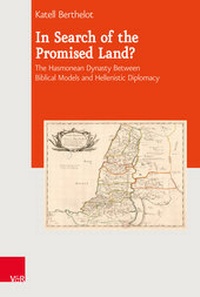
In Search of the Promised Land?
The Hasmonean Dynasty Between Biblical Models and Hellenistic Diplomacy
1st Edition
Published on 13. November 2017
494 pages
978-3-647-55252-1 (ISBN)
Description

Katell Berthelot challenges the widespread historiographical consensus that the Hasmoneans embarked on wars of conquest in order to reconquer the Promised Land, the Biblical Land of Israel. She shows that the sources used in support of this consensus - such as 1 Maccabees 15:33-35 - have been over-interpreted. She suggests a different approach to this question. In particular, she argues that in 1 Maccabees, the Hasmoneans deliberately imitate the language ascribed to the Seleucid kings, and that the discourse on the Land found in 1 Maccabees, is congruent with the language of property rights over a given territory in the rhetoric of Hellenistic diplomacy.Berthelot's close examination of accounts by Josephus and other writers, as well as of archaeological and numismatic data, allows her to reconstruct the different factors that led to the Hasmonean wars of conquest. Although Hasmonean leaders were clearly motivated by politico-religious objectives (e.g. getting rid of competing temples in areas under their control), the Deuteronomic commandment to wipe out the inhabitants of the Land and abolish idolatry does not necessarily account for their acts of destruction and the so-called 'forced conversion' of the Idumeans, the Itureans and other groups. Instead, Berthelot's analysis of the sources leads her to reach a different conclusion.Finally, Berthelot investigates the echoes of the Hasmonean wars of conquest in the Dead Sea Scrolls and their memory in rabbinic literature. This allows her to show that, contrary to expectation, there is little evidence that the Hasmonean dynasty was perceived as having reconquered the Promised Land or restored the people of Israel within the borders of the Land of Israel.
More details
Other editions
Additional editions
Katell Berthelot
In Search of the Promised Land?
The Hasmonean Dynasty Between Biblical Models and Hellenistic Diplomacy
Book
11/2017
1st Edition
Vandenhoeck & Ruprecht
from
€120.00
Shipment within 5-7 days
Persons
Content
- Intro
- Title Page
- Copyright
- Table of Contents
- Preface
- Abbreviations
- A Note on the Translations used in this Book
- Introduction. The Historiography of the Hasmonean Period: The Influence of Biblical Models and of Modern Debates on the Creation of a Jewish State
- 1. A brief overview of one hundred years of historical scholarship on the Hasmonean period (ca. 1850-1950)
- 2. The reconquest of the promised land: A ubiquitous paradigm
- 3. Dissident voices
- 4. Reflexions on some of the methodological problems raised by biblical models
- 4.1 The borders of the promised land
- 4.2 The question of the perenniality of the commandment to conquer the promised land
- 4.3 The "conversion" of non-Jews
- 5. "Religion" and "politics": two problematic categories in the historiography of the Hasmonean period
- 6. The structure of this book and its guiding principles
- Part I. Did the Hasmoneans Seek to Reconquer the Promised Land or Restore Judea? The Account of the Hasmonean Wars in 1 Maccabees
- 1. The First Book of Maccabees: general presentation
- 1.1 The contents of the book
- 1.2 The language, context, date and compositional unity of the book
- 1.3 Parallel accounts: The Second Book of Maccabees and the work of Josephus
- 1.3.1 The Second Book of Maccabees
- 1.3.2 The Judean (or Jewish) War and Jewish Antiquities by Flavius Josephus
- 2. The land: an objective conspicuous by its absence
- 2.1 The conspicuous absence of the issue of the land of Israel from The First Book of Maccabees
- 2.2 The land in 2 Maccabees and in Josephus' rewriting of 1 Maccabees
- 2.3 The territorial stakes of the Maccabean wars
- 3. The Hasmonean dynasty's biblical models
- 3.1 A few preliminary reflections on the concept of "Bible" in the second century B.C.E.
- 3.2 Biblical models and the literary structure of 1 Maccabees
- 3.3 Joshua, a model for the Hasmoneans?
- 3.4 A sacerdotal family seeking to legitimate its position as a royal dynasty
- 4. The wars against non-Judean peoples: Judeans versus Canaanites?
- 4.1 The prescriptions concerning the Canaanites in the Bible
- Scenario No 1: the expulsion of the Canaanites
- Scenario No 2: herem warfare or the extermination of the Canaanites
- Scenario No 3: slavery or "forced labour"
- 4.2 The war practices of Judas Maccabeus and his brothers: an attempt to put Deuteronomy 20 into practice?
- 4.2.1 The influence of Deuteronomy on 1 Maccabees
- 4.2.2 The laws of warfare in Deuteronomy 20 and 1 Maccabees
- 4.2.3 The wars waged by Judas, Jonathan and Simon, according to 2 Maccabees and Flavius Josephus
- 4.3 Do we encounter a "Canaanite" in a Hasmonean context? (1 Macc 9:37)
- 5. Did the Hasmoneans attempt to purify the land?
- 6. The "inheritance of our fathers" (1 Macc 15:33-35)
- 6.1 The territorial dispute between the Seleucids and the Hasmoneans, from Judas to Simon
- 6.2 The biblical background of the phrase "the inheritance of our fathers"
- 6.3 The parallels between the discourses of the Seleucids and Simon in 1 Maccabees
- 6.4 Understanding Simon's reply in the context of the territorial conflicts of the Hellenistic era
- 7. The development of a historico-juridical conception of Israel's right of ownership over the land
- 7.1 The original allotment of the land according to the Book of Jubilees and the Genesis Apocryphon
- The connections between the Book of Jubilees and the Genesis Apocryphon
- The Hellenistic context of the juridical or historico-juridical discourse used to establish the right of ownership
- 7.2 The posterity of this historico-juridical argument in Jewish thought
- Part II. The Era of the Conquests: Rise and Fall of the Hasmonean State
- 1. The inescapable Flavius Josephus: was his perspective anti-Hasmonean?
- 1.1 Strabo
- 1.2 Nicolaus of Damascus
- 1.3 The Judean (or Idumean) origins of some of Josephus' criticism of the Hasmoneans
- 1.4 Josephus' point of view
- 2. The different stages, the nature, and the motivations of the Hasmonean territorial expansion
- 2.1 John Hyrcanus
- The motivations of John Hyrcanus
- 2.2 Aristobulus I
- 2.3 Alexander Jannaeus
- 103-92 B.C.E.
- 92-83 B.C.E.
- 83-76 B.C.E.
- 2.4 Jannaeus' successors to the throne until 63 B.C.E.
- 3. The "forced conversions"
- 3.1 The Idumeans
- 3.1.1 Josephus' account of the Judaization of the Idumeans
- 3.1.2 Ptolemy the Historian's account of the Idumeans
- 3.1.3 Strabo's account of the Idumeans
- 3.1.4 Was the Judaization of the Idumeans an innovation on the biblical models?
- 3.2 The Itureans
- 3.3 The questions raised by the case of Pella
- 3.4 Summary
- 3.5 The presentation of the imposition of Judean laws on the conquered territories as a Seleucid idea in 1 Maccabees 10
- 4. The use of mercenaries
- 4.1 A sign of the Hellenization of the Hasmoneans
- 4.2 The Judaization of non-Judean populations versus the use of foreign mercenaries
- 4.3 The mercenaries and the Judean opposition to the Hasmoneans
- 4.4 The Hasmoneans' accumulation of riches
- Part III. Polemic, Memory, Forgetting
- 1. The polemic against the Hasmoneans
- 1.1 The critique of the Hasmoneans in the Qumran manuscripts
- 1.1.1 The first two generations: Mattathias and his sons
- 1.1.2 John Hyrcanus
- 4Q379: Was John Hyrcanus the "man of Belial"?
- 4QTestimonia, a threefold critique of John Hyrcanus
- The Essenes and prophecy
- A list of false prophets (4Q339)
- The fallibility of the prophet Joshua according to 4Q522
- The rules of war in the Temple Scroll
- 1.1.3 Alexander Jannaeus
- The times of wickedness in 4Q390
- The Pesher on Isaiah (a) (4Q161)
- 4Q448: for or against king Jonathan?
- The Pesher on Nahum
- The Pesher on Habakkuk
- Is there a condemnation of the Hasmonean wars in 4Q471a?
- 1.2 The critique of the Hasmoneans in the Psalms of Solomon
- 2. Memory and Forgetting: the Hasmonean expansion in rabbinic literature
- 2.1 The memory of the Hasmonean victories in rabbinic literature
- 2.1.1 The memory of these victories in Megillat Ta'anit
- 2.1.2 Beyond Megillat Ta'anit: the memory of the wars of liberation in the rest of rabbinic literature
- 2.1.3 On some of the echoes of Jannaeus' conquests in the Babylonian Talmud
- 2.1.4 The implications of John Hyrcanus' gift of prophecy
- 2.2 The critique of the accumulation of powers and the attempt to control the exercise of royal power
- 2.2.1 The critique of the accumulation of powers
- 2.2.2 The attempt to control the king's exercise of power
- 2.3 The ambiguity of the Babylonian Talmud
- 2.3.1 The presence of anti-Hasmonean revisions in the Babylonian Talmud
- The chronology of Seder 'Olam in b. Avodah Zarah 8b-9a
- Alexander Jannaeus as the murderer of the Sages
- The account of the fratricidal conflict between Aristobulus II and Hyrcanus II in b. Menahot 64b
- 2.3.2 The Hasmonean dynasty versus the Davidic dynastyin the Babylonian Talmud
- Conclusion
- Excursus: Eupolemus' perspective on the reigns of David and Solomon
- List of the documents describing the diplomatic relations between the Hasmoneans and Rome before 63 B.C.E.
- Chronology
- Maps
- Bibliography
- Index of ancient sources
- Body
