

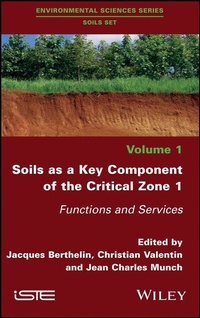
Soils as a Key Component of the Critical Zone 1
Description

More details
Other editions
Additional editions
Persons
Jacques Berthelin is former Research Director at CNRS and a member of the Académie d'Agriculture de France, Paris.
Christian Valentin, a member of the Académie d'Agriculture de France, is Research Director at IRD and Deputy Director of the Institut d'Ecologie et des Sciences de l'Environnement, Paris.
Jean Charles Munch is Emeritus Professor at the Technical University of Munich in Germany and former Director of the Institute of Soil Ecology at Helmholtz Zentrum München. He is also a member of the Académie d'Agriculture de France.
Content
Foreword xiii
Chapter 1. Soils as a Key Component of the Critical Zone 1 Jacques BERTHELIN, Guilhem BOURRIÉ, Michel-Claude GIRARD, Guillaume DHÉRISSARD and Christian VALENTIN
1.1. What are soils? 1
1.2. The Earth, land, soils, soil cover and the Critical Zone 2
1.3. The term "soil" has various meanings according to use and function processes 5
1.4. The concept of soil varies according to the user 6
1.4.1. Agricultural sector 7
1.4.2. Scientific communities 7
1.4.3. Urban communities 8
1.4.4. Current pressures and questions 8
1.5. The approaches and procedures of soil scientists and pedologists 9
1.6. Two principles to take into account: geographical continuity and multi-temporality 10
1.6.1. Principle of continuity 10
1.6.2. Principle of multi-temporality 13
1.7. Nature, organization and major modes of soil processes 15
1.7.1. Soils before the arrival of humans 15
1.7.2. Specifics and origins of the Earth's soils 17
1.7.3. The parameters controlling differentiation and diversity of soils 18
1.8. The functions and services of soils 23
1.8.1. Major functions 23
1.8.2. Services provided by soils 24
1.8.3. The role of soils within our culture and our history 25
1.9. The need and significance of soil information systems 29
1.10. Conclusion and recommendation 29
1.11. Bibliography 30
Chapter 2. Understanding Soils for Their More Efficient Management: A National Soil Information System 35 Marion BARDY, Dominique ARROUAYS, Claudy JOLIVET, Bertrand LAROCHE, Christine LE BAS, Manuel MARTIN, Céline RATIÉ, Anne C. RICHER-DE-FORGES, Nicolas SABY, Véronique ANTONI, Antonio BISPO, Michel BROSSARD, Jean-Luc FORT, Joëlle SAUTER and Chantal GASCUEL
2.1. Introduction 35
2.2. The inventory and monitoring of soils in Europe and in the world 36
2.3. National mechanisms for the acquisition of soil data 37
2.3.1. Issues and demands 37
2.3.2. Structuring of national data collection mechanisms 38
2.4. Data exploitation for the production of maps and indicators 44
2.5. Dissemination and availability of data 49
2.5.1. A national soil information system focused on data dissemination 49
2.5.2. A progressive enrichment of data and metadata supply 50
2.5.3. Assisting the use, improvement and control of data 52
2.6. Conclusion 52
2.7. Bibliography 53
Chapter 3. Soils and Regulation of the Hydrological Cycle 9 Marc VOLTZ, Cécile DAGÈS, Laurent PRÉVOT and Ary BRUAND
3.1. The soil - facilitator within the hydrological cycle 59
3.2. Soil control mechanisms 61
3.2.1. Infiltration-runoff partition 61
3.2.2. Aquifer recharge 65
3.2.3. Evaporation and transpiration flows 67
3.2.4. Capillary rise 70
3.2.5. Soil water budget 71
3.2.6. Hydrological flows along hillslopes 72
3.3. Impacts on the hydrological cycle at soil cover scale 74
3.3.1. Influence of soil and land use variations 75
3.3.2. Influence of land use changes 77
3.3.3. Influence of landscape infrastructures 78
3.4. Conclusions 79
Chapter 4. Soils as Bio-physicochemical Reactors 81 Fabienne TROLARD and Guilhem BOURRIÉ
4.1. What is a reactor? 81
4.2. Soil components 85
4.3. Reactivity drivers 86
4.4. Main reactions within soils 90
4.4.1. Master variables: pH and pe 90
4.4.2. Acid-base reactions 91
4.4.3. Reactions of oxido-reduction 94
4.4.4. Degradation of organic matter 95
4.5. Biogeochemical evolution of the Earth's surface and the consequences for soils 96
4.5.1. Availability of chemical elements changed with the Earth's evolution 96
4.5.2. The evolution of the Earth's reactor imposed the evolution of living organisms 99
4.5.3. Emergence of the "soil" function within the Critical Zone 101
4.6. Soil, biogeochemical reactor of soil formation 103
4.6.1. Vertical dynamics of soils: the lowering of horizons within landscapes 105
4.6.2. Lateral dynamics of soil and transformations of soil covers 107
4.6.3. Lateral dynamics by epigenesis (replacement) 111
4.7. Soil structure: a case of "soft matter" 112
4.8. Bibliography 113
Chapter 5. Soils are Biosystems, Habitats and Reserves of Biodiversity 117 Jacques BERTHELIN, Éric BLANCHART, Jean TRAP and Jean Charles MUNCH
5.1. Introduction 117
5.2. Emergence and development of microbial ecology and soil biology 118
5.2.1. Discovery of the microbial world, a turning point in the knowledge of the functioning of soil-plant systems 118
5.2.2. Discovery of the role of fauna and development of soil biology 119
5.3. Soil microbial communities 119
5.3.1. Richness and diversity of microbial communities 119
5.3.2. Evolution of methodologies in soil microbial ecology 123
5.4. Diversity of energy and nutritional pathways of microorganisms, key players in biogeochemical cycles 124
5.4.1. Heterotrophy, autotrophy and extreme environments 124
5.4.2. Soils, environments where life is active with or without oxygen 125
5.5. Richness and diversity of soil fauna 126
5.5.1. Diversity of soil fauna 126
5.5.2. Classification by size 127
5.5.3. Functional classification sensu lato 127
5.5.4. Characterization of the fauna 128
5.6. Soils, environments with energy and nutritional conditions favorable to microbial life and fauna 128
5.7. Determinants and remarkable sites of diversity and soil biological activities 129
5.7.1. Parameters and major activity sites 129
5.7.2. Impact of land use 130
5.7.3. Humus, integrators and developers of specific biological activities 131
5.7.4. The rhizosphere, a site of major interactions of soil-plant systems 132
5.8. Tools for understanding the habitats of soil organisms 133
5.9. Specificities of the soil fauna 133
5.9.1. Microregulators 134
5.9.2. The communities of organisms called "engineers" 134
5.10. Soil organisms: ecosystem service actors 135
5.11. Soil quality indicators 137
5.11.1. Soil organisms as indicators 137
5.11.2. Ecological functions as indicators 138
5.12. Conclusion and perspectives 138
5.13. Bibliography 139
Chapter 6. Soils, a Factor in Plant Production:Agroecosystems 147 Claire CHENU, Jean ROGER-ESTRADE, Chantal GASCUEL and Christian WALTER
6.1. Introduction 147
6.2. Evolution of soil-agriculture relationship over the last few decades 148
6.3. Agricultural capability of soils 150
6.3.1. How do we define the agricultural capability of a soil? 150
6.3.2. Limited soil resources on a global scale 154
6.4. Agricultural practices that alter soil properties 155
6.5. Toward sustainable management of agricultural soils 158
6.6. Conclusion 161
Chapter 7. Forest Soils: Characteristics and Sustainability 163 Jacques RANGER
7.1. Forest soils 163
7.2. Bioavailability of nutrients: soil-plant coevolution and the role of the biological cycle 165
7.3. Concept of forest soil fertility 170
7.4. Specificity of forest soils compared to agricultural soils 171
7.5. Threats to forest soils 175
7.5.1. Acidification 175
7.5.2. Physical degradation 177
7.5.3. The particular problem of organic carbon: soil fertility and climate change 179
7.5.4. Maintaining biodiversity 180
7.5.5. Pollution 181
7.5.6. Disappearance of forest soils 181
7.6. Conclusions 181
7.7. Bibliography 183
Chapter 8. Soils and Energy 187 Isabelle FEIX
8.1. Soils at the heart of global issues 187
8.2. Energy context 188
8.3. Soils, energy supports and energy suppliers 190
8.3.1. Forest and agricultural biomass production: for bioenergy production 190
8.3.2. Physical supports of renewable energy: ground-mounted photovoltaic power plants and onshore wind turbines 190
8.3.3. Heat and freshness supplies: horizontal superficial geothermal energy and climatic wells 191
8.3.4. Peat: formerly used as a biofuel 191
8.4. The consequences of energy production on mobilization, occupation and land-use change 192
8.4.1. Comparison of land use intensities and land area occupations for energy production 194
8.4.2. Comparison of land use changes related to different energies 202
8.4.3. Consequences of energy policies for land mobilization and LUC 204
8.4.4. Optimization of land use 206
8.5. Impacts of energy production on soil loss, degradation and quality 207
8.5.1. Impacts common to all energies 207
8.5.2. Peat 208
8.5.3. Fossil fuels 208
8.5.4. Nuclear energy 208
8.5.5. Solar and wind energies 209
8.5.6. Bioenergies 210
8.6. Conclusion 217
8.7. Bibliography 219
Chapter 9. Soils, Materials, and Infrastructure Supports 233 Guilhem BOURRIÉ and Fabienne TROLARD
9.1. The use of "raw" soils as building materials 233
9.2. Soils, infrastructure supports 236
9.3. The classical civil engineering versus the physical approach of granular media 237
9.4. Consumption of agricultural land, forest or natural areas by urban sprawl 239
9.5. The use of separate particle size fractions 242
9.5.1. The use of coarse fractions 242
9.5.2. The use of the clay fraction as material and reaction support 242
9.5.3. The use of the soil organic fraction 243
9.5.4. The use of soil oxides 243
9.6. The use of chemical elements after extraction and treatment 243
9.7. Bibliography 244
Chapter 10. Cultural Dimensions of Soils 247 Suzanne MÉRIAUX and Michel-Claude GIRARD
10.1. Soil representations - the Earth celebrated 247
10.1.1. The written Earth 248
10.1.2. The illustrated Earth 251
10.1.3. The Earth with sound 254
10.2. Humanity, Earth and soil: myths and rites 258
10.2.1. Defining myths 259
10.2.2. Earth and soils in myths 259
10.2.3. Myths 261
10.2.4. Rites 268
10.2.5. Analogies with the pedological approach? 269
10.2.6. Links between humans and earth/soils 270
10.2.7. Conclusion 271
10.3. Bibliography 272
Chapter 11. Environmental and Societal Memories of Soils 275 Marie-Agnès COURTY
11.1. Ancient soils: archives of human history 275
11.1.1. Objectives 275
11.1.2. Soil memory and climate change 276
11.1.3. Memory of ancient soils and societies 278
11.2. Methods of studying soil memory 279
11.2.1. The field approach 279
11.2.2. Analytical characterization 281
11.3. Reading the ancient soil memory 282
11.3.1. Foundations 282
11.3.2. Sedimentary features 283
11.3.3. Combustion features 285
11.3.4. Soil features 287
11.4. Conclusion and perspectives 294
11.5. Bibliography 295
Chapter 12. A Mesological Point of View 299 Pierre DONADIEU
12.1. Soil ubiquity 299
12.2. Soil as 301
12.3. Off-ground? 303
12.4. Living off-ground 304
12.5. Limits of the off-ground 307
12.6. Conclusion 309
12.7. Bibliography 309
List of Authors 311
Index 315
1
Soils as a Key Component of the Critical Zone
1.1. What are soils?
The year 2015 was the International Year of Soils, swiftly followed by the International Decade of Soils 2015-2024. Through this initiative, the UN General Assembly [UNI 13] wished to raise awareness with both civil society and policy-makers as to the crucial importance of soils in humans' lives. Scientific, political and media interest in soils has appeared to be revived for a number of years [HAR 08a, HAR 08b]. They are now genuinely acknowledged as support for plant production and human activities, but also as an essential land-based system in the biosphere, as regulators of the major equilibria (the water cycle, and the carbon, nitrogen, phosphorous, potassium, sulfur cycles and others, which have a remarkable multi- functionality [JEF 10, GIR 11a, GIR 11b, BIS 16]). This multi-functionality of soils positions them as a key component of the Critical Zone for humanity [NRC 01, LIN 10] where life flourishes. However, do we actually know what soils are and what they do?
The word "soil" comes from the French sol, itself derived from the Latin solum, meaning ground but also base, bottom, foundation, earth, land, floor and pavement. It also means dirt, originating this time from Old French soillier meaning to make dirty. Another meaning of soil is also where one is born.
These terms are linked: in western culture, that which can be cursed - "cursed is the ground because of you" (Genesis 3:17) - is that which is dirtied by its sediment, or even upon death and burial. It is also considered as a source of all life, sphere of the gods, provider of wealth, stories and legends, patriotic pride, and other factors. Hence, the various interests, indeed contradictory, or lack of interest for this entity which feeds plants, regulates water flow and shows a fantastic biodiversity containing no doubt 25% of the Earth's living species [DEC 10], other organisms and other biodiversity upon which we live and work. We should know that clay soils are used in pharmacopoeia (beidellite, attapulgite and smectite) for digestive disorders or in cosmetics (clay masks, hair degreasers, shampoos and other products) [LEF 11]. Do not forget that clay soils are used as construction materials (for example, adobe, tiles and bricks) and for thermal insulation. Did you know that these "soils" contain microorganisms (for example, bacteria and fungi), which produce antibiotics and vitamins and that studies of microbial population and of their antagonisms led Waksman to discover antibiotics (streptomycin) and to his Nobel Prize for Medicine in 1952 [BER 06]?
Do we know what soils are? How are they perceived? How do we define them? What is their position on the earth's surface? How are they formed? How do their processes work? What do they do? What purpose do they serve? It is such questions to which this series of six works under the heading Soils strives to respond. This first volume, entitled Soils as a Key Component of the Critical Zone 1: Functions and Services, contains 12 chapters, including this introductory one, focused around definitions, presentations and discussions around soil properties, around the processes and services that they ensure, around the pressures by which they are influenced and the perspectives that open up. The five following works are more specialized and more detailed (Societal Issues, Soils and Water Circulation, Soils and Water Quality, Degradation and Rehabilitation and Ecology) and will approach various major aspects of soil processes and the issues that they incorporate.
1.2. The Earth, land, soils, soil cover and the Critical Zone
The semantics of the term "Earth" are vast, even without mentioning the term "ground", which simultaneously takes account of geographical, economic and property aspects, which is hence situated at the level of the farm, the watershed or the ecosystem. The expression "field work" is analogous to "in vivo" versus "in vitro" and "laboratory study". Man's level of understanding is such that he rarely appreciates the layers underneath arable land. It is true that, to do this, you must plough the ground: "The harvest past, Time's forelock take, And search with plough and spade and rake. To show by such a measure, That toil itself is treasure." wrote Jean de La Fontaine in Le laboureur et ses enfants (The Ploughman and His Sons).
We can group the various meanings that the word "earth" takes into four different spheres:
- - those attached to the Earth (with a capital letter), which comprises all of the continents and the oceans and the planet;
- - those attached to the use of soils (and therefore a link with everything which is within agriculture). This may be:
- - a surface area corresponding to a given land ownership - you often come across references such as "this is my land", or "the price of land" (which depends upon its use: a forest, crop production, vineyard, second home and similar terms), and "selling his or her land";
- - a loose layer of the soil cover where plants grow: arable land, "wheat-producing land" and "unfertile land";
- - the behavior, the properties or the qualities of the surface layer used by humans: "black loam", "soft soil", "organic soil", "sandy soil", "light soil", "soft soil", "clayey soil, "heavy soil", "limestone soil, "fallow soil", "cold ground", "poor soil", "heathland soil", "stony soil" and "fine soil". Thus, according to the Scandinavian proverb, "black soil produces white bread" and the Albanian proverb "the gardeners hands are blackened with earth but his loaves of bread are white" (see Chapters 6 and 7: "Soils, a Factor in Plant Production: Agroecosystems" and "Forest Soils: Characteristics and Sustainability");
- - those attached to:
- - clay - often confused with the term earth - as with, for example, clay used for pottery;
- - construction material: "brick-earth", "fuller's earth" and "clay soil";
- - surface characteristics: "red earth", "black earth", "white earth" and other such characteristics (see Chapter 9: "Soils, Materials and Infrastructure Supports");
- - those linked with humanity, for example, using various expressions:
- - "being known throughout the Earth", with the term "earth" meaning the entire humanity;
- - "this is my land" indicates the area characterized by the property that a given individual owns;
- - "native land", an expression which comes closer to myths, by qualifying a given space through its link with a population;
- - "my ancestors' soils" may be linked in the sense of the previous expression, but it goes further in both the mythical and generational sense (see Chapter 10, "Cultural Dimensions of Soils"). Soils have an archaeological memory, but also an environmental memory, which associates or distinguishes the influence and history of human and climatic activities (see Chapter 11: "Environmental and Societal Memories of Soils").
Soils can be considered as entities with their own constituent characteristics or as complex natural objects, defined by their structural and functional properties and their uses.
Their definition depends upon the perception of them, their uses, their functional processes and the benefits that they provide, the given study routes and the mode of study adopted. The Larousse dictionary of the French language defines soils as the "outermost layer for the crust of a telluric planet" (Earth, Mars, the Moon, Mercury, Venus). However, there are major differences between the soils on Earth and those on Mars or the Moon, as the latter do not appear to reveal organizational structures linked to the action of living organisms. They might be able to be described as regoliths, which are formations of loose particles [DER 64], which are not fundamentally altered by the effects of living organisms.
Within this work devoted to the Earth's soils, soils comprise this layer of the Earth where life is highly active and which we describe as the "soil cover" [GIR 11a]. This quasi-continuous, three-dimensional soil cover, which evolves from the Earth's surface, is a key component of what was recently defined as the "Critical Zone of humanity". This Critical Zone (CZ) has been defined by early authors [NRC 01, LIN 10] as extending from the base of aquifers to the top of plant formations. In our view, it should have, as its sub-stratum limits, unaltered mineral substrates and as its top layer the lower atmosphere, sites where life and the biogeochemical and water cycles are still significant.
The term "soil cover" insists on the fact that soils form a given part, known as the pedosphere, located on the one hand upon another part which most often has a mineral...
