

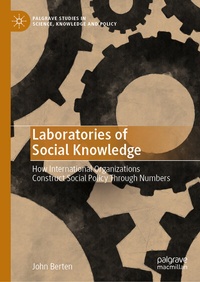
Laboratories of Social Knowledge
Description

The book examines the politics of knowledge in global social policy, investigating how international organisations (IOs) have contributed to the emergence and development of social security as a global policy field. It reconstructs the role of numerical knowledge in the International Labour Organization (ILO) and the World Bank, theorising how IOs contribute to epistemic infrastructures of global social security. The book shows how IOs' knowledge production has led to a continuous refinement of the meaning and purpose of social security. First, it reveals how IOs arrived at a shared conception of social security: what the book calls an ontological framework. Second, it traces how numbers have increasingly enabled the assessment of countries according to shared benchmarks: what the book calls an evaluative framework. The author demonstrates the political and epistemic work involved in universalising knowledge of social security, while highlighting the limits of governing by numbers in global social policy.
More details
Other editions
Additional editions
Person
John Berten is a postdoctoral researcher and junior research group leader at the Faculty of Sociology of Bielefeld University, Germany. His research and teaching focuses on global social policy, social policy in the Global South, knowledge and ideas in policymaking, and the role of futures in global politics.
Content
Chapter 1: Introduction.- Chapter 2: Theory: The construction of a field of global social policy.- Chapter 3: 1919-2019: Social security policies in the ILO and the World Bank.- Chapter 4: Methodology: A discursive analysis of epistemic infrastructures.- Chapter 5: The development of a shared ontological framework in the interwar and WWII period.- Chapter 6: The development of a shared ontological framework after WWII.- Chapter 7: The development of a shared evaluative framework.- Chapter 8: Discussion: The making of global social policy through numbers.- Chapter 9: Conclusion.
