

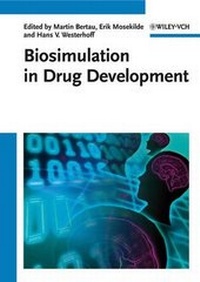
Biosimulation in Drug Development
1st Edition
Published on 8. September 2008
XXVIII, 512 pages
978-3-527-62268-9 (ISBN)
Description

This first comprehensive survey to cover all pharmaceutically relevant topics provides a comprehensive introduction to this novel and revolutionary tool, presenting both concepts and application examples of biosimulated cells, organs and organisms.
Following an introduction to the role of biosimulation in drug development, the authors go on to discuss the simulation of cells and tissues, as well as simulating drug action and effect. A further section is devoted to simulating networks and populations, and the whole is rounded off by a look at the potential for biosimulation in industrial drug development and for regulatory decisions.
Part of the authors are members of the BioSim Network of Excellence that encompasses more than 40 academic institutions, pharmaceutical companies and regulatory authorities dealing with drug development; other contributors come from industry, resulting in a cross-disciplinary expert reference.
Following an introduction to the role of biosimulation in drug development, the authors go on to discuss the simulation of cells and tissues, as well as simulating drug action and effect. A further section is devoted to simulating networks and populations, and the whole is rounded off by a look at the potential for biosimulation in industrial drug development and for regulatory decisions.
Part of the authors are members of the BioSim Network of Excellence that encompasses more than 40 academic institutions, pharmaceutical companies and regulatory authorities dealing with drug development; other contributors come from industry, resulting in a cross-disciplinary expert reference.
More details
Other editions
Additional editions
M. Bertau
Biosimulation in Drug Development
Software
07/2008
Wiley-VCH
€355.22
No shipping information available
Martin Bertau | Erik Mosekilde | Hans V. Westerhoff
Biosimulation in Drug Development
Book
10/2007
1st Edition
Wiley-VCH
€255.00
Article exhausted; check different version
Persons
Martin Bertau is Professor of Technical Chemistry at Freiberg University of Mining and Technology. He received his PhD in organic chemistry from Freiburg University, Germany, in 1997. He then ran the biotechnology division of Rohner Ltd. in Basle, Switzerland, conducting research and education in co-operation with the University of Basle and Basle University of Applied Sciences, before joining Dresden University of Technology in 2000 as Assistant Professor and head of the bioorganic chemistry group. Since 2006 he has been leading the Institute of Technical Chemistry at Freiberg University of Mining and Technology. His scientific interests include molecular principles of whole-cell biocatalysis and the computational simulation of intracellular interactions in the presence of xenobiotics, as well as methods for the production of semiconducting materials and applications thereof in chemistry and life sciences.
Hans V. Westerhoff is AstraZeneca Professor of Systems Biology at the Manchester Centre for Integrative Systems Biology as well Professor of Microbial Physiology at the Free University Amsterdam and of Mathematical Biochemistry at the University of Amsterdam. He has edited several journals, chaired the Steering Committee of the German HepatoSys program and has held the Unilever Chemistry prize, the Prize of the Dutch Biochemical Society and the gold medal of the Royal Dutch Chemical Society. Professor Westerhoff has worked on hierarchical control and regulation, the silicon cell, EGF signaling, and DNA structure, as well as exemplifying bottom-up systems biology.
Born in Århus, Denmark, Erik Mosekilde gained his PhD from the Technical University of Denmark, and shortly afterwards received an IBM postdoctoral fellowship for the Thomas J. Watson Research Center, New York. In 1972 he was appointed associate professor in modern physics, and in 2000 Professor in Biological Applications of Nonlinear Dynamics at the Technical University of Denmark. He has been a member of various educational and editorial boards, a visiting researcher or guest professor at 15 institutes worldwide, on the steering committee of several societies, and has a number of books and articles to his name. Professor Mosekilde is currently a member of the Danish Academy of Natural Sciences, coordinator of a European network of excellence in biosimulation and chairman of MIDIT.
Hans V. Westerhoff is AstraZeneca Professor of Systems Biology at the Manchester Centre for Integrative Systems Biology as well Professor of Microbial Physiology at the Free University Amsterdam and of Mathematical Biochemistry at the University of Amsterdam. He has edited several journals, chaired the Steering Committee of the German HepatoSys program and has held the Unilever Chemistry prize, the Prize of the Dutch Biochemical Society and the gold medal of the Royal Dutch Chemical Society. Professor Westerhoff has worked on hierarchical control and regulation, the silicon cell, EGF signaling, and DNA structure, as well as exemplifying bottom-up systems biology.
Born in Århus, Denmark, Erik Mosekilde gained his PhD from the Technical University of Denmark, and shortly afterwards received an IBM postdoctoral fellowship for the Thomas J. Watson Research Center, New York. In 1972 he was appointed associate professor in modern physics, and in 2000 Professor in Biological Applications of Nonlinear Dynamics at the Technical University of Denmark. He has been a member of various educational and editorial boards, a visiting researcher or guest professor at 15 institutes worldwide, on the steering committee of several societies, and has a number of books and articles to his name. Professor Mosekilde is currently a member of the Danish Academy of Natural Sciences, coordinator of a European network of excellence in biosimulation and chairman of MIDIT.
Content
PART I INTRODUCTION
1 Simulation in Clinical Drug Development
2 Modeling of Complex Biomedical Systems
3 Biosimulation of Drug Metabolism
PART II SIMULATING CELLS AND TISSUES
4 Correlation Between In Vitro, In Situ, and In Vivo Models
5 Core-Box Modeling in the Biosimulation of Drug Action
6 The Glucose-Insulin Control System
7 Biological Rhythms in Mental Disorders
8 Energy Metabolism in Conformational Diseases
9 Heart Simulation, Arrhythmia, and the Actions of Drugs
PART III TECHNOLOGIES FOR SIMULATING DRUG ACTION AND EFFECT
10 Optimizing Temporal Patterns of Anticancer Drug Delivery by Simulations of a Cell Cycle Automaton
11 Probability of Exocytosis in Pancreatic ß-Cells: Dependence on Ca2+ Sensing Latency Times, Ca2+ Channel Kinetic Parameters, and Channel Clustering
12 Modeling Kidney Pressure and Flow Regulation
13 Toward a Computational Model of Deep Brain Stimulation in Parkinson's Disease
14 Constructing a Virtual Proteasome
PART IV APPLICATIONS OF BIOSIMULATION
15 Silicon Cell Models: Construction, Analysis, and Reduction
16 Building Virtual Human Populations: Assessing the Propagation of Genetic Variability in Drug Metabolism to Pharmacokinetics and Pharmacodynamics
17 Biosimulation in Clinical Drug Development
18 Biosimulation and Its Contribution to the Three Rs
1 Simulation in Clinical Drug Development
2 Modeling of Complex Biomedical Systems
3 Biosimulation of Drug Metabolism
PART II SIMULATING CELLS AND TISSUES
4 Correlation Between In Vitro, In Situ, and In Vivo Models
5 Core-Box Modeling in the Biosimulation of Drug Action
6 The Glucose-Insulin Control System
7 Biological Rhythms in Mental Disorders
8 Energy Metabolism in Conformational Diseases
9 Heart Simulation, Arrhythmia, and the Actions of Drugs
PART III TECHNOLOGIES FOR SIMULATING DRUG ACTION AND EFFECT
10 Optimizing Temporal Patterns of Anticancer Drug Delivery by Simulations of a Cell Cycle Automaton
11 Probability of Exocytosis in Pancreatic ß-Cells: Dependence on Ca2+ Sensing Latency Times, Ca2+ Channel Kinetic Parameters, and Channel Clustering
12 Modeling Kidney Pressure and Flow Regulation
13 Toward a Computational Model of Deep Brain Stimulation in Parkinson's Disease
14 Constructing a Virtual Proteasome
PART IV APPLICATIONS OF BIOSIMULATION
15 Silicon Cell Models: Construction, Analysis, and Reduction
16 Building Virtual Human Populations: Assessing the Propagation of Genetic Variability in Drug Metabolism to Pharmacokinetics and Pharmacodynamics
17 Biosimulation in Clinical Drug Development
18 Biosimulation and Its Contribution to the Three Rs
