

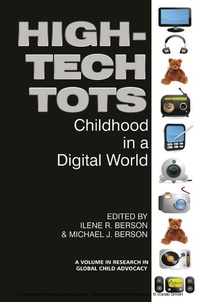
High-Tech Tots
Childhood in a Digital World
1st Edition
Published on 1. May 2010
289 pages
978-1-61735-011-5 (ISBN)
Description

Young children are coming of age surrounded by information and communication technology (ICT). ICT is a prominent force in their lives, and working with ICT can stimulate students intellectually, incite their creativity, and challenge them to apply developmentally appropriate inquiry approaches that enhance their learning experiences. Digital technologies also allow children to expand their physical space and access many online social environments that transcend time and space. However, any focus on the efficiency and effectiveness of technology applications in the early childhood years cannot overlook the potential consequences of technological development on children with regard to their social functioning, interpersonal interactions, and global understanding. In addition to evaluating technology as a tool of instruction, we must focus on educational implications and ethical issues associated with their use.
This book is the fifth in the Research in Global Child Advocacy Series. The volume examines theoretical assumptions as well as the application of innovative strategies that optimize the interface between young children and ICT from a global perspective. Despite divergent perspectives, the chapter authors share a commitment to explore the immersion of ICT into the lives of young children and consider the educational value of these tools as well as the developmental appropriateness of technological affordances. This volume brings together scholars and policymakers whose rich discourse delves into questions such as: How do communication technologies benefit young children's social and cognitive development? What standards and technical specifications are needed to effectively safeguard young children engaged with ICT? How are young children introduced to ICT? What are the challenges and risks for young children online? What programs are effective in mediating risk? What are the educational applications for ICT in early childhood? Is social networking the new "online playground" for young children? How can young children become competent users of digital technology and media? How can early childhood educators and families encourage positive usage and discourage negative social consequences associated with today's technology? How can ICT enhance teaching and learning for young children? What ICT activities are developmentally appropriate for young children?
In the book there are three primary areas of emphasis: (a) ICT as a teaching and learning tool across cultures and countries to promote the social and cognitive development of young children; (b) research on developmentally appropriate education on cybersafety and cybercitizenship; and (c) studies on the influence of digital technologies on young children, including exposure to inappropriate content and participation in online social networks. This resource offers readers a glimpse into the experience of children and the expertise of researchers and professionals who diligently work toward crafting a framework for action that reflects intercultural and cross-national initiatives. Given the role that electronic media plays in the lives of children as both an educational and entertainment tool, understanding the physical and social contexts, as well as the developmental issues, is critical to programs aiming to optimize the full potential of digital tools that support and enhance the experiences of young children.
All prices
More details
Other editions
Additional editions
Book
03/2010
Information Age Publishing
€70.60
Article not available at the moment
Content
- Intro
- ACKNOWLEDGMENTS
- Introduction
- High-Tech Tots: Childhood in a Digital World
- Ilene R. Berson and Michael J. Berson
- To be surprised, to wonder, is to begin to understand.
- -Jose Ortega y Gasset
- chapter 1
- Figure 2. 2. Preschool photographers.
- Figure 2. 1. Building Blocks, plans, and drawings in preschool.
- New technologies, playful experiences, and multimodal learning
- Nicola J. Yelland
- Play and learning in early childhood
- Playful Explorations
- Changing contexts for learning
- Multimodal playful experiences
- Creativity and Imaginative playful experiences
- Becoming multiliterate . playfully
- Social media as a playful context
- Summary
- References
- chapter 2
- Young Children's Technology Experiences in Multiple Contexts
- Bronfenbrenner's Ecological Theory Reconsidered
- X. Christine Wang, Ilene R. Berson, Candace Jaruszewicz, Lynn Hartle, and Dina Rosen
- Jessica's World: A Changing Ecology in 21st Century
- Jessica in School
- Jessica at Home
- Jessica at the Museum
- Jessica in Cyberspace
- Making Sense of Jessica's Experiences
- Reconsidering Bronfenbrenner's Ecological Theory
- Child as an Active Agent
- Understanding Children's Experiences in Multiple Contexts
- Dynamic and Fluid Relations Among the Systems and Contexts
- Temporal Dimension of Development and Ecology
- Understanding and Facilitating Young Children's Technology Experience
- Developmentally Appropriate Practices With ICT
- Skills Needed for Children, Parents, and Teachers
- Support and Guidance for Children
- Conclusions
- References
- chapter 3
- Figure 3. 1. Beyond Bronfenbrenner's ecological theory.
- Table 3.1. 21st Century Skills
- 1. Core Subjects, such as reading, math, and science
- 2. 21st Century Themes, such as
- 3. Learning and Innovation Skills
- 4. Information, Media, and Technology Skills
- 5. Life and Career Skills
- Figure 4. 1. A tangible programming language for robotics developed at Tufts University. With this language, children construct programs using interlocking wooden blocks.
- Figure 4. 2. This picture taken from a pilot study show kindergarten students using the tangible programming language developed at Tufts to program a robot to act out a short story.
- Tangible Programming in Early Childhood
- Revisiting Developmental Assumptions Through New Technologies
- Marina Umaschi Bers and Michael S. Horn
- Background
- Robotics and Computer Programming in Early Childhood Education
- Tangible Computer Programming
- Tangible Programming Curriculum for Kindergarten
- Research Questions
- Methodological Approach: Design-Based Research
- Study
- Results
- Technology Evolution
- Conclusion
- Acknowledgments
- Notes
- References
- chapter 4
- Figure 4. 3. In our first round of evaluation in classrooms we used wooden blocks shaped like jigsaw puzzle pieces.
- Table 4.1. Powerful Ideas From Computer Programming and Robotics Emphasized in Our Curriculum
- Table 4.2. Kindergarten Computer Programming and Robotics Curriculum Activities
- Developing a Cybersafety Program for Early Childhood Education
- A New Zealand Case Study
- Richard Beach
- The NetSafe program for ECE
- The New Zealand ECE Environment
- The Place of ICT in New Zealand ECE Services
- Early Childhood Education Services and Risk
- 1. To gather and analyze data on:
- (a) The basic set up and use of computers in centers, including connection to the Internet.
- (b) Measures in place regarding security and safety practices including:
- 2. To use the data obtained to assist the further development of cybersafety practices, procedures, and professional learning within this sector.
- 3. To use the data to assist development of a consistent approach to cybersafety best practice across the sector and the variety of services.
- 4. To use the data to identify issues and concerns requiring follow-up (e.g., intervention, more in depth research).
- 5. To inform the sector and wider society of the state of play with regards to cybersafety practices and issues for ECE.
- 6. To provide a baseline for comparison with a similar survey in 2-3 years, which would help stakeholders identify trends and evaluate the efficacy of projects and initiatives.
- Implications of the Survey Data
- Policies and Procedures
- Electronic Security
- Filtering
- Education
- First Steps
- Professional Learning for ECE Educators
- Encouraging Participation
- The NetSafe Kit for ECE
- Recent Developments
- A Learning Pathway for Cybercitizens
- A Moderate Approach-A Positive View of Technology
- Collaboration-We All Have Something to Offer
- Education at the Core-Not Self-Serving
- Sound Principles and Evidence
- References
- chapter 5
- Figure 6. 1. Group shot.
- Hector's WorldT
- Educating Young Children About Life Online
- Liz Butterfield
- Hector's World Background
- Resources Online (All Can Be Accessed For Free)
- The Organization
- Setting the stage in New Zealand 1998-2003
- Building the "world" 2004-2005
- The Focus of the Content
- The Group of Friends
- Roots in New Zealand
- A Global Resource
- The First Episode
- A dream of social entrepreneurship- Hector's World LTD
- The Constant Quest to be More Effective
- Getting the Best Results
- The Rubric: An Important New Tool
- Reaching More Children Through Education Partnership 2007-Present
- Accelerating Toward a Commercial Hyper-reality for the Very Young Online
- Priorities for Hector's World
- References
- chapter 6
- Figure 6. 2. Early Hector.
- Figure 6. 3. Photo of Mark Saunders and storyboards.
- Figure 6. 4. First poster image.
- Figure 6. 5. Scene from episode 1.
- Figure 6. 6. Hector icon for notification area of taskbar.
- Figure 6. 7. Connect with Hector poster in Mori.
- Is social networking the new "online playground" for young children?
- A Study of Rate Profiles in Estonia
- Andra Siibak and Kadri Ugur
- Introduction
- Playground as a place for anticipatory socialization
- The influence of peer culture on identity constructions
- Online environments and young children
- The role of adults on the playground
- Types of play
- Social Networking Site Rate.ee as an Online-Playground
- Methods and Data
- 1. Social Distance marks the distance from where the photo is taken (Kress & van Leeuwen, 1996). The category was divided into six subcategories:
- 2. Activities. The category consisted also of six subcategories which were studied in order to analyze what are the main activities young children are interested in portraying about themselves.
- 3. Behavior: Based on the studies of Bell (2001) the Category of Behavior was used to analyze the way the person depicted on the photo looks at the camera. The category of behavior was narrowed down to four different behavior patterns represented on ...
- 1. Facial Expressions: The subcategories of this category were entitled: smiling, serious, pouting, making faces, covering one's face (mouth).
- 2. Location: The Category was cut into four different subcategories depending on the location where the photo is taken:
- Sociodramatic role play on the profiles
- Gendered play on the profiles
- Identity games with the element of imitation
- Adults on the online playground
- Recommendations for parental strategies
- Conclusions
- Acknowledgments
- Notes
- References
- chapter 7
- Table 7.1. Knowledge, Skills, and Attitudes Needed for Beneficial Acting in Online Communities
- Figure 8. 7. Which measures are adequate to protect children and youth?
- Figure 8. 2. Where do you locate responsibility for youth protection on the Internet?
- Figure 8. 3. Which areas of the virtual world do you estimate the most dangerous for kids and teens?
- Online Youth Protection
- Joint Efforts Are Needed
- Jutta Croll and Katharina Kunze
- An Intercommunicable Sociotechnical Approach to Online Youth Protection
- Measuring the Landscape-Results of an Experts' Survey on Matters of Youth Protection Online
- Common Ground
- About the Survey
- Method
- The Risks From Real Life are Evident in the Virtual World
- Highest Responsibility for the Users Themselves
- Great Regional Differences
- Interactive Areas of the Web are Estimated to be the Most Dangerous
- Inappropriate Sexual Content is Seen as Most Harmful
- Parents, Teachers and Social Youth Workers are the Preferred Caregivers Throughout Europe
- Primary Protection Measures are Empowerment and Parental Control
- Vague Knowledge About the Legal Situation
- Figure 8. 8. Vague knowledge about the legal situation of youth protection.
- Self Regulation: Little Knowledge-Little Trust
- Many Institutional Activities Undertaken to Protect Children and Youths
- 3 Cs-Content, Contact, Conduct: A Matrix of Risks
- Figure 8. 10. Matrix of risks and threats.
- Risks Related to Online Content
- Appropriate Measures to Deal with the Risks: A Combination of Educational Measures and Technical Tools
- Filter Software
- Monitoring and Surveillance
- Age Verification
- Other Technical Tools
- Protective Measures: A Walled Garden for Younger Children
- New Significance for Digital Literacy
- The Four Dimensions of Digital Literacy
- The Youths' Voice
- Analysis and Research in Regard to Digital Literacy
- Joint Efforts of All Stakeholders are Needed to Achieve the Goal of a Safer Online Environment for children and youths
- Notes
- References
- chapter 8
- Figure 8. 4. What do you think most harmful for kids and teens?6
- Figure 8. 5. Who should take care of children online?: Regional differences.
- Figure 8. 9. Do you have knowledge of any national or international instruments of self-regulation, i.e., Codes of Conduct?
- Figure 8. 1. Where do you locate responsibility for youth protection on the Internet?
- Figure 8. 11. Matrix with supportive technologies and pedagogical measures.
- Figure 8. 6. Who should take care of children online?: Type of respondent expertise
- Children and the Janus-faced Internet
- Social Policy Implications for Mauritius as a Developing Country Case Study
- Komalsingh Rambaree
- Introduction
- The Opportunity for a Leap Forward: Mauritius as a Case Study
- The Situation of Children's Access and Use of the Internet in Mauritius
- The Potential Benefits and Challenges of Promoting Internet Access for Children in Developing Countries
- Potential Benefits
- Challenges
- Key Social Policy Implications Regarding Online Child Safety and Protection in Developing Countries
- Online Child Safety and Protection
- Internet-Based Pornography
- Internet Grooming
- Bridging the Generational "Digital Divide"
- Ethical Use of the Internet
- Conclusion
- Note
- References
- chapter 9
- Childhood, Cell Phones, and Health
- Richard Chalfen
- It's the wave of the future,. Why, it's only a matter of time before hospitals distribute cell phones to newborns right along with birth certificates
- -Clinch (2009, p. 2)
- The Health and Safety Context
- Part of the Problem
- Topics of Interest
- Cancer Scares
- Contagion
- Mental Health Issues
- Medical Settings and in Medical Care
- Applied Cell Phone Use: Health Management
- Personal Safety: Threats to Children's Health and Well-Being
- School Settings
- Other School-Related Threats-Cyberbullying and Sexting
- Discussion
- Notes
- References
- chapter 10
- The One Laptop per Child Project and the problems of technology-led educational development
- Marcus Leaning
- The History of the Project and its Constructionist Roots
- Problems with the Program
- Technological Determinism
- Colonial Technology Dissemination
- Media Technology Only and the Need for Literacy
- Conclusion and Recommendations
- References
- chapter 11
- Webkinz as Consumerist Discourse
- A Critical Ideological Analysis
- Charlie Dellinger-Pate and Rosemarie J. Conforti
- New Media, New Perspective
- Theoretical Perspective
- Webkinz World: A World of Consumption
- Get It While You Can! Child's Play and Consumer Discourse
- "You're Back! That Makes Me Smile!:" Pet and Child Relations
- "We Have a Winner!:" Competition in Webkinz World
- "Caring is Winning": The Rules of Webkinz
- Webkinz and a Culture of Consumption
- note
- References
- chapter 12
- About the Authors

