

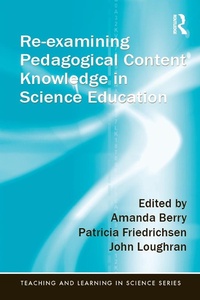
Re-examining Pedagogical Content Knowledge in Science Education
Published on 24. March 2015
280 pages
978-1-317-56465-2 (ISBN)
Description

Pedagogical Content Knowledge (PCK) has been adapted, adopted, and taken up in a diversity of ways in science education since the concept was introduced in the mid-1980s. Now that it is so well embedded within the language of teaching and learning, research and knowledge about the construct needs to be more useable and applicable to the work of science teachers, especially so in these times when standards and other measures are being used to define their knowledge, skills, and abilities.
Re-examining Pedagogical Content Knowledge in Science Education is organized around three themes: Re-examining PCK: Issues, ideas and development; Research developments and trajectories; Emerging themes in PCK research. Featuring the most up-to-date work from leading PCK scholars in science education across the globe, this volume maps where PCK has been, where it is going, and how it now informs and enhances knowledge of science teachers' professional knowledge. It illustrates how the PCK research agenda has developed and can make a difference to teachers' practice and students' learning of science.
Re-examining Pedagogical Content Knowledge in Science Education is organized around three themes: Re-examining PCK: Issues, ideas and development; Research developments and trajectories; Emerging themes in PCK research. Featuring the most up-to-date work from leading PCK scholars in science education across the globe, this volume maps where PCK has been, where it is going, and how it now informs and enhances knowledge of science teachers' professional knowledge. It illustrates how the PCK research agenda has developed and can make a difference to teachers' practice and students' learning of science.
Reviews / Votes
"This book provides a state-of-the-art overview over the most recent developments in PCK research in the world and identifies common themes and perspectives for future research. A distinct feature is the proposal of a consensus model of teacher professional knowledge including PCK. As such, this is a must-read for every researcher working in the field of science teacher education as well as science teacher educators who want to learn more about what to teach and how to teach it to their students."Knut Neumann, Leibniz-Institute for Science and Mathematics Education, Germany
"This book can offer guidance and direction for other science education researchers in pursuing the impact of PCK on teaching and learning in science. It is timely, and it is needed. It is an important resource for all PCK researchers."
William R. Veal, College of Charleston, USA
More details
Series
Language
English
Place of publication
London
United Kingdom
Publishing group
Taylor & Francis Ltd
Target group
College/higher education
Illustrations
24 s/w Abbildungen, 12 s/w Tabellen
12 Tables, black and white; 24 Illustrations, black and white
File size
3,46 MB
ISBN-13
978-1-317-56465-2 (9781317564652)
Copyright in bibliographic data and cover images is held by Nielsen Book Services Limited or by the publishers or by their respective licensors: all rights reserved.
Schweitzer Classification
Other editions
Additional editions
Amanda Berry | Patricia Friedrichsen | John Loughran
Re-examining Pedagogical Content Knowledge in Science Education
Book
03/2015
1st Edition
Routledge
€242.10
Shipment within 10-20 days
Amanda Berry | Patricia Friedrichsen | John Loughran
Re-examining Pedagogical Content Knowledge in Science Education
Book
03/2015
1st Edition
Routledge
€76.70
Shipment within 10-20 days
Persons
Amanda Berry is Associate Professor, ICLON, Leiden University, the Netherlands.
Patricia Friedrichsen is Associate Professor, University of Missouri, USA.
John Loughran is Dean, Faculty of Education, Monash University, Australia.
Patricia Friedrichsen is Associate Professor, University of Missouri, USA.
John Loughran is Dean, Faculty of Education, Monash University, Australia.
Content
Preface
Section 1: Introducing PCK: Issues, ideas and development
Chapter 1 PCK: Its genesis and exodus, Lee S. Shulman
Chapter 2 The PCK summit: A process and structure for challenging current ideas, provoking future work, and considering new directions, Janet Carlson, Laura Stokes & Jenifer Helms, Julie Gess-Newsome & April Gardner
Chapter 3 A model of teacher professional knowledge and skill including PCK: Results of the thinking from the PCK summit, Julie Gess-Newsome
Section 2: Research developments and trajectories
Chapter 4 Supporting growth of Pedagogical Content Knowledge in science, Kirsten R. Daehler, Joan I. Heller & Nicole Wong
Chapter 5 Science teachers' PCK: Understanding sophisticated practice, Rebecca Cooper, John Loughran & Amanda Berry
Chapter 6 Tracing a research trajectory on PCK and chemistry university professors' beliefs, Kira Padilla & Andoni Garritz
Chapter 7 Assessing PCK: A new application of the uncertainty principle, P. Sean Smith & Eric R. Banilower
Chapter 8 From portraying toward assessing PCK: Drivers, dilemmas and directions for future research, Soonhye Park & Jeekyung Suh
Chapter 9 Towards a more comprehensive way to capture PCK in its complexity, Ineke Henze & Jan H. van Driel
Chapter 10 The PCK summit and its effect on work in South Africa, Marissa Rollnick & Elizabeth Mavhunga
Chapter 11 My PCK research trajectory: A purple book prompts new questions, Patricia Friedrichsen
Chapter 12 Pedagogical content knowledge reconsidered: A teacher educator's perspective, Rebecca M. Schneider
Chapter 13 On the beauty of knowing then not knowing: Pinning down the elusive qualities of PCK, Vanessa Kind
Section 3: Pedagogical Content Knowledge: Emerging themes
Chapter 14 Examining PCK Research in the Context of Current Policy Initiatives, Aaron J. Sickel, Eric Banilower, Janet Carlson & Jan van Driel
Chapter 15 Science teacher PCK learning progressions: Promises and challenges, Patricia Friedrichsen & Amanda Berry
Chapter 16 Gathering evidence for the validity of PCK measures: Connecting ideas to analytic approaches, Sophie Kirschner, Joseph Taylor, Marissa Rollnick, Andreas Borowski, Elizabeth Mavhunga
Section 4: Provocations and closing thoughts
Chapter 17 Re-examining PCK: A personal commentary, Richard F Gunstone
About the Contributors
Index
Section 1: Introducing PCK: Issues, ideas and development
Chapter 1 PCK: Its genesis and exodus, Lee S. Shulman
Chapter 2 The PCK summit: A process and structure for challenging current ideas, provoking future work, and considering new directions, Janet Carlson, Laura Stokes & Jenifer Helms, Julie Gess-Newsome & April Gardner
Chapter 3 A model of teacher professional knowledge and skill including PCK: Results of the thinking from the PCK summit, Julie Gess-Newsome
Section 2: Research developments and trajectories
Chapter 4 Supporting growth of Pedagogical Content Knowledge in science, Kirsten R. Daehler, Joan I. Heller & Nicole Wong
Chapter 5 Science teachers' PCK: Understanding sophisticated practice, Rebecca Cooper, John Loughran & Amanda Berry
Chapter 6 Tracing a research trajectory on PCK and chemistry university professors' beliefs, Kira Padilla & Andoni Garritz
Chapter 7 Assessing PCK: A new application of the uncertainty principle, P. Sean Smith & Eric R. Banilower
Chapter 8 From portraying toward assessing PCK: Drivers, dilemmas and directions for future research, Soonhye Park & Jeekyung Suh
Chapter 9 Towards a more comprehensive way to capture PCK in its complexity, Ineke Henze & Jan H. van Driel
Chapter 10 The PCK summit and its effect on work in South Africa, Marissa Rollnick & Elizabeth Mavhunga
Chapter 11 My PCK research trajectory: A purple book prompts new questions, Patricia Friedrichsen
Chapter 12 Pedagogical content knowledge reconsidered: A teacher educator's perspective, Rebecca M. Schneider
Chapter 13 On the beauty of knowing then not knowing: Pinning down the elusive qualities of PCK, Vanessa Kind
Section 3: Pedagogical Content Knowledge: Emerging themes
Chapter 14 Examining PCK Research in the Context of Current Policy Initiatives, Aaron J. Sickel, Eric Banilower, Janet Carlson & Jan van Driel
Chapter 15 Science teacher PCK learning progressions: Promises and challenges, Patricia Friedrichsen & Amanda Berry
Chapter 16 Gathering evidence for the validity of PCK measures: Connecting ideas to analytic approaches, Sophie Kirschner, Joseph Taylor, Marissa Rollnick, Andreas Borowski, Elizabeth Mavhunga
Section 4: Provocations and closing thoughts
Chapter 17 Re-examining PCK: A personal commentary, Richard F Gunstone
About the Contributors
Index
