

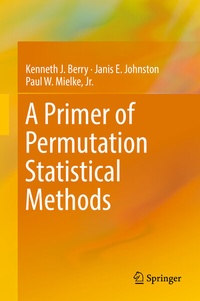
A Primer of Permutation Statistical Methods
Description

The primary purpose of this textbook is to introduce the reader to a wide variety of elementary permutation statistical methods. Permutation methods are optimal for small data sets and non-random samples, and are free of distributional assumptions. The book follows the conventional structure of most introductory books on statistical methods, and features chapters on central tendency and variability, one-sample tests, two-sample tests, matched-pairs tests, one-way fully-randomized analysis of variance, one-way randomized-blocks analysis of variance, simple regression and correlation, and the analysis of contingency tables. In addition, it introduces and describes a comparatively new permutation-based, chance-corrected measure of effect size.
Because permutation tests and measures are distribution-free, do not assume normality, and do not rely on squared deviations among sample values, they are currently being applied in a wide variety of disciplines. This book presents permutation alternatives to existing classical statistics, and is intended as a textbook for undergraduate statistics courses or graduate courses in the natural, social, and physical sciences, while assuming only an elementary grasp of statistics.More details
Other editions
Additional editions
Persons
Janis E. Johnston works for the U.S. Government as a data analyst. She received B.S. degrees in mathematics and natural science from the University of Wyoming, her M.A. in sociology from the University of Wyoming, and her Ph.D. from Colorado State University. From 2007 to 2009 she was an American Association for the Advancement of Science, Science & Technology fellow and began government service after the fellowship. Her research interests are in permutation methods, statistical inference, and policy analysis.
Paul W. Mielke, Jr. is Emeritus Professor at Colorado State University and a fellow of the American Statistical Association. He received a B.A. in mathematics from the University of Minnesota before training in meteorology at the University of Chicago for the U.S. Air Force. He earned an M.A. in mathematics from the University of Arizona and a Ph.D. in biostatistics from the University of Minnesota. In 1963 he joined the Department of Mathematics and Statistics at Colorado State University, retiring in 2002. His research interests are in permutation methods, meteorology, and environmental issues.
