

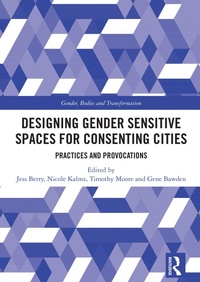
Designing Gender Sensitive Spaces for Consenting Cities
Practices and Provocations
Published on 18. March 2025
316 pages
978-1-040-32891-0 (ISBN)
Description

This edited collection investigates gender-sensitive spaces, design practices, and provocations that challenge the complex social and material structures that shape inequities of access and inclusion in the urban environment.
Designing Gender Sensitive Spaces for Consenting Cities: Practices and Provocations centres intersectional, gender-sensitive approaches to design in the urban environment as an integral strategy in combating spatial inequities. Through an investigation of design-led methods, project case studies, activist interventions, and processes of resistance and agency, this volume offers new thinking and practical approaches to demonstrate how design might shift towards safer and more inclusive cities for women, gender-diverse people, and LGBTIQ+ communities.
This book will appeal to practitioners, scholars, and students of urbanism, design, planning, architecture, and geography, as well as government and non-profit organisations that are interested in gender and equality and can influence the future narratives of cities.
Designing Gender Sensitive Spaces for Consenting Cities: Practices and Provocations centres intersectional, gender-sensitive approaches to design in the urban environment as an integral strategy in combating spatial inequities. Through an investigation of design-led methods, project case studies, activist interventions, and processes of resistance and agency, this volume offers new thinking and practical approaches to demonstrate how design might shift towards safer and more inclusive cities for women, gender-diverse people, and LGBTIQ+ communities.
This book will appeal to practitioners, scholars, and students of urbanism, design, planning, architecture, and geography, as well as government and non-profit organisations that are interested in gender and equality and can influence the future narratives of cities.
More details
Series
Language
English
Place of publication
London
United Kingdom
Publishing group
Taylor & Francis Ltd
Target group
College/higher education
Professional and scholarly
Illustrations
4 Tables, black and white; 5 Line drawings, black and white; 45 Halftones, black and white; 50 Illustrations, black and white
File size
12,84 MB
ISBN-13
978-1-040-32891-0 (9781040328910)
Copyright in bibliographic data and cover images is held by Nielsen Book Services Limited or by the publishers or by their respective licensors: all rights reserved.
Schweitzer Classification
Other editions
Additional editions
Jess Berry | Nicole Kalms | Timothy Moore
Designing Gender Sensitive Spaces for Consenting Cities
Practices and Provocations
Book
approx. 07/2026
1st Edition
Routledge
€57.50
Not yet published

Jess Berry | Nicole Kalms | Timothy Moore
Designing Gender Sensitive Spaces for Consenting Cities
Practices and Provocations
Book
04/2025
Routledge
Unfortunately, price unknown
Available (delivery time upon request)
Jess Berry | Nicole Kalms | Timothy Moore
Designing Gender Sensitive Spaces for Consenting Cities
Practices and Provocations
Book
03/2025
1st Edition
Routledge
€208.20
Shipment within 10-20 days
Persons
Jess Berry is a design historian and an associate professor at Monash University. She is a senior researcher at the XYX Lab, where her research focuses on gendered spatial practices. Her research explores how gender identities are articulated and mediated through, and by, fashion, architecture, and interior design in cities.
Nicole Kalms is a professor in the Faculty of Art, Design, and Architecture and founding director of the Monash University XYX Lab, which leads national and international research in gender and place. The innovation of Kalms' research is the examination of digital, experiential, political, and material interventions collated to articulate both the shared and conflicted struggles of women and girls internationally. Her praxis repositions design as a strategic tool for challenging gender inequity. Her recent research has focused on public transport spaces for women and girls, gender-sensitive CPTED, and the use of participatory co-design to challenge gender-neutral urban policy.
Timothy Moore is a founder of Sibling Architecture, Senior Lecturer in Architecture at Monash University, and the Curator of Contemporary Design and Architecture at the National Gallery of Victoria. As a researcher within XYX Lab, he looks at the relationship between gender, sexual identity, equity, and architecture.
Gene Bawden is a communication designer and the head of Monash University's Design Department. His research interrogates the design of Australian domestic spaces constructed as a prescriptive but highly charged representation of cultural belonging, social alignment, and gendered expectation. Gene combines his knowledge of gendered spatial practices and his communication design expertise within collaborative research projects.
Nicole Kalms is a professor in the Faculty of Art, Design, and Architecture and founding director of the Monash University XYX Lab, which leads national and international research in gender and place. The innovation of Kalms' research is the examination of digital, experiential, political, and material interventions collated to articulate both the shared and conflicted struggles of women and girls internationally. Her praxis repositions design as a strategic tool for challenging gender inequity. Her recent research has focused on public transport spaces for women and girls, gender-sensitive CPTED, and the use of participatory co-design to challenge gender-neutral urban policy.
Timothy Moore is a founder of Sibling Architecture, Senior Lecturer in Architecture at Monash University, and the Curator of Contemporary Design and Architecture at the National Gallery of Victoria. As a researcher within XYX Lab, he looks at the relationship between gender, sexual identity, equity, and architecture.
Gene Bawden is a communication designer and the head of Monash University's Design Department. His research interrogates the design of Australian domestic spaces constructed as a prescriptive but highly charged representation of cultural belonging, social alignment, and gendered expectation. Gene combines his knowledge of gendered spatial practices and his communication design expertise within collaborative research projects.
Content
Designing gender-sensitive spaces for consenting cities: An overview
PART ONE: Designing approaches
Introduction: Designing approaches
1. In search of a method that works: the story of the gendered landscape of Umea
2. To go for a walk alone and be a woman
3. Designing gender-responsive housing/home: a feminist exploration
4. A super-duper wicked problem: expanding intersectional climate adaptation
5. Data design and dissemination: visualising gender inequality statistics for public audiences
PART TWO: Making material changes
Introduction: Making material changes
6. Kitchen Revolutions
7. Shared reading and place-making in the rural Australian city: mediating climate crisis, marginality and gendered experience through collective reading practices
8. Institutionalising Pride: the rise of the Pride Centre in Melbourne
9. Engendering justice: on (in)visibilities of penal design, aestheticization of punishment and space of solidarity
10. Making room for the unexpected: street sex work and the indecorous city
11. Developing advocacy: insights from gender-sensitive placemaking training in the public sector
PART THREE: The possibilities of night
Introduction: The possibilities of night
12. Untangling the relationship of fear, safety and accessibility in night-time Kolkata
13. Feminist urban planning through community action and transformation: the case of Nocturnas
14. Reclaim the night: women walk to reimagine nightlife
15. Pride of place: (re)imagining a queer Sydney during WorldPride
PART FOUR: Infrastructures of care
Introduction: Infrastructures of care
16. Feminist criteria for territorialising the caring city
17. Rethinking spatial analysis and analytics: Native, Black and Latina/x feminist theories and methods for engagement, equity and justice
18. Eco-Feminist co-housing: a design approach
19. How it started/how it's going: real-time reflections* on a queer research practice
PART ONE: Designing approaches
Introduction: Designing approaches
1. In search of a method that works: the story of the gendered landscape of Umea
2. To go for a walk alone and be a woman
3. Designing gender-responsive housing/home: a feminist exploration
4. A super-duper wicked problem: expanding intersectional climate adaptation
5. Data design and dissemination: visualising gender inequality statistics for public audiences
PART TWO: Making material changes
Introduction: Making material changes
6. Kitchen Revolutions
7. Shared reading and place-making in the rural Australian city: mediating climate crisis, marginality and gendered experience through collective reading practices
8. Institutionalising Pride: the rise of the Pride Centre in Melbourne
9. Engendering justice: on (in)visibilities of penal design, aestheticization of punishment and space of solidarity
10. Making room for the unexpected: street sex work and the indecorous city
11. Developing advocacy: insights from gender-sensitive placemaking training in the public sector
PART THREE: The possibilities of night
Introduction: The possibilities of night
12. Untangling the relationship of fear, safety and accessibility in night-time Kolkata
13. Feminist urban planning through community action and transformation: the case of Nocturnas
14. Reclaim the night: women walk to reimagine nightlife
15. Pride of place: (re)imagining a queer Sydney during WorldPride
PART FOUR: Infrastructures of care
Introduction: Infrastructures of care
16. Feminist criteria for territorialising the caring city
17. Rethinking spatial analysis and analytics: Native, Black and Latina/x feminist theories and methods for engagement, equity and justice
18. Eco-Feminist co-housing: a design approach
19. How it started/how it's going: real-time reflections* on a queer research practice
