

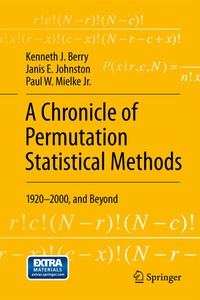
A Chronicle of Permutation Statistical Methods
Description

The focus of this book is on the birth and historical development of permutation statistical methods from the early 1920s to the near present. Beginning with the seminal contributions of R.A. Fisher, E.J.G. Pitman, and others in the 1920s and 1930s, permutation statistical methods were initially introduced to validate the assumptions of classical statistical methods.
Permutation methods have advantages over classical methods in that they are optimal for small data sets and non-random samples, are data-dependent, and are free of distributional assumptions. Permutation probability values may be exact, or estimated via moment- or resampling-approximation procedures. Because permutation methods are inherently computationally-intensive, the evolution of computers and computing technology that made modern permutation methods possible accompanies the historical narrative.
Permutation analogs of many well-known statistical tests are presented in a historical context, includingmultiple correlation and regression, analysis of variance, contingency table analysis, and measures of association and agreement. A non-mathematical approach makes the text accessible to readers of all levels.
Reviews / Votes
Selected by Choice magazine as an "Outstanding Academic Title" for 2015
"This unique work represents the most thorough discussion to date of the history of permutation statistical methods from 1920 to the present. . This clearly written book is a succinct compilation of those tests associated with the history of permutation statistical methods and their impact on the field of statistics. Its nonmathematical coverage makes it accessible to most readers. Summing Up: Highly recommended. Upper-division undergraduates through professionals/practitioners." (D. J. Gougeon, Choice, Vol. 52 (9), May, 2015)
"This book is a very impressive work with a unique, comprehensive in-depth coverage of the birth and development of permutation-based statistical methods that should prove to be invaluable for anyone interested in this topic. . It should also be useful for practitioners who are using permutation-based statistical methods and are interested in understanding the foundations and the motivations behind the usage of a specific method." (Andreas Rosenblad, International Statistical Review, Vol. 83 (1), 2015)
More details
Other editions
Additional editions
Persons
Kenneth J. Berry is Professor of Sociology at Colorado State University.
Janis E. Johnston is a Social Science Policy Analyst with the United States government in Washington, D.C.
Paul W. Mielke, Jr. is Professor Emeritus of Statistics at Colorado State University and Fellow of the American Statistical Association.
