

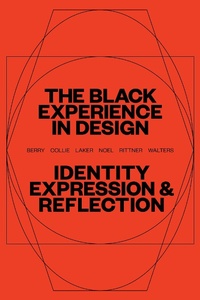
The Black Experience in Design
Identity, Expression & Reflection
Published on 1. February 2022
264 pages
978-1-62153-786-1 (ISBN)
Description

The Black Experience in Design spotlights teaching practices, research, stories, and conversations from a Black/African diasporic lens.
Excluded from traditional design history and educational canons that heavily favor European modernist influences, the work and experiences of Black designers have been systematically overlooked in the profession for decades. However, given the national focus on diversity, equity, and inclusion in the aftermath of the nationwide Black Lives Matter protests in the United States, educators, practitioners, and students now have the opportunity-as well as the social and political momentum-to make long-term, systemic changes in design education, research, and practice, reclaiming the contributions of Black designers in the process.
The Black Experience in Design, an anthology centering a range of perspectives, spotlights teaching practices, research, stories, and conversations from a Black/African diasporic lens. Through the voices represented, this text exemplifies the inherently collaborative and multidisciplinary nature of design, providing access to ideas and topics for a variety of audiences, meeting people as they are and wherever they are in their knowledge about design. Ultimately, The Black Experience in Design serves as both inspiration and a catalyst for the next generation of creative minds tasked with imagining, shaping, and designing our future.
Excluded from traditional design history and educational canons that heavily favor European modernist influences, the work and experiences of Black designers have been systematically overlooked in the profession for decades. However, given the national focus on diversity, equity, and inclusion in the aftermath of the nationwide Black Lives Matter protests in the United States, educators, practitioners, and students now have the opportunity-as well as the social and political momentum-to make long-term, systemic changes in design education, research, and practice, reclaiming the contributions of Black designers in the process.
The Black Experience in Design, an anthology centering a range of perspectives, spotlights teaching practices, research, stories, and conversations from a Black/African diasporic lens. Through the voices represented, this text exemplifies the inherently collaborative and multidisciplinary nature of design, providing access to ideas and topics for a variety of audiences, meeting people as they are and wherever they are in their knowledge about design. Ultimately, The Black Experience in Design serves as both inspiration and a catalyst for the next generation of creative minds tasked with imagining, shaping, and designing our future.
More details
Persons
Anne H. Berry is a writer and educator whose research focuses on race/representation in the field of design. Her writing has been published in AIGA's Eye on Design, Communication Arts, and the inaugural issue of the anthology Recognize featuring essays and commentary from indigenous people and people of color.
Kareem Collie is a designer, strategist, and educator specializing in collaborative and human-centered design approaches to capture, reveal, and produce visual and experiential narratives. He holds a master's degree from NYU in culture and communication studies and a bachelor's in fine arts from Pratt Institute in communication design.
Penina Acayo Laker is a designer and educator whose practice and research is centered around topics that utilize a human-centered approach to solving social problems, locally and internationally. She is currently broadening the scope and access of design education to young people in Uganda through her DesignEd workshops.
Dr. Lesley-Ann Noel focuses on equity, social justice, and the experiences of people who are often excluded from design education, research and practice. She promotes greater critical awareness among designers and design students by introducing critical theory concepts and vocabulary into the design studio e.g. through The Designer's Critical Alphabet and the Positionality Wheel.
Jennifer Rittner is a writer and educator. She is currently Visiting Assistant Professor in the School of Design Strategies at Parsons School of Design. Her work has been published in the New York Times, DMI: Journal, AIGA Eye on Design, and Core77; and in 2021 served as guest editor for a special issue on Design & Policing for Design Museum magazine. Jennifer earned her B.A. from the Gallatin School of Individualized Studies at New York University and her M.Ed. in Communication and Education at Columbia University's Teachers College.
Kelly Walters is a designer, educator and founder of the multidisciplinary design studio Bright Polka Dot. Her ongoing design research interrogates the complexities of identity formation, systems of value, and the shared vernacular in and around Black visual culture. She is the author of Black, Brown + Latinx Design Educators: Conversations on Design and Race published by Princeton Architectural Press. Kelly is an Assistant Professor and Associate Director of the BFA Communication Design Program at Parsons School of Design at The New School in New York.
Kareem Collie is a designer, strategist, and educator specializing in collaborative and human-centered design approaches to capture, reveal, and produce visual and experiential narratives. He holds a master's degree from NYU in culture and communication studies and a bachelor's in fine arts from Pratt Institute in communication design.
Penina Acayo Laker is a designer and educator whose practice and research is centered around topics that utilize a human-centered approach to solving social problems, locally and internationally. She is currently broadening the scope and access of design education to young people in Uganda through her DesignEd workshops.
Dr. Lesley-Ann Noel focuses on equity, social justice, and the experiences of people who are often excluded from design education, research and practice. She promotes greater critical awareness among designers and design students by introducing critical theory concepts and vocabulary into the design studio e.g. through The Designer's Critical Alphabet and the Positionality Wheel.
Jennifer Rittner is a writer and educator. She is currently Visiting Assistant Professor in the School of Design Strategies at Parsons School of Design. Her work has been published in the New York Times, DMI: Journal, AIGA Eye on Design, and Core77; and in 2021 served as guest editor for a special issue on Design & Policing for Design Museum magazine. Jennifer earned her B.A. from the Gallatin School of Individualized Studies at New York University and her M.Ed. in Communication and Education at Columbia University's Teachers College.
Kelly Walters is a designer, educator and founder of the multidisciplinary design studio Bright Polka Dot. Her ongoing design research interrogates the complexities of identity formation, systems of value, and the shared vernacular in and around Black visual culture. She is the author of Black, Brown + Latinx Design Educators: Conversations on Design and Race published by Princeton Architectural Press. Kelly is an Assistant Professor and Associate Director of the BFA Communication Design Program at Parsons School of Design at The New School in New York.
Content
- Front Cover
- Title Page
- Copyright Page
- Dedication
- Contents
- FOREWORD
- 0 - 0.4 INTRODUCTION
- Why Is This Book Needed?
- Searching for a Black Aesthetic in American Graphic Design
- On Sylvia Harris: The Contributions of Black Designers
- Designing with Complexity: An Intersectional View
- 1 - 1.7 DESIGN PRACTICES
- Chapter Introduction
- An Exhibition by Black Designers
- In Conversation: Darhil Crooks, Ian Spalter & Dantley Davis on Practicing Design While Black, with Kareem Collie
- Another Brick in the Wall
- The Four Pillars
- To Be Just . . .
- In Conversation: Annika Hansteen-Izora on Identity, Community & Authenticity, with Jennifer Rittner
- 2 - 2.7 DESIGN EDUCATION
- Chapter Introduction
- In Conversation: Maurice Woods & Anne H. Berry on Meeting the Demands of the Future
- The New Visual Abnormal
- Unvisible (What's the Scenario?)
- The Strong Black Woman
- A Reading List for the Politics of Design
- Beyond the Universal: Positionality & Promise in an HBCU Classroom
- 3 - 3.6 DESIGN SCHOLARSHIP
- Chapter Introduction
- Follow the Golden Ratio from Africa to the Bauhaus for a Cross-Cultural Aesthetic for Images
- The Pause: Reflecting on a Righteous Consciousness that Informs Our Design as Afrikans
- Finding Anthony: Establishing a Research Trajectory
- Bondage by Paper: Devices of Slaveholding Ingenuity
- At the Jim Crow Museum, We Use Racist Objects to Engage Hearts & Heads in Social Justice
- 4 - 4.9 ACTIVISIM, ADVOCACY & COMMUNITY-ENGAGED DESIGN
- Chapter Introduction
- Participatory & Emanicipatory Aspirations in Afrika
- From the Black Anti-Ableist Diary: A Tribute to My Black Disabled Son from a Black Disabled Mother
- The Infrastructure of Care: Community Design, Healing & Organizational Post-Traumatic Growth
- The Center in the Margins: Locating Intimacy in Multi-Communities
- Biophilia Patterns in Black & Brown Spaces
- In Conversation: Amos Kennedy & Kareem Collie on Advocating for Humanity
- The Preconditions to Healing
- In Conversation: Raja Schaar & Jennifer Rittner on Sustainability as a Historically Black Practice
- 5 - 5.6 AFROFUTURISM IN DESIGN
- Chapter Introduction
- From Algorithms to Afro-Rithms in Afrofuturism
- A Black-Centered Design Ethos: Engaging Afrofuturism in Catalyzing More Inclusive Technological Futures
- What Type of Ancestor Do You Want to Be?
- Black Secret Technologies
- Dark Matter's Magic in Design
- 6 - 6.8 JOURNEYS IN DESIGN
- Chapter Introduction
- The Black Designer's Journey: Theory of Change
- In Pursuit of a Prismatic Profession
- &&&: Provoking Type
- 1 Word / 1 Object
- Curating My Way into Design: A Work in Progress
- My Journey to Design
- Moving On: Interview with White Male Academic
- 7 - 7.6 DESIGN = ART ? DESIGN
- Chapter Introduction
- In Conversation: Nontsikelelo Mutiti & Kelly Walters on Image Making, Conceptual Process, and the Tools of Design
- In Conversation: Cey Adams & Kelly Walters on Design Detours & Artistic Possibilities
- Design (Is) Art. If You Want It to Be.
- In Conversation: Mimi Onuoha & Romi Morrison on Unsettling the Equivalents
- In Conversation: Rhea L. Combs & Anne H. Berry on Representing Everyday Black Lives through Film & Photography
- 8 - 8.7 COLLECTIVE, RADICAL & LIBERATORY SPACES IN DESIGN
- Chapter Introduction
- for colored girls who feel trapped in white institutions
- The Black Student Union
- Make the Path by Talking
- Building BADG: The Guild as a Model for Liberatory Space
- Designer Profile: Ari Melenciano
- This Is Our Time! adrienne maree brown on Design, Liberation, and Transformation as told to Lesley-Ann Noel
- GUIDING QUESTIONS
- GLOSSARY
- Letter to Future Designers
- On Writing & Editing this Book
- AFTERWORD Eddie Opara
- BIOS
- ACKNOWLEDGMENTS
- INDEX
