

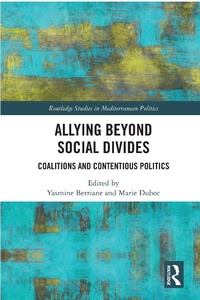
Allying beyond Social Divides
Coalitions and Contentious Politics
1st Edition
Published on 25. November 2020
160 pages
978-1-000-08201-2 (ISBN)
Description

This book offers a fresh look at the role of coalitions in contentious politics in North Africa and the Middle East, based on conceptual reflexions and empirical case studies by researchers who have conducted extensive fieldwork in the region.
Coalitions of actors that have traditionally not been allies have become a key feature of the protest movements that have emerged across North Africa and the Middle East since 2011. But what happens when Islamists ally with Leftists, workers with student unions and young engineers with local tribesmen? How do coalitions form across ideological, generational, professional, ethnic and class divides? Are such collaborations transformative? The authors seek to show that it is important to go beyond analyses that focus mainly on identifying the factors that led to a coalition's success or failure: coalitions are moments of transformative encounter that can lead to changes affecting relations with political authorities, ideological learnings, repertoires of action and understandings of the notion of right. Instead of analyzing coalitions and social divides as two opposite processes, this book further argues that studying the alliance of social groups goes hand in hand with exploring processes of differentiation that are engineered by both political regimes and social actors.
Focusing on the role of coalitions in contentious politics, before and after the Arab uprisings, this book proposes a sociology of coalitions in the Middle East based on key empirical examples, to analyze the transformations that emerged out of such alliances at the levels of repertoires of action, forms of organization, relations to political authorities and ideological learnings.
The chapters in this book were originally published as a special issue of the journal, Mediterranean Politics.
Coalitions of actors that have traditionally not been allies have become a key feature of the protest movements that have emerged across North Africa and the Middle East since 2011. But what happens when Islamists ally with Leftists, workers with student unions and young engineers with local tribesmen? How do coalitions form across ideological, generational, professional, ethnic and class divides? Are such collaborations transformative? The authors seek to show that it is important to go beyond analyses that focus mainly on identifying the factors that led to a coalition's success or failure: coalitions are moments of transformative encounter that can lead to changes affecting relations with political authorities, ideological learnings, repertoires of action and understandings of the notion of right. Instead of analyzing coalitions and social divides as two opposite processes, this book further argues that studying the alliance of social groups goes hand in hand with exploring processes of differentiation that are engineered by both political regimes and social actors.
Focusing on the role of coalitions in contentious politics, before and after the Arab uprisings, this book proposes a sociology of coalitions in the Middle East based on key empirical examples, to analyze the transformations that emerged out of such alliances at the levels of repertoires of action, forms of organization, relations to political authorities and ideological learnings.
The chapters in this book were originally published as a special issue of the journal, Mediterranean Politics.
More details
Series
Edition
1. Auflage
Language
English
Place of publication
London
United Kingdom
Publishing group
Taylor & Francis Ltd
Target group
College/higher education
ISBN-13
978-1-000-08201-2 (9781000082012)
Copyright in bibliographic data and cover images is held by Nielsen Book Services Limited or by the publishers or by their respective licensors: all rights reserved.
Schweitzer Classification
Other editions
Additional editions
Book
01/2024
1st Edition
Routledge
€64.70
Shipment within 15-20 days
Book
07/2020
1st Edition
Routledge
€131.90
Shipment within 15-20 days
Persons
Yasmine Berriane is tenured researcher at the French National Centre for Research in Paris, France. Her research focuses on social movements, gender and land rights politics in North Africa.
Marie Duboc is postdoctoral researcher at Sorbonne University, Paris, France. Her research focuses on social movements and labour relations in the Middle East.
Marie Duboc is postdoctoral researcher at Sorbonne University, Paris, France. Her research focuses on social movements and labour relations in the Middle East.
Content
Allying beyond social divides: An introduction to contentious politics and coalition in the Middle East and North Africa.
1. When unemployment meets environment. The case of the anti-fracking coalition in Ouargla
2. Egypt is not for sale! Harnessing nationalism for alliance building in Egypt's Tiran and Sanafir island protests
3. Corporatist coalitions as agents of civil society: The politics of student and labour unions in Iran
4. Coalitions for change in Egypt: Bridging ideological and generational divides in the revolution
5. Bridging the gap: Social divides and coalition building in the phosphate-mining industry in Jordan
6. Opposition coalitions in the Middle East: Origins, demise, and afterlife?
1. When unemployment meets environment. The case of the anti-fracking coalition in Ouargla
2. Egypt is not for sale! Harnessing nationalism for alliance building in Egypt's Tiran and Sanafir island protests
3. Corporatist coalitions as agents of civil society: The politics of student and labour unions in Iran
4. Coalitions for change in Egypt: Bridging ideological and generational divides in the revolution
5. Bridging the gap: Social divides and coalition building in the phosphate-mining industry in Jordan
6. Opposition coalitions in the Middle East: Origins, demise, and afterlife?
