

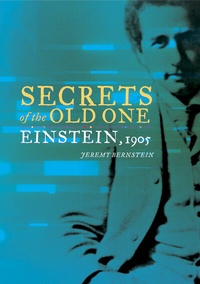
Secrets of the Old One
Description

Beginning on the 18th of March, 1905,at approximately eight week intervals, the noted German physics journal Annalen der Physik received three hand-written manuscripts from a relatively unknown patent examiner in Bern. The patent examiner was the twenty-six year old Albert Einstein and the three papers would set the agenda for twentieth century physics. A fourth short paper was received by the journal on the 27th of September. It contained Einstein's derivation of the formula E=mc2. These papers with their many technological ramifications changed our lives in the twentieth century and beyond. While to a professional physicist the mathematics in these papers is quite straight forward, the ideas behind the mathematics are not. In fact, none of Einstein's contemporaries fully understood what he had done. The goal of this book is to make these ideas accessible to a general reader with no more mathematics than one learns in high school.
PRAISE FOR BOOK:
"With wonderfully chosen digressions and some sophisticated physics plus the minimum amount of math to support it, Jeremy Bernstein has produced a charming account of Einstein's epoch-making papers of 1905. Here is surely the thinking person's guide to Einstein's 'Miracle Year."
-Owen Gingerich, Harvard-Smithsonian Center for Astrophysics, Author, The Book Nobody Read: Chasing the Revolutions of Nicolaus Copernicus
"Why are physicists celebrating the centenary of Einstein's miracle year? In this gem of a book-and in simple words-Bernstein explains how young Albert, in that one year, set the foundation to a century of progress in physics."
-Sheldon L. Glashow, Winner of the 1979 Nobel Prize inPhysics, Professor, Boston University
Reviews / Votes
Secrets of the Old One is one of the best scientist-sketches and adds to Bernstein's long list of such successes.
Peter L. Gallison, American Scientist, Volume 94, Number 3, May-June 2006
Bernstein's book is wonderful and, as far as I can judge as a professional physicist, very pedagogical for non-specialists.
Andre Martin, CERN Courier, Volume 46, Number 3, 2006
More details
Other editions
Additional editions
Person
Many readers will recognize Bernstein (Cranks, Quarks & the Cosmos, LJ 1/93) as the noted science essayist for the New Yorker for the past 30 years. He has also contributed essays to Scientific American and The Atlantic Monthly. He wrote A Theory for Everything (Copernicus, 1996) which collected some of these essays as well as Hitler's Uranium Club 2e (Copernicus, 1996).
