

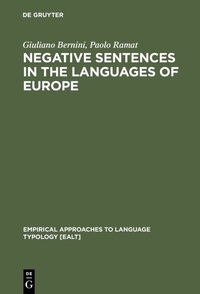
Negative Sentences in the Languages of Europe
A Typological Approach
1st Edition
Published on 25. October 2012
XIII, 274 pages
978-3-11-081974-8 (ISBN)
Description

No detailed description available for "Negative Sentences in the Languages of Europe".
More details
Other editions
Additional editions
Book
08/1996
1st Edition
De Gruyter Mouton
€119.95
Shipment within 7-9 days
Book
01/1996
1st Edition
De Gruyter Mouton
€169.95
Article exhausted; check different version
Content
- Intro
- Abbreviations of grammatical terms
- Abbreviations of language names
- Abbreviations of authors and texts
- 0. Introduction
- 0.1. The rationale of the research
- 0.2. On negation in general
- 0.3. The linguistic phenomenology of negation
- 0.4. Organization of the work
- Part I: The diachronic and areal perspective
- 1. Types of negation in the Romance languages
- 2. The diachronic perspective
- 2.1. Towards a reconstruction of the negative sentence in Proto-Indo-European
- 2.2. Diachronic developments
- 2.3. Reinforcement of NEG: the creation of new negative morphemes
- 3. Word order and negation
- 3.1. Preverbal negation
- 3.2. Postverbal negation
- 3.3. Discontinuous negation
- 3.4. The negative verb
- 4. The areal perspective
- 4.1. Geographical distribution
- 4.2. Areal typology
- 4.3. Sentence final negation in Afrikaans and its Portuguese basis
- Part II: The analysis of the Questionnaire
- Foreword
- The questionnaire, the type of inquiry
- 5. Sentence and phrase negation
- 5.1. The sentence Q1: negation in replies to 'yes/no' questions ['NO']
- 5.2. Sentences Q2 and Q34: anaphoric holophrastic negation ['NEGHOL']
- 5.3. Sentences Q3, Q4: negative coordination
- 5.4. Sentences Q6, Q7: phrasal negation
- 5.5. Sentence Q5: the simple negative sentence
- 5.6. Sentences Q37, Q38: the negative imperative
- 6. Quantifier systems
- 6.1. Introduction
- 6.2. "Tertia comparationis": semantic value and grammatical categories
- 6.3. Characterisation of the value of quantifiers
- 6.4. Types of quantifier oppositions
- 6.5. Typology of the quantifier systems
- 6.6. Systems of indefinite and negative pronouns in Europe
- 6.7. Observations on the S items
- 7. Morphological typology of negative quantifiers
- 7.1. Introduction
- 7.2. The inventories of negative quantifiers: semantics and grammar
- 7.3. The morphological organisation of the inventories
- 7.4. Types of inventories
- 7.5. Negative quantifiers in adjectival function
- 7.6. No-one, Ulysses and Polyphemus
- 8. The syntax of negative quantifiers
- 8.1. Co-occurrence of quantifiers with sentence negation
- 8.2. Co-occurrence of negative quantifiers
- 8.3. The syntax of quantifiers and sentence negation
- 8.4. The syntax of negative adjectives
- 9. 'Raising'
- 10. Conclusions
- 10.1. Parameters of comparison
- 10.2. Parameter a: Q1 ('NO') and Q5 ('NEGPRED')
- 10.3. Parameter ß: Q1 ('NO') and Q2 ('NEGHOL')
- 10.4. Parameter ?: Q2 ('NEGHOL') and Q34 ('QUAM NON')
- 10.5. Parameter d: Q3b ('NECF') and Q5 ('NEGPRED')
- 10.6. Parameter e: Q37a ('NEGPROHIB') and Q5 ('NEGPRED')
- 10.7. Parameter ?: 'permeability' of NEG
- 10.8. Concluding remarks
- Notes
- References
- Appendix
- The questionnaire
- a) English version
- b) Italian version
- Index of languages
- Index of authors
