

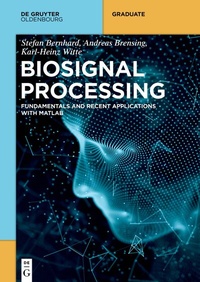
Biosignal Processing
Description

This book explains the principles of biosignal processing and its practical applications using MATLAB. Topics include the emergence of biosignals, electrophysiology, analog and digital biosignal processing, signal discretization, electrodes, time and frequency analysis, analog and digital filters, Fourier-transformation, z-transformation, pattern recognition, statistical data analysis, physiological modelling and applications of EEG, ECG, EMG, PCG and PPG signals. Additional scientifi c contributions on motion analysis by guest authors Prof. Dr. J. Subke and B. Schneider as well as classification of PPG signals by Dr. U. Hackstein.
More details
Other editions
Additional editions
Persons
Stefan Bernhard
is Professor for medical technology and extracorporeal systems at Technical University Mittelhessen. His research is focused on cardiovascular modelling and biosignal processing.
Andreas Brensing
is Professor for medical technology at RheinMain University of Applied Sciences. His research is focused on medical application of microwave technology and biosignal processing.
Karl-Heinz Witte
is Professor of transmission technology and was lecturer in biosignal processing at RheinMain University of Applied Sciences. His research is focused on biosignal processing and modeling.
Content
- Intro
- Foreword
- Contents
- Image credits
- 1 Introduction to Biosignal Processing
- 2 Fundamentals of Information, Signal and System Theory
- 3 Fundamentals of the Formation of Biosignals
- 4 Measurement of Biosignals and Analog Signal Processing
- 5 Methods for Discrete Processing and Analysis of Biosignals
- 6 Applications and Methods in Biosignal Processing
- 7 Appendix: Quantity- / Unit Symbols and Important Constants
- Bibliography
- Index
