

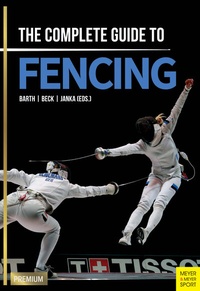
The Complete Guide to Fencing
2nd Edition
Published on 1. September 2017
412 pages
978-1-78255-776-0 (ISBN)
Description

This teaching and reference book covers the most important concepts of training theory in the sport of fencing and their methodological application. Supplemented by the general teaching methods and experiences of Germany's most successful trainers, findings, theories, and methods of training, science-oriented basic concepts are integrated here with application-oriented editing. Through the collaboration of internationally renowned scientists and long-time successful trainers, a fencing book was created that is unique in fencing literature.
From the Contents:
Essential information regarding terminology
Basic methods of fencing training
Youth training
Aspects of sports medicine in fencing
Foil fencing
Epée fencing
Saber fencing
International development trends in fencing
More details
Other editions
Additional editions
Berndt Barth | Claus Janka | Emil Beck
The Complete Guide to Fencing
Book
08/2017
2nd Edition
Meyer & Meyer Sport (UK) Ltd
€32.00
Shipment within 3-4 weeks
Persons
Dr. Berndt Barth headed the DFB's (German Fencing Federation) committee for education and training science, and served as the DFB's secretary general. His teaching activity at the Coaches Academy Cologne and the College of Sports Management in Potsdam, Germany, and being on the editorial board at the magazine Leistungssport, allow him to stay current on all the latest sports science research.
Claus Janka was a successful long-time association coach for the German Fencing Federation in former East Germany. He was a category A international umpire, served as president of the FIE's promotion committee and the FIE's Fencing Officials Commission.
Emil Beck passed away in 2006. Still, today, his name is considered a trademark in the world of fencing.
Content
- Cover
- Contents
- Preface by Prof. Dr. Lutz Nordmann
- Preface by the authors
- Introduction: Essential information regarding terminology
- 1 Divided like the country-the sport of fencing in post-1945 Germany
- 2 Performance structure, performance capacity, and performance development
- 2.1 Demand and performance structure by Prof. Dr. Berndt Barth
- 2.1.1 Demand profile and performance structure
- 2.1.2 Demand structure and training tasks
- 2.2 Basic pedagogic and psychological principals of fencing
- 2.2.1 Functional requirements in fencing and their psychological dimensions
- 2.2.2 Fundamentals and prerequisites for the development of psychological abilities and skills
- 2.2.2.1 The person-environment interrelation in fencing
- 2.2.2.2 Psychological abilities and skills (psychophysiological model)
- 2.2.2.3 Psychological impact factors
- 2.2.3 Methods for learning and stabilizing mental training programs
- 2.3 Fundamentals of fencing technique
- 2.3.1 Fencing technique characteristics
- 2.3.2 Technical requirements of a fencer
- 2.3.3 Technical-coordinative performance requisites
- 2.3.4 Fundamentals and teaching methods for technical training
- 2.3.5 Criteria and methods for technique analysis
- 2.4 Fundamentals of fencing strategy and tactics
- 2.4.1 Characteristics of strategy and tactics
- 2.4.2 Strategic tactical demands on a fencer
- 2.4.3 Prerequisites for strategic-tactical performance
- 2.4.4 Strategic-tactical training
- 2.4.5 Criteria and methods for the monitoring of strategic-tactical performance requirements and performances
- 2.5 Physical fitness requirements of a fencer
- 2.5.1 Characteristics of physical fitness
- 2.5.2 Endurance and endurance training
- 2.5.2.1 Basic endurance
- 2.5.2.2 Competition-specific endurance
- 2.5.3 Strength and strength training
- 2.5.3.1 Maximum strength and training for maximum strength
- 2.5.3.2 Power and power training
- 2.5.3.3 Strength endurance and strength endurance training
- 2.5.4 Speed and speed training
- 2.5.4.1 Basic speed
- 2.5.4.2 Complex speed
- 3 Basic methods of fencing training
- 3.1 Training goals, content, aids, methods, and forms of training organization
- 3.1.1 Exercises without a partner
- 3.1.2 Exercises on training devices
- 3.1.3 Partner exercises
- 3.1.4 Combative exercises
- 3.1.5 Schooling and training fights
- 3.1.5.1 Fights with technical goals
- 3.1.5.2 Fights with technical and tactical goals
- 3.1.5.3 Fights with tactical goals
- 3.2 Lesson with the trainer
- 3.2.1 Lesson goals and purposes
- 3.2.2 Lesson organization and design
- 3.2.3 Trainer's technique during lesson
- 3.3 "Tauberbischofsheim fencing lessons" as per the "Emil Beck System"
- 3.4 Basic orientation for fencing training
- 3.5 Competitions
- 3.6 Methodological steps for the development of a fencer's competitive skills
- 3.7 Training control
- 3.8 Warming up before training and competition
- 3.9 About the role of the trainer in the training process
- 4 Youth training
- 4.1 Basic information on youth training
- 4.2 Pedagogic-methodological recommendations for youth training
- 4.2.1 Practicing must be learned along with fencing
- 4.2.2 Pedagogic guidance and independence
- 4.2.3 Monitoring and evaluating as important learning actions
- 4.2.4 Monitoring and self-monitoring in training
- 4.3 The "Tauberbischofsheim model" for youth training in fencing
- 4.4 The children's trainer
- 5 Aspects of sports medicine in fencing
- 5.1 Healthy living
- 5.2 Toughening-up and increasing defense mechanisms
- 5.3 Nutrition
- 5.4 Heat stress and adapting to heat
- 5.5 Doping and doping control
- 5.6 Training, preconditions, and goals
- 5.7 Typical injuries and capacity overload damage in fencing
- 5.8 Long distance travel and immunization
- 5.9 Sports medical care and examination system
- 6 Foil fencing
- 6.1 Particularities of foil fencing
- 6.2 Select basic strategic elements
- 6.2.1 Basic attacks
- 6.2.1.1 Direct attacks
- 6.2.1.2 Disengagement attacks
- 6.2.1.3 Sweep attacks
- 6.2.2 Remise attacks
- 6.2.2.1 Direct remise attacks
- 6.2.2.2 Disengagement remise attacks
- 6.2.2.3 Sweep remise attacks
- 6.2.3 Parries
- 6.2.4 Ripostes
- 6.2.4.1 Direct ripostes
- 6.2.4.2 Disengagement ripostes
- 6.2.4.3 Sweep ripostes
- 6.2.5 Counter attacks
- 6.2.5.1 Counter attacks with gain in time
- 6.2.5.2 Displacement counter attacks
- 6.2.5.3 Stop hits
- 6.2.5.4 Esquives
- 6.2.6 Compound attacks
- 6.2.6.1 Feint attacks
- 6.2.6.2 Variations of the feint attack
- 6.2.6.2.1 Feint ripostes
- 6.2.6.2.2 Feint counter attacks
- 6.2.6.2.3 Remise attacks with feint
- 6.2.6.3 Attacks with second intention
- 7 Epée fencing
- 7.1 Particularities of épée fencing
- 7.2 Select basic strategic elements
- 7.2.1 Basic attacks
- 7.2.1.1 Direct attacks
- 7.2.1.2 Disengagement attacks
- 7.2.1.3 Sweep attacks
- 7.2.2 Remise attacks
- 7.2.3 Defensive actions and ripostes
- 7.2.3.1 Parries
- 7.2.3.2 Evasive actions
- 7.2.3.3 Ripostes
- 7.2.4 Feint attacks
- 7.2.5 Counter attacks
- 7.2.6 Attacks with second intention
- 7.2.7 Feint in time
- 7.2.8 Counter time
- 8 Saber fencing
- 8.1 Particularities of saber fencing
- 8.2 Select basic strategic elements
- 8.2.1 Attacks
- 8.2.1.1 Basic attacks
- 8.2.1.2 Long attack
- 8.2.1.3 Sweep attacks
- 8.2.1.4 Compound attacks
- 8.2.2 Parries
- 8.2.3 Counter attacks
- 8.2.3.1 Counter attack with gain in time
- 8.2.3.2 Stop hits
- 8.2.3.3 Displacement counter attacks/feint in time
- 8.2.3.4 Esquive counterattacks/"whip-over"
- 8.2.3.5 Sweep counter attacks/Prise de Fer
- 8.2.4 Second intention
- 8.2.5 Remise attacks
- 9 International development trends
- 9.1 Working to broaden the sport's base
- 9.2 Creating a modern, popular image of the sport
- 10 Presentation of the sport of fencing
- Appendix
- International successes of German fencers at the Olympic Games and World Championships (after 1945)
- References
- Authors
- Credits
