

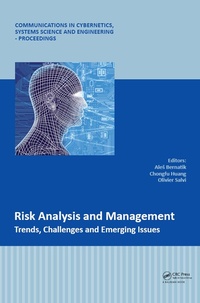
Risk Analysis and Management - Trends, Challenges and Emerging Issues
Proceedings of the 6th International Conference on Risk Analysis and Crisis Response (RACR 2017), June 5-9, 2017, Ostrava, Czech Republic
Published on 26. June 2017
316 pages
978-1-351-96686-3 (ISBN)
Description

This book collects the papers presented at the 6th International Conference on Risk Analysis and Crisis Response (RACR-2017) held in Ostrava/Prague, Czech Republic, on June 5-9, 2017, organized by VSB-Technical University of Ostrava, Czech Republic. The overall theme of the sixth international conference on risk analysis and crisis response is Risk Analysis and Management - Trends, Challenges and Emerging Issues, highlighting science and technology to improve risk analysis capabilities and to optimize crisis response strategy.
This book contains primarily research articles of risk issues. Underlying topics include natural hazards and major (chemical) accidents prevention, disaster risk reduction and society resilience, information and communication technologies safety and cybersecurity, modern trends in crisis management, energy and resources security, critical infrastructure, nanotechnology safety and others. All topics include aspects of multidisciplinarity and complexity of safety in education and research. The book should be valuable to professors, engineers, officials, businessmen and graduate students in risk analysis and risk management.
About the book series
Communications in Cybernetics, Systems Science and Engineering - Proceedings (CCSSEP) is a cross-disciplinary book series devoted to theoretical and applied research contributions, that cater to a rapidly growing worldwide interest in a cybernetic and systemic methodology with an ever-increasing capacity to deal with new challenges in a way that traditional science cannot. The series aims to become a comprehensive reference work on and guide to developments within the field and strategies required for better implementation of advances, with a view to environmental protection and sustainable social and economic development. The CCSSE series targets all working in theoretical and applied fields of cybernetics, systems science and engineering, e.g. academics, researchers and consultants, computer and information scientists, development and systems engineers, mathematicians, management cyberneticists and systemists, medical scientists, and intelligent and manufacturing engineers in industry, as well as leading decision- and policy-makers.
Series editor: Jeffrey 'Yi-Lin' Forrest
This book contains primarily research articles of risk issues. Underlying topics include natural hazards and major (chemical) accidents prevention, disaster risk reduction and society resilience, information and communication technologies safety and cybersecurity, modern trends in crisis management, energy and resources security, critical infrastructure, nanotechnology safety and others. All topics include aspects of multidisciplinarity and complexity of safety in education and research. The book should be valuable to professors, engineers, officials, businessmen and graduate students in risk analysis and risk management.
About the book series
Communications in Cybernetics, Systems Science and Engineering - Proceedings (CCSSEP) is a cross-disciplinary book series devoted to theoretical and applied research contributions, that cater to a rapidly growing worldwide interest in a cybernetic and systemic methodology with an ever-increasing capacity to deal with new challenges in a way that traditional science cannot. The series aims to become a comprehensive reference work on and guide to developments within the field and strategies required for better implementation of advances, with a view to environmental protection and sustainable social and economic development. The CCSSE series targets all working in theoretical and applied fields of cybernetics, systems science and engineering, e.g. academics, researchers and consultants, computer and information scientists, development and systems engineers, mathematicians, management cyberneticists and systemists, medical scientists, and intelligent and manufacturing engineers in industry, as well as leading decision- and policy-makers.
Series editor: Jeffrey 'Yi-Lin' Forrest
More details
Series
Language
English
Place of publication
London
United Kingdom
Publishing group
Taylor & Francis Ltd
Target group
College/higher education
Professional and scholarly
File size
33,07 MB
ISBN-13
978-1-351-96686-3 (9781351966863)
Copyright in bibliographic data and cover images is held by Nielsen Book Services Limited or by the publishers or by their respective licensors: all rights reserved.
Schweitzer Classification
Other editions
Additional editions
Ales Bernatik | Chongfu Huang | Olivier Salvi
Risk Analysis and Management - Trends, Challenges and Emerging Issues
Proceedings of the 6th International Conference on Risk Analysis and Crisis Response (RACR 2017), June 5-9, 2017, Ostrava, Czech Republic
Book
05/2017
1st Edition
CRC Press
€99.22
Article not available at the moment
Persons
Prof. Ales Bernatik, the Vice-Dean for international and social affairs of Faculty of Safety Engineering, VSB-Technical University of Ostrava, is a doctor in Methodology for Industrial Risk Assessment and graduated in Environmental Protection, professor in 2015. He has a great experience in risk analysis of industrial accidents, environmental consultancy at the Regional EIA Centre, and now is in charge of research and education in the area of major-accident prevention.
Prof. Chongfu Huang, President of Society for Risk Analysis - China, Editor-in-Chief of Journal of Risk Analysis and Crisis Response, is a full professor of Beijing Normal University. He received his Ph.D. in Applied Mathematics from Beijing Normal University in 1993. His significant contributions to society would be that he established Risk Analysis Council of China Association for Disaster Prevention in 2004, which is the unique academic organization authorized by the Chinese government for studying all risk issues.
Olivier Salvi graduated in 1994 as an engineer in Environment and Industrial Risks (Ecole des Mines d'Ales, France). He has been working at INERIS, the French National Institute in charge of industrial risk and environment protection from 1995 to 2013 as Programme Manager in the field of Risk Assessment and Management, then as Scientific Manager and finally as Business Development Manager. In 2013, he became the President of INERIS DEVELOPPEMENT SAS, the subsidiary company in charge of international business development.
Prof. Chongfu Huang, President of Society for Risk Analysis - China, Editor-in-Chief of Journal of Risk Analysis and Crisis Response, is a full professor of Beijing Normal University. He received his Ph.D. in Applied Mathematics from Beijing Normal University in 1993. His significant contributions to society would be that he established Risk Analysis Council of China Association for Disaster Prevention in 2004, which is the unique academic organization authorized by the Chinese government for studying all risk issues.
Olivier Salvi graduated in 1994 as an engineer in Environment and Industrial Risks (Ecole des Mines d'Ales, France). He has been working at INERIS, the French National Institute in charge of industrial risk and environment protection from 1995 to 2013 as Programme Manager in the field of Risk Assessment and Management, then as Scientific Manager and finally as Business Development Manager. In 2013, he became the President of INERIS DEVELOPPEMENT SAS, the subsidiary company in charge of international business development.
Content
Preface, Organisation, Sponsor, RACR, ARAMIS heritage, 10 years after the end of the project, Author index
