

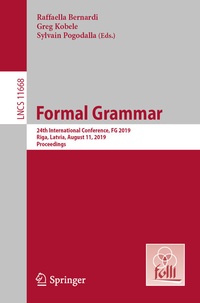
Formal Grammar
24th International Conference, FG 2019, Riga, Latvia, August 11, 2019, Proceedings
Published on 1. August 2019
IX, 117 pages
978-3-662-59648-7 (ISBN)
Description

Edited in collaboration with FoLLI, the Association of Logic, Language and Information, this book constitutes the refereed proceedings of the 24th International Conference on Formal Grammar, FG 2019, held in Riga, Latvia, in August 2019, in conjunction with the 31st European Summer School in Logic, Language and Information, ESSLI 2019.
The 7 full papers presented were carefully reviewed and selected from 11 submissions. They present new and original research on formal grammar, mathematical linguistics, and the application of formal and mathematical methods to the study of natural language and focus on topics such as formal and computational phonology, morphology, syntax, semantics, and pragmatics; model-theoretic and proof-theoretic methods in linguistics; logical aspects of linguistic structure; constraint-based and resource-sensitive approaches to grammar; learnability of formal grammar; integration of stochastic and symbolic models of grammar; foundational, methodological, and architectural issues in grammar and linguistics; and mathematical foundations of statistical approaches to linguistic analysis.
The 7 full papers presented were carefully reviewed and selected from 11 submissions. They present new and original research on formal grammar, mathematical linguistics, and the application of formal and mathematical methods to the study of natural language and focus on topics such as formal and computational phonology, morphology, syntax, semantics, and pragmatics; model-theoretic and proof-theoretic methods in linguistics; logical aspects of linguistic structure; constraint-based and resource-sensitive approaches to grammar; learnability of formal grammar; integration of stochastic and symbolic models of grammar; foundational, methodological, and architectural issues in grammar and linguistics; and mathematical foundations of statistical approaches to linguistic analysis.
More details
Other editions
Additional editions
Raffaella Bernardi | Greg Kobele | Sylvain Pogodalla
Formal Grammar
24th International Conference, FG 2019, Riga, Latvia, August 11, 2019, Proceedings
Book
07/2019
Springer
€53.49
Shipment within 7-9 days
Content
- Intro
- Preface
- Organization
- What Inductive Biases Enable Human-Like Syntactic Generalization? (Abstract of Invited Talk)
- Contents
- A Purely Surface-Oriented Approach to Handling Arabic Morphology
- 1 Introduction
- 2 Arabic Morphology: Theoretical and Computational Approaches
- 3 A Purely Surface-Oriented Approach
- 3.1 Glued Strings
- 3.2 Occurrence
- 3.3 Morphological Class
- 3.4 Discontinuity, Reduplication and Handlers
- 3.5 Morphs and Morphemes
- 4 Arabic Morphology Within the Proposed Framework
- 4.1 Root and Pattern Matching
- 4.2 Morphophonemic Alternations
- 5 Results and Future Work
- References
- A Topos-Based Approach to Building Language Ontologies*-12pt
- 1 Introduction
- 2 A Synopsis of Topos Theory
- 3 Building a Topos-Based Type System
- 3.1 From Montague's e to a Hierarchy of Types
- 3.2 From Type Hierarchy to an Ontology of Types
- 3.3 A Short Account of Dot Objects
- 4 Related Works and Future Perspectives
- References
- Structure Sensitive Tier Projection: Applications and Formal Properties
- 1 Introduction
- 2 Preliminaries
- 3 Structure-Sensitive TSL Languages
- 3.1 Strictly Local and Tier-Based Strictly Local Languages
- 3.2 Insufficiency of TSL
- 3.3 TSL as the Composition of Three Transductions
- 3.4 Input-Sensitive TSL
- 4 Formal Analysis
- 4.1 Relations to Other Subregular Classes
- 4.2 Closure Properties
- 5 Intersection Closure of TSL and ITSL
- 5.1 Intersection Closure of TSL Languages
- 5.2 Intersection Closure of ITSL Languages
- 6 Learnability Considerations
- 7 Conclusions
- References
- Quantificational Subordination as Anaphora to a Function
- 1 Introduction
- 2 Type-Theoretical Semantics
- 3 The Proposal
- 3.1 Syntax and Semantics
- 3.2 Derivations
- 4 Telescoping
- 4.1 Covert Subordination
- 4.2 Constraints
- 5 Comparison with TTS
- 6 Discussion and Future Work
- References
- Undecidability of a Newly Proposed Calculus for CatLog3
- 1 Introduction
- 2 The Calculus
- 3 The Bracket-Free System and the Projection
- 4 Undecidability Proof
- 5 Conclusion
- References
- Proof-Theoretic Aspects of Hybrid Type-Logical Grammars
- 1 Introduction
- 2 Natural Deduction
- 3 Normalisation
- 4 Proof Nets
- 4.1 Proof Structures
- 4.2 Abstract Proof Structures
- 4.3 Structural Rules and Contractions
- 5 Correctness of the Proof Net Calculus
- 6 Complexity
- 7 Conclusion
- References
- On the Computational Complexity of Head Movement and Affix Hopping
- 1 Introduction
- 2 MG Without Head Movement
- 2.1 Parsing with Succinct MG
- 3 MG with Head Movement
- 4 Improved Parsing of MG with Head Movement
- 5 ATB Head Movement
- 6 Affix Hopping
- 7 Conclusion
- References
- Author Index
