

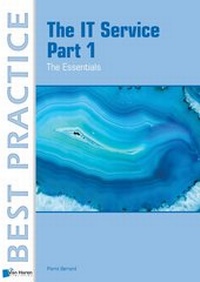
The IT Service Part 1 – The Essentials
The Essentials
1st Edition
Published on 30. June 2012
370 pages
978-90-8753-917-7 (ISBN)
Description

Make it Simple and Keep it Simple
Since the early 2000s numerous external scenarios and drivers have added significant pressures upon the IT organisations. Among many, these include:
Regulatory compliance: data privacy requirements and corporate scandals have focused a requirement for transparency - with high impact on IT organisations
Economic pressures: require IT organisations to more closely align with business imperatives.
The outcome has been an explosion of 'standards' and 'frameworks' each designed to support the IT organisation as it demonstrates to the world that they are the 'rock' of an organisation: strong, reliable, effective and efficient. Most of these standards and frameworks have great elements but no organisation can adopt them all - and many were created without sufficient considerations for interoperability.
The IT Service (in 2 parts) looks at the key and very simple goals of an IT organisation and clearly and succinctly presents to the reader the best 'rock solid' elements in the Industry. It then shows how all the key elements can easily 'crystallise' together -with great templates and check-lists.
In Part 1 (this book) the reader is presented with the simple objectives that the IT organisation really must address. The author uses his extensive expertise to present to the reader they key themes and processes that apply. In order to keep it simple the author strips down what appears to be complex standards into their basic components and demonstrates to the reader that these components are actually common sense. The author's independence means that the reader doesn't get one view of one or two approaches - every aspect of the IT service is considered and presented to create a unique holistic view of the basic building blocks of a 'rock solid' IT department. Topics included are:
Designing The Service
Management Of Risks
Transitioning The Service
Managing The Service Day-To-Day
Improvement Efforts
Upcoming Trends
N.B.: In Part 2 (another book) the reader gains expert advice on how the components of IT Service are 'crystallised' in a real environment.
More details
Other editions
Additional editions
Book
06/2012
Van Haren Publishing BV
€67.90
Shipment within 10-15 days
Content
1 - Colophon [Seite 5]
2 - Foreword [Seite 6]
3 - Acknowledgements [Seite 8]
4 - Preface [Seite 10]
5 - 1 Introduction [Seite 20]
5.1 - The Island of no services [Seite 22]
5.2 - Now, for some concepts. [Seite 23]
5.3 - Does value mean quality? [Seite 26]
6 - 2 The case study [Seite 28]
6.1 - Meet our case study - "THE ORGANISATION" [Seite 28]
6.2 - Example 2.1 - The vision, mission, goals and objectives [Seite 29]
6.3 - Example 2.2 - Funding the organisation's goals and objectives [Seite 30]
6.4 - Example 2.3 - A message from the CEO [Seite 31]
6.5 - Example 2.4 - Communication [Seite 32]
6.6 - Example 2.5 - The issues for the IT organisation [Seite 33]
6.7 - Example 2.6 - Impact on the suppliers of the IT organisation [Seite 36]
7 - 3 The strategy [Seite 38]
7.1 - Introduction [Seite 38]
7.2 - Communication [Seite 41]
7.3 - Generating the strategy [Seite 46]
7.4 - Financial management [Seite 47]
7.5 - About the financial management process model [Seite 61]
7.6 - Demand management [Seite 63]
7.7 - Business outcomes [Seite 71]
7.8 - Executives, partners and empowerment [Seite 71]
7.9 - Strategy and the IT organisation [Seite 78]
7.10 - Measuring and demonstrating the value of IT [Seite 82]
7.11 - The approach: project vs. change [Seite 86]
7.12 - What it means for our case study [Seite 94]
8 - 4 Understanding value creation [Seite 100]
8.1 - Introduction [Seite 100]
8.2 - Best practice vs. Good practice vs. Proven practice [Seite 101]
8.3 - A product IT a component of a service [Seite 110]
8.4 - What IT means for our case study [Seite 112]
9 - 5 Service components [Seite 118]
9.1 - Introduction [Seite 118]
9.2 - Types of services [Seite 118]
9.3 - Utility and warranty [Seite 123]
9.4 - About resources and capabilities [Seite 126]
9.5 - Tying utility to value, outcomes, costs and risks [Seite 131]
9.6 - Tying warranty to value, outcome, costs and risks [Seite 142]
9.7 - What this chapter means for our case study [Seite 148]
10 - 6 Aspects of service design [Seite 154]
10.1 - Introduction [Seite 154]
10.2 - Resources and capabilities revisited [Seite 155]
10.3 - Five domains to consider when designing services [Seite 163]
10.4 - Aspects of designing a service - the service solutions [Seite 173]
10.5 - The service portfolio vs. The service catalogue [Seite 176]
10.6 - More on the service model [Seite 194]
10.7 - Service management tools [Seite 197]
10.8 - About technology architectures [Seite 206]
10.9 - Overall process management activities [Seite 209]
10.10 - Generic process model [Seite 211]
10.11 - Using suppliers [Seite 223]
10.12 - About agreements [Seite 228]
10.13 - What it means for our case study [Seite 232]
11 - 7 Service examples [Seite 242]
11.1 - Introduction [Seite 242]
11.2 - Service classification [Seite 243]
11.3 - Practical service examples in today's world [Seite 248]
11.4 - What it means for our case study [Seite 261]
12 - 8 Management of risks [Seite 266]
12.1 - Introduction [Seite 266]
12.2 - The open group: Technical standard for managing risks [Seite 266]
12.3 - M_o_R: The principles of risk management [Seite 269]
12.4 - M_o_R: Management of risk [Seite 271]
12.5 - Methods and techniques used to gather risk information [Seite 272]
12.6 - What it means for our case study [Seite 281]
13 - 9 Transitioning the service [Seite 288]
13.1 - Introduction [Seite 288]
13.2 - The transition approach [Seite 289]
13.3 - What it means for our case study [Seite 292]
14 - 10 Managing the service day-to-day [Seite 300]
14.1 - Introduction [Seite 300]
14.2 - Fundamentals of service operation [Seite 302]
14.3 - Processes within service operation [Seite 302]
14.4 - Functions within service operation [Seite 304]
15 - 11 Improvement efforts [Seite 306]
15.1 - Introduction [Seite 306]
15.2 - About continual improvement [Seite 307]
15.3 - Retiring the previous version of the service [Seite 309]
15.4 - What it means for our case study [Seite 310]
16 - 12 Making the case study more real [Seite 314]
16.1 - Introduction [Seite 314]
16.2 - What it means for our case study [Seite 321]
17 - 13 Upcoming and already ongoing trends [Seite 326]
17.1 - Introduction [Seite 326]
17.2 - Cloud computing services [Seite 327]
17.3 - Social media [Seite 328]
17.4 - Smartphones [Seite 329]
17.5 - Tablet technology [Seite 329]
17.6 - The ABC of ICTT [Seite 330]
17.7 - Summary [Seite 331]
18 - Appendices [Seite 338]
18.1 - A References [Seite 340]
18.1.1 - ITIL books [Seite 340]
18.1.2 - Other titles suggested by the author [Seite 340]
18.2 - B Some complementary frameworks, methodologies and standards [Seite 342]
18.3 - C Frameworks and methodologies for ITSM [Seite 344]
18.4 - D List of all ITIL processes and functions [Seite 346]
18.5 - E Summary of what ITIL is [Seite 348]
18.6 - F Appendix F - Architecture frameworks [Seite 350]
19 - List of tables [Seite 352]
20 - List of figures [Seite 354]
21 - List of examples for "the organisation" [Seite 356]
22 - End notes [Seite 358]
2 - Foreword [Seite 6]
3 - Acknowledgements [Seite 8]
4 - Preface [Seite 10]
5 - 1 Introduction [Seite 20]
5.1 - The Island of no services [Seite 22]
5.2 - Now, for some concepts. [Seite 23]
5.3 - Does value mean quality? [Seite 26]
6 - 2 The case study [Seite 28]
6.1 - Meet our case study - "THE ORGANISATION" [Seite 28]
6.2 - Example 2.1 - The vision, mission, goals and objectives [Seite 29]
6.3 - Example 2.2 - Funding the organisation's goals and objectives [Seite 30]
6.4 - Example 2.3 - A message from the CEO [Seite 31]
6.5 - Example 2.4 - Communication [Seite 32]
6.6 - Example 2.5 - The issues for the IT organisation [Seite 33]
6.7 - Example 2.6 - Impact on the suppliers of the IT organisation [Seite 36]
7 - 3 The strategy [Seite 38]
7.1 - Introduction [Seite 38]
7.2 - Communication [Seite 41]
7.3 - Generating the strategy [Seite 46]
7.4 - Financial management [Seite 47]
7.5 - About the financial management process model [Seite 61]
7.6 - Demand management [Seite 63]
7.7 - Business outcomes [Seite 71]
7.8 - Executives, partners and empowerment [Seite 71]
7.9 - Strategy and the IT organisation [Seite 78]
7.10 - Measuring and demonstrating the value of IT [Seite 82]
7.11 - The approach: project vs. change [Seite 86]
7.12 - What it means for our case study [Seite 94]
8 - 4 Understanding value creation [Seite 100]
8.1 - Introduction [Seite 100]
8.2 - Best practice vs. Good practice vs. Proven practice [Seite 101]
8.3 - A product IT a component of a service [Seite 110]
8.4 - What IT means for our case study [Seite 112]
9 - 5 Service components [Seite 118]
9.1 - Introduction [Seite 118]
9.2 - Types of services [Seite 118]
9.3 - Utility and warranty [Seite 123]
9.4 - About resources and capabilities [Seite 126]
9.5 - Tying utility to value, outcomes, costs and risks [Seite 131]
9.6 - Tying warranty to value, outcome, costs and risks [Seite 142]
9.7 - What this chapter means for our case study [Seite 148]
10 - 6 Aspects of service design [Seite 154]
10.1 - Introduction [Seite 154]
10.2 - Resources and capabilities revisited [Seite 155]
10.3 - Five domains to consider when designing services [Seite 163]
10.4 - Aspects of designing a service - the service solutions [Seite 173]
10.5 - The service portfolio vs. The service catalogue [Seite 176]
10.6 - More on the service model [Seite 194]
10.7 - Service management tools [Seite 197]
10.8 - About technology architectures [Seite 206]
10.9 - Overall process management activities [Seite 209]
10.10 - Generic process model [Seite 211]
10.11 - Using suppliers [Seite 223]
10.12 - About agreements [Seite 228]
10.13 - What it means for our case study [Seite 232]
11 - 7 Service examples [Seite 242]
11.1 - Introduction [Seite 242]
11.2 - Service classification [Seite 243]
11.3 - Practical service examples in today's world [Seite 248]
11.4 - What it means for our case study [Seite 261]
12 - 8 Management of risks [Seite 266]
12.1 - Introduction [Seite 266]
12.2 - The open group: Technical standard for managing risks [Seite 266]
12.3 - M_o_R: The principles of risk management [Seite 269]
12.4 - M_o_R: Management of risk [Seite 271]
12.5 - Methods and techniques used to gather risk information [Seite 272]
12.6 - What it means for our case study [Seite 281]
13 - 9 Transitioning the service [Seite 288]
13.1 - Introduction [Seite 288]
13.2 - The transition approach [Seite 289]
13.3 - What it means for our case study [Seite 292]
14 - 10 Managing the service day-to-day [Seite 300]
14.1 - Introduction [Seite 300]
14.2 - Fundamentals of service operation [Seite 302]
14.3 - Processes within service operation [Seite 302]
14.4 - Functions within service operation [Seite 304]
15 - 11 Improvement efforts [Seite 306]
15.1 - Introduction [Seite 306]
15.2 - About continual improvement [Seite 307]
15.3 - Retiring the previous version of the service [Seite 309]
15.4 - What it means for our case study [Seite 310]
16 - 12 Making the case study more real [Seite 314]
16.1 - Introduction [Seite 314]
16.2 - What it means for our case study [Seite 321]
17 - 13 Upcoming and already ongoing trends [Seite 326]
17.1 - Introduction [Seite 326]
17.2 - Cloud computing services [Seite 327]
17.3 - Social media [Seite 328]
17.4 - Smartphones [Seite 329]
17.5 - Tablet technology [Seite 329]
17.6 - The ABC of ICTT [Seite 330]
17.7 - Summary [Seite 331]
18 - Appendices [Seite 338]
18.1 - A References [Seite 340]
18.1.1 - ITIL books [Seite 340]
18.1.2 - Other titles suggested by the author [Seite 340]
18.2 - B Some complementary frameworks, methodologies and standards [Seite 342]
18.3 - C Frameworks and methodologies for ITSM [Seite 344]
18.4 - D List of all ITIL processes and functions [Seite 346]
18.5 - E Summary of what ITIL is [Seite 348]
18.6 - F Appendix F - Architecture frameworks [Seite 350]
19 - List of tables [Seite 352]
20 - List of figures [Seite 354]
21 - List of examples for "the organisation" [Seite 356]
22 - End notes [Seite 358]
