

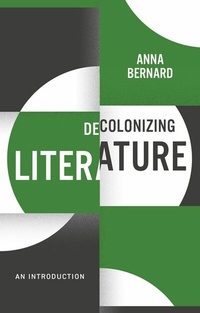
Decolonizing Literature
Description

Anna Bernard argues that the decolonization of literary studies requires a change to not only what, but how, we read. In lively prose, she explores work that has already been done, both within and beyond the academy, and challenges readers to think about where we go from here. She suggests ways to recognize and respond to the political work that texts do, considering questions of language and translation, comparative reading, ideological argument, and genre in relation to the history of anticolonial struggle. Above all, Bernard shows that although we still have far to go, the work of decolonizing literary studies is already under way.
Decolonizing Literature is a must-have resource for all those concerned by the development and future of the field.
More details
Other editions
Additional editions
Person
Content
Introduction
1 Decolonization and Literature: A History
2 Unfinished Business: How Do We Decolonize Literature?
3 Language and Translation: What Is 'English' Literature?
4 'A Comparative Literature of Imperialism': Reading Colonial and Anticolonial Texts Together
5 Telling a Collective Story: Literature and Anticolonial Struggle
6 Decolonizing Genre: Anticolonial Understandings of Literary Craft
Conclusion
Notes
Bibliography
Index
Introduction
Decolonization must offer a language of possibility, a way out of colonialism.
Linda Tuhiwai Smith (2012 [1999])
Decolonising the curriculum is a hot topic now, so for now, we have the moment. The moment is ours if we hold our nerve, but if we falter, the moment is lost, as are we.
Foluke Adebisi (2019)
In April 2015, after a month of demonstrations, the University of Cape Town gave in to its students' demands and removed a statue of the British colonial administrator Cecil Rhodes from the campus. The visibility and success of this campaign - which also took place online, using the hashtag #RhodesMustFall - inspired student activists across South Africa and beyond, including at the University of Oxford, where students began a similarly high-profile campaign to remove another Rhodes statue from Oriel College. As Achille Mbembe observed at the time, the UCT activists focused on the Rhodes statue as an emblem of the racist violence and destructiveness of British colonial rule:
Cecil Rhodes belonged to the race of men who were convinced that to be black is a liability. During his time and life in Southern Africa, he used his considerable power - political and financial - to make black people all over Southern Africa pay a bloody price for his beliefs. . [B]ringing Rhodes' statue down is one of the many legitimate ways in which we can, today in South Africa, demythologize that history and put it to rest. (2015, pp. 2-3)
Mbembe, like the student activists and the contemporary Black Lives Matter movement, is making the point that statues, street names, and commemorative plaques are not innocuous traces of a long-vanished empire. They represent a system of institutionalized white supremacy that took hold during centuries of European colonial rule in Africa, Asia, and the Americas and that continues to structure our economic, social, political, and cultural lives. These movements are united in their belief that the removal of such symbols is only the first step in a much longer and more difficult process of decolonization, which demands that the formal and informal structures that maintain the dominance of the former colonial powers and the prestige of whiteness are abolished, wherever they are found.
The recent student movements have also called for the decolonization of the curriculum, which is a key form in which colonial structures of thought are perpetuated in universities. While this means different things in different disciplines, there is a broad consensus among the students and teachers who are involved in this effort that, in order to begin to decolonize our curricula, we must identify and undo the colonial ideas and assumptions that underpin our fields. This means uncovering the colonial history of our disciplines and confronting the Eurocentrism of our methodologies, objects of study, citation practices, programme structures, and syllabi. Literature students have been some of the most vocal participants in these campaigns. These students' demands are not limited to the inclusion of more Black, Brown, Indigenous, women, LGBTQ+, disabled, and working-class authors on their reading lists; they also seek fundamental changes to how literature students are taught to read and what they are encouraged to value. As Cambridge English students put it in an open letter to their faculty, this 'means challenging the pervasive notion that reading texts in the light of gender, race, ability, class and so on is to crush them under the weight of subjectivity, dismantling the idea that white and male is the norm, unmarked by identity' (Fly Cambridge, 2017).
Decolonizing Literature takes its cue from such interventions, arguing that the decolonization of literary studies requires a change to not only what, but how, we read. Along with the decentring of historically dominant perspectives, this might mean a renewed attention to authors' efforts to document socio-economic conditions or persuade the reader of a particular point of view; a broader definition of literary experimentation, beyond its tacit identification with Western modernism and postmodernism; more developed strategies for reading texts in translation or in postcolonial and regional versions of European imperial languages; and more in-depth analysis of works that explicitly align themselves with anticolonial political movements or seek to imagine genuinely postcolonial futures. This book offers literature students and educators some suggestions for beginning to read in these ways, and thus to unlearn the still prevalent belief that a text's aesthetic properties can be considered separately from its politics (Jameson, 1986; Bernard, 2013, pp. 22-8).
Literature is already a high-profile site of debate about disciplinary decolonization, and some important gains have been made in the last few decades. This is due mainly to the influence of postcolonial studies, which gained an institutional footing in English literature departments in the 1980s and 1990s, as I discuss in chapter 1. Scholars aligned with this field set out to expose the imperial foundations of the idea of 'English literature' and to demonstrate its historical role in legitimizing the British empire. They also sought to remake the English literary canon by turning to texts written in English by authors from former British colonies and from metropolitan ethnic minority backgrounds. (By 'metropolitan', I mean countries that were imperial centres and still command disproportionate wealth and power, such as Britain and France, or the United States, whose ongoing global dominance means it is better described as a neo-imperial centre.) Over time, this challenge to the traditional canon has expanded to include literature in translation from other languages and from the rest of the formerly colonized world, including the Middle East/North Africa and Latin America, leading to postcolonial literature's reformulation as 'world literature' and increasingly blurring the lines between English departments and departments of comparative literature and modern languages. Meanwhile, similar attempts to interrogate the origins of the discipline and tackle its Eurocentrism have taken place in European literature studies, particularly in French departments, and in Black, Asian (especially Asian-American), Latinx, and Indigenous studies.
These efforts to diversify and decentre the canon have been moderately successful. As Neil Lazarus argued two decades ago, '[t]oday courses in post-1945 "English" literature that ignore "minority" or "postcolonial" writers and the issues of decolonization, migration, and diaspora are simply anachronistic' (2004, p. 14). In metropolitan anglophone universities, there are now very few literature departments that do not include at least one specialist in postcolonial or world literature, and most literature students will encounter some work by non-European or metropolitan ethnic minority writers and be encouraged to read canonical texts in relation to the history of empire. In some institutions, particularly in the United States, this transformation has gone even further, so that, in the post-1945 curriculum, modules that focus on texts by writers of colour, women, and/or queer writers are now in the majority. (For more discussion of current trends in university English literature teaching, see chapter 2.) But this does not mean that literary studies has been decolonized. Conventional historical periodization and 'great authors' courses continue to underpin the curriculum in many departments, even those with more diverse post-1945 coverage. Domestic ethnic minority writing is also far better represented in most English departments than writing from the rest of the world, which tends to be reserved for the fewer, smaller, and less well-resourced comparative literature and modern languages departments. Moreover, despite increased attention to the relationship between literature and political movements, modules that use words such as 'justice', 'protest', 'solidarity', or 'decolonization' in their titles or descriptions remain rare in comparison to modules organized according to group identity (African-American writing, Australian Indigenous writing, etc.). The limitations of such reforms have led scholars such as Claire Westall (2015, p. 18) to argue that postcolonial criticism allowed the wider discipline of literary studies to rehabilitate itself as a post-imperial and multicultural discipline simply by incorporating a restricted amount of 'new' material, without having to significantly change the makeup of the 'core' canon or the assumptions brought to bear on literary texts (see also Etherington and Zimbler, 2021, p. 228).
As Kavita Bhanot reminds us, such 'quick-fixes to the "diversity" problem . ensur[e] that literature remains in the same circles of power, within one class and caste . [W]hite literature is held up as the "real" literature that we all need to aspire towards' (2015). Bhanot is referring to the treatment of British Black and Asian writers in the British publishing industry, but her critique also applies to university literature education and research. Like the removal of the Rhodes statues, diversification of our reading lists is the start of decolonizing our discipline, not its end point. Indeed, to describe this work as decolonizing is to name decolonization as an...
