

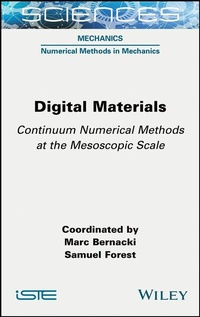
Digital Materials
Description

Digital materials are integral to the modern design methods for industrial components and structures, allowing mechanical properties to be predicted from a description of the microstructure and behavior laws of the constituent parts.
This book examines a wide range of material properties, from transport phenomena to the mechanics of materials and microstructure changes in physical metallurgy. The fundamental mechanisms of deformation, annealing and damage to materials involve complex atomic processes; these have been explored and studied by numerical simulations, such as molecular dynamics.
In contrast to this minutely detailed approach, Digital Materials explores how these mechanisms can instead be integrated into an approach that considers the continuum of the physics and mechanics of materials at the mesoscopic scale. The book thus focuses on the mechanics of continuous media and the continuum thermodynamics of irreversible processes. The models displayed take the myriad properties of different materials into account, in particular their polycrystalline and/or composite natures; this becomes an intermediate step toward establishing effective laws for engineers in the processes of structure calculation and manufacturing.
More details
Other editions
Additional editions
Persons
Marc Bernacki is Professor of Physical and Computational Metallurgy at MINES Paris PSL, France. He leads the DIGIMU consortium, which develops new numerical methods for modeling microstructure evolutions in the context of metal forming and their applications.
Samuel Forest is Research Director at the CNRS, Professor of Continuum Mechanics at MINES Paris PSL, France, and a member of the French Academy of Sciences. His work focuses on modeling and simulation in the mechanics of materials.
Content
Preface ix
Marc BERNACKI and Samuel FOREST
Chapter 1 Dislocation-based Mechanics: The Various Contributions of Dislocation Dynamics Simulations 1
Sylvain QUEYREAU
1.1. Introduction 1
1.2. Overview of discrete dislocation dynamics 2
1.2.1. Initial configurations and periodic boundary conditions 4
1.2.2. Mobility functions 5
1.2.3. Forces on dislocations 7
1.2.4. Topological changes 11
1.2.5. Boundary conditions 12
1.3. Mesoscale plasticity 15
1.3.1. Forest interactions 17
1.3.2. Statistical investigations of dislocation mechanisms 23
1.3.3. Lattice friction 29
1.3.4. Combination of multiple strengthening mechanisms 32
1.3.5. Toward polycrystalline plasticity 33
1.3.6. Cyclic deformations 40
1.4. Conclusion and future work 43
1.5. Acknowledgments 44
1.6. References 44
Chapter 2 Statistical Approach to the Representative Volume Element Size of Random Composites 55
Dominique JEULIN and Samuel FOREST
2.1. Introduction 55
2.2. Elements of numerical homogenization of heterogeneous media 56
2.2.1. Examples of physical properties of heterogeneous media 56
2.2.2. Change of scale in heterogeneous media 57
2.2.3. Principle of calculation of apparent properties 58
2.2.4. Homogenization of random media by numerical simulations 63
2.3. Statistical definition of the RVE 64
2.3.1. Variance of estimation and integral range 65
2.3.2. Definition of the statistical RVE of apparent properties 67
2.3.3. Practical determination of the size of the RVE 69
2.3.4. Scaling of the bias, or systematic error 70
2.3.5. Determination of the size of the RVE in the nonlinear case 72
2.3.6. Remarks on the reduction of variance 73
2.4. Examples of application 73
2.4.1. Linear elastic properties and thermal conductivity 74
2.4.2. Elastic and viscoelastic properties of nanocomposites 89
2.4.3. Optical properties of nanocomposites 90
2.4.4. Fluid flow and permeability 94
2.4.5. Acoustic properties and wave propagation in fibrous media 95
2.4.6. Nonlinear properties 97
2.5. Conclusion 104
2.6. References 105
Chapter 3 Analytical Micromechanical Methods for Elasto-Viscoplastic Composites and Polycrystals 113
Stéphane BERBENNI and Samuel FOREST
3.1. Introduction 113
3.2. Translated field method 116
3.2.1. Field equations and integral equation 116
3.2.2. TF-based method: theoretical foundations 118
3.2.3. TF method for elasto-viscoplastic two-phase composite materials 119
3.2.4. TF method for elasto-viscoplastic polycrystals using the SC scheme 125
3.3. The ß-model dynasty for multiphase elastoviscoplastic polycrystals 127
3.4. Applications of the analytical micromechanical methods 131
3.4.1. Applications of the TF method to composites and polycrystals 131
3.4.2. Applications of ß-models to elastoviscoplastic polycrystals at finite deformations 141
3.5. Concluding remarks 147
3.6. References 148
Chapter 4 Vertex and Front-Tracking Methods for the Modeling of Microstructure Evolution at the Solid State 155
Marc BERNACKI
4.1. Introduction 155
4.2. Vertex frameworks 156
4.3. From Vertex to front-tracking then to enriched Vertex frameworks 160
4.4. Enrichment of the Vertex approach 163
4.5. Other front-tracking frameworks for the modeling of microstructure evolution 169
4.6. Conclusion 173
4.7. References 173
Chapter 5 Phase Field: Theory, Numerical Implementation and Applications 177
Ingo STEINBACH and Oleg SHCHYGLO
5.1. Introduction 177
5.2. The soliton solution of a propagating wave front 179
5.3. Thermodynamically consistent derivation of the phase-field equations 183
5.4. The multi-phase fields approach 184
5.5. Multi-component alloy transformation 187
5.6. Multi-phase field with elasticity 191
5.7. Numerical treatment and applications 192
5.8. Examples 193
5.8.1. Martensitic transformation 193
5.8.2. Recrystallization and coarsening 194
5.8.3. Multicomponent solidification 198
5.9. References 199
Chapter 6 Level-Set Method for the Modeling of Microstructure Evolution 203
Marc BERNACKI
6.1. Introduction 203
6.2. Kinetics equations of microstructure evolution at the mesoscopic scale 205
6.3. Level-set function, description of polycrystal and meshing adaptation 208
6.4. Isotropic framework for LS modeling of ReX and GG 213
6.5. Anisotropy of GB properties and CDRX modeling 218
6.5.1. LS formulations in context of anisotropic GB properties 218
6.5.2. CDRX modeling 225
6.6. Static/evolutive SPPs 228
6.7. Modeling of diffusive solid-state phase transformation 235
6.8. Solute drag aspect 243
6.9. Conclusion 246
6.10. References 248
Chapter 7 Resolution Methods for Digital Materials - Recent Developments of Cellular Automaton Method 261
Lukasz MADEJ and Mateusz SITKO
7.1. Introduction 261
7.2. Cellular automaton and applications 262
7.3. CA front tracking model within the static recrystallization case study 268
7.4. Calculation times and perspectives 281
7.5. References 284
List of Authors 291
Index 293
Preface
Marc BERNACKI1 and Samuel FOREST2
1CNRS UMR 7635, Centre for Material Forming (CEMEF), MINES Paris, PSL Research University, Sophia Antipolis, France
2CNRS UMR 7633, Centre des Matériaux, MINES Paris, PSL Research University, Evry, France
Digital materials have now become an integral part of design methods for industrial components and structures. Their mechanical properties can be predicted from a description of the microstructure and behavior laws of the constituents. This topic is now well established through the concept of integrated computational materials engineering (ICME).
This book covers a wide range of material properties from transport phenomena to the mechanics of materials and microstructure changes in physical metallurgy. It is not, however, an exhaustive review of numerical simulation methods for these phenomena, but rather a current look at the continuum simulation of elasticity, viscoplasticity, phase changes and grain boundary migration in metals, alloys and composites.
The elementary mechanisms of deformation and damage in materials involve complex atomic processes, which are now well explored by appropriate numerical simulations such as molecular dynamics. In contrast, this book shows how these mechanisms can be integrated into a continuum approach to the physics and mechanics of materials at the mesoscopic scale. It therefore focuses on the mechanics of continuous media and the continuum thermodynamics of irreversible processes. These models take into account the heterogeneities of materials, namely, their polycrystalline and/or composite nature, and constitute an intermediate step toward the establishment of effective laws for engineers in the calculation of structures and manufacturing processes.
The scientific topics selected in the book focus on the homogenization theory developed for periodic or random composite materials. The mean field approach is based on an idealization of the microstructure and provides estimates of the mean stresses and strains in the various phases present. These models can be fed by the full-field approach, where the representative elementary volume is the key concept. Plasticity is also given a significant place in this book, particularly at the grain scale, thanks to crystal plasticity in its discrete form, namely, the dynamics of dislocations, or its continuous form, which evaluates the quantities of slip and strain hardening associated with each slip system. Another strong point is the treatment of moving surfaces within the microstructure of materials, whether for phase changes, grain boundary migration and recrystallization. Statistical methods are used extensively to take account of the random nature of the distribution of constituents, dislocations and cracks, and also to exploit the large volumes of data produced by these simulations.
The book is structured into two parts. The first three chapters are devoted to mean-field and full-field approaches to establish the constitutive laws of elastoviscoplastic heterogeneous materials. The next four chapters focus on the numerical simulation of microstructure evolution, with particular attention paid to the modeling of the motion of interfaces (grain boundaries, moving interfaces for phase changes, etc.) and a whole range of numerical front-tracking or front-capturing methods that are now well established or in full development.
The first chapter is a summary presentation by Sylvain Queyreau of the methods and results of discrete dislocation dynamics (DDD) simulations. It begins with a description of the simulation technique, which is based on the elastic theory of dislocations in crystals, as well as on information relating to the core of dislocations and dislocation interaction rules derived from molecular dynamics analyses and microscopic observations. The method is capable of making predictions about the behavior of the single crystal, in particular the strain hardening laws. Recent developments address the response of polycrystals to complex loading, particularly cyclic loading conditions.
In the second chapter, Dominique Jeulin immediately places the question of the representative volume element (RVE) at the heart of the debate on the construction of the effective behavior of heterogeneous materials. He promotes statistical analysis of the morphology of phase distribution within the microstructure and the construction of random morphological models on which to base simulations of physical and mechanical properties. He proposes a precise statistical definition of the size of the RVE according to the precision required for the targeted property estimates. It emphasizes the biases associated with the choice of boundary conditions applied to the boundaries of the domain and stresses the importance of the concept of integral range for the definition of the RVE. The approach is highly effective for predicting linear material properties such as thermal and electrical conductivity, permeability and elasticity, but also acoustics and wave propagation. The statistical definition of the RVE, initially developed for linear properties, is extended here to the nonlinear case by using the space average of the local energy. Finally, the approach is heuristically extended to the elastoplastic behavior of heterogeneous materials, in particular metallic polycrystals and porous media.
The micromechanics of materials is addressed in Chapter 3 within the framework of the mean field approach. In a discipline whose history, outlined in the introduction, has been particularly rich over the last 60 years, the chapter focuses on the thorny issue of homogenization in the case of elastoviscoplastic behavior of the phases involved. The translated field method is highlighted and compared with other models available in the literature. It is first applied to the case of two-phase composites and then to metallic polycrystals. The second part of the chapter concerns the pragmatic approach developed by Cailletaud and Pilvin, which has proven its worth in the prediction of complex loading paths, particularly cyclic loading. It is extended here to the case of large deformations of metallic polycrystals in order to predict the evolution of the crystallographic texture and internal stresses for different deformation paths encountered particularly during metal forming.
The second part of the book, devoted to the simulation of evolving microstructures during thermomechanical treatments, begins with a presentation of the Vertex method in Chapter 4. The migration of grain boundaries and the growth of new grains are modeled by tracking grain boundaries, triple lines and vertices whose movements are dictated by surface energy, grain boundary curvature and, possibly, the energy stored in the grains in the form of dislocation densities assumed homogeneous per grain. Topological changes in the microstructure represent a major challenge in the tracking of these geometric objects within representative elementary volumes. Robust methods are now available and have proved their worth in simulating numerous metallurgical phenomena such as dynamic recrystallization or grain growth with second-phase particles and anisotropic properties of grain boundaries.
Predicting microstructural evolution during complex transformation processes, including mechanical, thermal and metallurgical aspects, is now possible thanks to the thermodynamics of continuous media and irreversible processes. This energy-based approach combines mechanical contributions (elasticity, viscoplasticity and strain hardening), chemical contributions (multi-constituent diffusion) and phase changes (oxidation, diffusive and displacive transformations). Electromagnetic coupling is also possible. The implementation of this holistic modeling is enhanced by the phase field method, which enables the kinetics and dynamics of interface motion to be calculated by formulating coupled free energy potentials and substituting diffuse interfaces for ideal surfaces. This is the subject of Chapter 5 by Ingo Steinbach and Oleg Schchyglo. The theoretical part of the chapter presents the multi-phase and multi-component formulation, which enables realistic alloy compositions to be addressed and the evolution of phase diagrams to be taken into account in detail. The phase field method excels in predicting changes in phase morphology, both coalescence and separation, but is often unsuitable for nucleation processes. Illustrations concern multi-component solidification, martensitic transformation and recrystallization phenomena.
The level-set method is described in Chapter 6 for applications to diffusive phase transformations (Oswald ripening and precipitate coalescence), grain growth and static or dynamic recrystallization in polycrystals. The driving pressures for interface migration are described in detail, as is the finite element numerical implementation. The crucial ingredient of the underlying model is the interface mobility law linking its velocity to the driving pressures of curvature and the stored energy jump in the case of recrystallization, or the Gibbs free energy jump in the case of diffusive phase changes. The technical subtleties of implementing these methods in finite element codes are explained, and the applications concern both 2D and 3D simulations, with original methods for meshing grain boundaries and interfaces. Once again, particular attention is paid to the treatment of multiple junctions. Large-scale computations of polycrystalline aggregates are used to study the influence of grain boundary types on their growth in relation to the anisotropy of surface energies.
The last chapter...
