

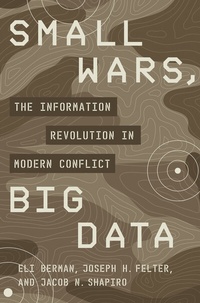
Small Wars, Big Data
The Information Revolution in Modern Conflict
1st Edition
Published on 21. August 2018
408 pages
978-1-4008-9011-8 (ISBN)
Description

How a new understanding of warfare can help the military fight today's conflicts more effectively
The way wars are fought has changed starkly over the past sixty years. International military campaigns used to play out between large armies at central fronts. Today's conflicts find major powers facing rebel insurgencies that deploy elusive methods, from improvised explosives to terrorist attacks. Small Wars, Big Data presents a transformative understanding of these contemporary confrontations and how they should be fought. The authors show that a revolution in the study of conflict--enabled by vast data, rich qualitative evidence, and modern methods-yields new insights into terrorism, civil wars, and foreign interventions. Modern warfare is not about struggles over territory but over people; civilians-and the information they might choose to provide-can turn the tide at critical junctures.
The authors draw practical lessons from the past two decades of conflict in locations ranging from Latin America and the Middle East to Central and Southeast Asia. Building an information-centric understanding of insurgencies, the authors examine the relationships between rebels, the government, and civilians. This approach serves as a springboard for exploring other aspects of modern conflict, including the suppression of rebel activity, the role of mobile communications networks, the links between aid and violence, and why conventional military methods might provide short-term success but undermine lasting peace. Ultimately the authors show how the stronger side can almost always win the villages, but why that does not guarantee winning the war.
Small Wars, Big Data provides groundbreaking perspectives for how small wars can be better strategized and favorably won to the benefit of the local population.
The way wars are fought has changed starkly over the past sixty years. International military campaigns used to play out between large armies at central fronts. Today's conflicts find major powers facing rebel insurgencies that deploy elusive methods, from improvised explosives to terrorist attacks. Small Wars, Big Data presents a transformative understanding of these contemporary confrontations and how they should be fought. The authors show that a revolution in the study of conflict--enabled by vast data, rich qualitative evidence, and modern methods-yields new insights into terrorism, civil wars, and foreign interventions. Modern warfare is not about struggles over territory but over people; civilians-and the information they might choose to provide-can turn the tide at critical junctures.
The authors draw practical lessons from the past two decades of conflict in locations ranging from Latin America and the Middle East to Central and Southeast Asia. Building an information-centric understanding of insurgencies, the authors examine the relationships between rebels, the government, and civilians. This approach serves as a springboard for exploring other aspects of modern conflict, including the suppression of rebel activity, the role of mobile communications networks, the links between aid and violence, and why conventional military methods might provide short-term success but undermine lasting peace. Ultimately the authors show how the stronger side can almost always win the villages, but why that does not guarantee winning the war.
Small Wars, Big Data provides groundbreaking perspectives for how small wars can be better strategized and favorably won to the benefit of the local population.
More details
Other editions
Additional editions
Eli Berman | Joseph H. Felter | Jacob N. Shapiro
Small Wars, Big Data
The Information Revolution in Modern Conflict
Book
07/2020
Princeton University Press
€26.50
Shipment within 10-20 days
Eli Berman | Joseph H. Felter | Jacob N. Shapiro
Small Wars, Big Data
The Information Revolution in Modern Conflict
Book
06/2018
Princeton University Press
€30.95
Shipment within 10-20 days
Persons
Eli Berman is chair of economics at the University of California, San Diego, and research director for international security studies at the UC Institute on Global Conflict and Cooperation. Joseph H. Felter is a senior research scholar at Stanford University's Center for International Security and Cooperation. Jacob N. Shapiro is professor of politics and international affairs at Princeton University. Felter and Shapiro codirect the Empirical Studies of Conflict Project.
Content
- Cover
- Title
- Copyright
- Dedication
- CONTENTS
- Preface
- 1 Know the War You're In
- 2 ESOC's Motivation and Approach
- 3 Information-Centric Insurgency and Counterinsurgency
- 4 The Information Mechanism
- 5 The Role of Development Assistance
- 6 The Role of Suppression
- 7 How Civilians Respond to Harm
- 8 Economic Conditions and Insurgent Violence
- 9 What Works? Leveraging the Information Mechanism
- 10 The Enduring Importance of Understanding Asymmetric Conflict
- Notes
- Index
