

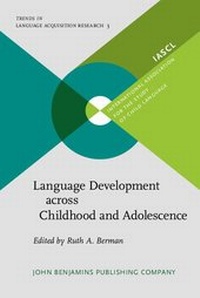
Language Development across Childhood and Adolescence
1st Edition
Published on 30. November 2004
XIV, 308 pages
978-90-272-9500-2 (ISBN)
Description

This volume brings together work by scholars with backgrounds in linguistics, psycholinguistics, developmental psychology, education, and language pathology. As such, the book adds psycholinguistic and crosslinguistic perspectives to the clinical and classroom approaches that have dominated the study of "later language development". Incorporating insights from prior language acquisition research, it goes beyond preschool age to consider both isolated utterances and extended discourse, conversational interactions and monologic text construction, and both written and spoken language use from early school-age across adolescence. Data from French, Hebrew, Spanish, and Swedish as well as English cover varied domains: morphology and lexicon, syntax and verb-argument structure, as well as peer interaction, spelling, processing of on-line writing, and reading poetry. The epilogue suggests explanations for the findings documented. Across the book, the authors show how cognitive and social maturation combines with increased literacy in the path taken by schoolchildren and adolescents towards the flexible deployment of a growing repertoire of lexical elements in varied morpho-syntactic constructions and different discourse contexts that constitutes the hallmark of maturely proficient language use.
More details
Other editions
Additional editions
Ruth A. Berman
Language Development across Childhood and Adolescence
Book
11/2004
John Benjamins Publishing Co
€90.10
Shipment within 10-15 days
Person
Content
- Language Development across Childhood and Adolescence
- Editorial page
- Titled page
- LCC page
- Table of contents
- Contributors
- Series editors' preface
- Preface
- Research on later language development
- 1. What is the nature and substance of language growth beyond the preschool years?
- 1.1. The literate lexicon and figurative language
- 1.2. Syntactic attainments
- 1.3. Spelling
- 2. How can growth in later language development be revealed?
- 3. What factors drive these later linguistic attainments?
- 3.1. Education, literacy, and metalinguistic competence
- 3.2. Cognition
- 3.3. Socialization
- Conclusions
- Between emergence and mastery
- 1. Introduction
- 2. A phase-based model of language development
- 3. Examples from acquisition of Hebrew
- 3.1. Classes of adjectives
- 3.2. Adjectival versus syntactic passives
- 3.3. Nonfinite forms and nominalizations
- 4. Conclusion
- Notes
- Lexical acquisition in the early school years*
- 1. Introduction
- 1.1. What needs to be acquired?
- 1.2. `Fast mapping' and constraints in early lexical acquisition
- 1.3. Beyond fast mapping and constraints
- 2. The assessment of vocabulary
- 2.1. Comprehension and production in assessment
- 2.2. Alternative methods of investigating word knowledge
- 3. School-based lexical development
- 3.1. Oral language input
- 3.2. Written language input
- 4. The challenges of later vocabulary learning
- 4.1. Phonological processes in lexical acquisition
- 4.2. Semantic factors in lexical acquisition
- 4.3. Morphological factors in lexical acquisition
- 5. Difficulties in vocabulary learning
- 5.1. Children with language difficulties
- 5.2. Lexical acquisition and phonological representations
- 5.3. Lexical acquisition and semantic representations
- 5.4. Summary
- 6. Conclusions
- Note
- Derivational morphology revisited
- Introduction
- 1. Psycholinguistic and developmental perspectives on the lexicon
- 1.1. The mental lexicon
- 1.2. Cognition and literacy in later lexical development
- 1.3. The literate lexicon
- 2. Developmental trends in the advanced lexicon of Hebrew
- 2.1. Passive constructions
- 2.2. Derived nominals
- 2.3. Denominal adjectives
- 3. Conclusions
- Notes
- Discursive constraints on the lexical realization of arguments in Spanish*
- 1. Introduction
- 1.1. Argument structure
- 1.2. Flow of information and argument structure
- 1.3. Genre, age, and argument structure
- 2. Description of study
- 2.1. Corpus
- 2.2. Coding
- 3. Analyses and findings
- 4. Conclusion
- Notes
- Syntactic ability in children and adolescents with language and learning disabilities
- 1. Introduction
- 2. Grammatical deficits
- 2.1. Command of grammatical morphemes
- 2.2. Other types of grammatical error
- 2.3. Error rate
- 3. Connectivity in literate contexts
- 3.1. Clause connectivity
- 3.2. Modality modifications of clause connectivity
- 4. Causes and consequences
- Notes
- Growing into academic French*
- 1. Introduction
- 1.1. Learning to speak as you write: The key to academic success
- 1.2. `Standard' French
- 1.3. Variable usage: Past participle agreement marking and two forms of future tense
- 1.4. Lexico-syntactic indicators of spoken versus written French
- 2. Developmental perspectives on text production
- 2.1. Syntactic packaging and maintaining reference in narrative discourse
- 2.2. Non-finite syntactic packaging in expository texts
- 2.3. Discourse stance
- 3. Conclusion
- Notes
- Learning to spell in a deep orthography
- 1. Introduction
- 2. Acquisition of untaught (sub)lexical regularities
- 3. Optional reliance on morphology and morpho-syntax
- 4. Reliance on obligatory morpho-syntax
- 5. Conclusions
- Acknowledgment
- Note
- Text-writing development viewed through on-line pausing in Swedish
- 1. Introduction
- 2. Methodology
- 3. Analysis of data
- 3.1. Intra-word transition times
- 3.2. Inter-word and inter-sentence pauses
- 4. Conclusion
- The role of peer interaction in later pragmatic development
- 1. Introduction
- 2. Pragmatic development: An overview
- 2.1. Turn-taking
- 2.2. Children's dialogue
- 2.3. Discursive literacy: The developmental path of conversational narratives
- 3. Peer talk: Peer cultures and peer language
- 3.1. The study: Peer talk of Israeli children
- 3.2. The merits of peer-talk
- 4. Speech representation: From voicing to reporting
- 4.1. Some preliminaries
- 4.2. Speech representation and conversational skills: Register
- 4.3. Speech representation and discursive literacy: Conversational narratives
- 5. Conclusion
- Notes
- On reading poetry
- 1. The nature of poetry versus prose
- 2. Research on students' reading of poetry
- 2.1. Study 1: An expert-novice study
- 2.2. Study 2: Comparative research on reading prose versus poetry
- 3. Language as an object of thought: Development of the Say-Mean distinction
- 4. Poetry reading and later language development
- 5. Conclusion
- Appendix A
- On a Drop of Dew by Andrew Marvell
- Appendix B
- The nature and scope of later language development*
- 1. Introduction and overview
- 2. Some features of later language development
- 2.1. Texture
- 2.2. Non-conventional meaning
- 2.3. The development of dialogue
- 2.4. Alternative worlds
- 3. How ToM relates to the central features of later language development
- 4. How literacy affects later language development
- 5. Directions for future research
- Notes
- References
- Author index
- Subject index
- The series Trends in Language Acquisition Research
