

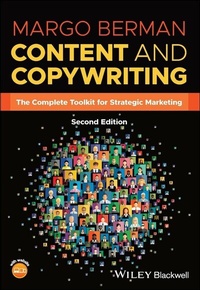
Content and Copywriting
Description

Today, just writing strong content or catchy copy isn't enough. You must also know how to create gripping messages and interactive engagement.
Content and Copywriting: The Complete Toolkit for Strategic Marketing is your one-stop resource to sharpen your skills and explore innovative methods to reach your audience. This comprehensive real-world guide helps you create content for any device and consumer touchpoint by seamlessly integrating social media writing and advertising copywriting.
As an award-winning copywriter, producer/director, and professor, Margo Berman explains conceptual strategies and writing techniques to develop dynamic copy for a wide range of traditional and emerging media. This step-by-step approach offers specific instructions for writing websites, blogs, social media, direct mail, product packaging, viral marketing, radio, television, and videos. This work also analyzes immersive, experiential, augmented, mixed, and virtual reality content, then presents tips to maximize results.
This updated and expanded second edition contains dozens of new TV and radio storyboards and scripts, charts and infographics, templates and writing tips, exercises and examples, terminology lists, plus over 100 new images of innovative marketing campaigns. It also covers shareable content, digital storytelling, headline and slogan techniques, and interactive experiences. In addition, there is a valuable section with skill-building resources, references, and suggested readings.
Featuring an extensive collection of innovative visual examples, content writing templates, and teaching and learning resources, Content and Copywriting: The Complete Toolkit for Strategic Marketing is the ideal textbook for undergraduate courses in advertising, communications, public relations, and integrated marketing, and an invaluable reference for graduate students and professionals alike.
More details
Other editions
Additional editions
Person
Content
Part One Content Writing: Content Versus Copywriting 1
1 The Shareable Word: Content Creation Process 3
2 The Digital Storytelling Word: Audience Engagement 40
3 The Template Word: Visual Engagement for Cross- platform Use 89
4 The Experiential Word: Immersive, MR (Mixed Reality), and Interactive Engagement 115
Part Two Copywriting for Three Platforms: 1) Video, 2) Audio, 3) Print, plus Cross-platform Campaigns 151
5 The Persuasive Word: Strategy ABCs: Audience, Benefits, and Creative Briefs 153
6 The Strategic Word: Strategy Categories 171
7 The Animated Word: TV, Interactive Spots, and Video Scripts 192
8 The Spoken Word: Radio Script Writing and Formats 237
9 The Chosen Word: Copywriting Techniques 274
10 The Sticky Word: Headline and Slogan Techniques 289
11 The Written Word: Print Ads, Posters, Brochures, and More 308
12 The Ambient and Moving Word: Out- of- home and Transit 347
13 The Abridged Word: Small- space Writing:Direct Mail, Package Copy, Coupons, Freebies, etc 381
14 The Cross- platform Word: Integrated Campaigns: Traditional, Social Media, and Interactive 413
Part Three Resources 467
A Short, Handy List of Resource Links 469
Terminology 475
Suggested Reading 487
Index 489
Introduction
There are several significant changes to this work. First, the book is restructured into three sections for quick access to relevant topics. Each part will start with an explanation of that section, as follows:
Part One - Content Writing: Content Versus Copywriting
- Chapter 1: The Shareable Word: Content Creation Process
- Chapter 2: The Digital Storytelling Word: Audience Engagement
- Chapter 3: The Template Word: Visual Engagement for Cross-platform Use
- Chapter 4: The Experiential Word: Immersive, MR (Mixed Reality), and Interactive Engagement
Part Two - Copywriting for Three Platforms: (1) Video, (2) Audio, (3) Print, plus Cross-platform Campaigns
- Chapter 5: The Persuasive Word: Strategy ABCs: Audience, Benefits, and Creative Briefs
- Chapter 6: The Strategic Word: Strategy Categories
- Chapter 7: The Animated Word: TV, Interactive Spots, and Video Scripts (Platform 1)
- Chapter 8: The Spoken Word: Radio Script Writing and Formats (Platform 2)
- Chapter 9: The Chosen Word: Copywriting Techniques
- Chapter 10: The Sticky Word: Headline and Slogan Techniques
- Chapter 11: The Written Word: Print Ads, Posters, Brochures, and More (Platform 3)
- Chapter 12: The Ambient and Moving Word: Out-of-home and Transit
- Chapter 13: The Abridged Word: Small-space Writing: Direct Mail, Package Copy, Coupons, Freebies, etc.
- Chapter 14: The Cross-platform Word: Integrated Campaigns: Traditional, Social Media, and Interactive
Part Three - Resources
Other changes to help navigate through the 2nd edition include:
- New content in the first four chapters, plus some content from Chapters 10 through 12 (1st edition)
- A hundred new images of innovative social media, interactive, experiential, TV, out-of-home, transit, print, and radio campaigns
- Dozens of new TV and radio storyboards and scripts
- New charts, infographics, content-writing templates, and campaign examples
- New social media, video, and other handy templates (Chapter 3)
- A new resource section (Part Three), which will help readers gain access to a curated list of skill-building references
- Some new in-chapter terminology lists, checklists, and other reference lists, as well as new exercises, callout quotes, writing tips, and end-of-the-book terminology
Below are the section-by-section and chapter-by-chapter summaries for easy reference.
Part One - Content Writing: Content Versus Copywriting
The first part discusses writing techniques with some exciting forms of engagement, such as interactive and experiential content.
Chapter 1 - The Shareable Word: Content Creation Process
This chapter discusses how to develop the topics for content writing. It includes a "Seven-step Content Writing Process" detailed below. This is similar to the Creative Brief in Chapter 1 in the first edition. These kinds of comparisons will help guide writers in the idea- and campaign-development process. (Chapter 2 will begin with step four.)
1. Why are you sharing or advertising? Purpose/goal
To help writers focus their ideas, they should write down in one sentence the reason for this message. What is it supposed to do: inform, entertain, educate, inspire, generate shares, solve a problem, etc.? Once the purpose of the content is clear, the writing can begin.
2. What are you saying? Content/message (Copy development)
We next ask writers to consider what they want the reader to know and ask them to think about what attracts them to continue reading? We review ways to present the message, such as quick checklists, quick peeks, in-depth explanations, etc. We point out the importance of tailoring content because consumers look for information on specific topics.
3. To whom are you speaking? Segments/audience
We look into which audience they want to reach. We also examine how these consumers process information and where they consume content. We study the three buying states: (1) awareness, (2) consideration, and (3) decision. We also examine the five targets in the buying process: (1) Initiator, (2) Influencer, (3) Decider, (4) Buyer, and (5) User. Plus, we cover other audience-targeting techniques, including segmentation, to maximize the content impact.
Chapter 2 - The Digital Storytelling Word: Audience Engagement
This chapter continues the "Seven-step Content Writing Process," starting with step four below:
4. Which tools are you using? Audience analytics/research
This is a discussion of content formats and frameworks. How and where is it going to be presented? Is it written, as in a social media post, an email, a blog, or a mini post? Is it in audio format for a podcast or Clubhouse discussion? Is it a recorded video for TikTok, YouTube, or an Amazon review? Is it a live streaming video for Facebook Live, Instagram Live, or gamers on Twitch? Is it a visual depiction in a pictographic, an illustration, or an infographic? Is it a shoppable post for social commerce? Techniques and templates will clarify the format options.
5. Where are you reaching them? Channel content/platform strategies
This section will show how to apply analytics to create multichannel communication, segment targeting, personalization, and more. The immediate application of consumer insights strengthens content, as well as the readers' comprehension and retention. Discussed are specific ways to integrate consumer data into usable content on myriad platforms.
6. How are you presenting the content? Format/vehicles
This covers an analysis of social and interactive and formats, plus how they guide writing development. By understanding how the communication will be delivered, writers can more accurately design effective marketing campaigns for Facebook, LinkedIn, X (previously Twitter), Instagram, Pinterest, YouTube, AR/VR/MR, AI-powered content, and more.
7. When are you scheduling the content? Scheduling/media plan and social media options
Here we discuss how to tailor the release times to best reach the audience. As usual, we review the first steps in content creation: (1) purpose and (2) audience. Again, we examine the initial audience questions: Who's reading or watching it? Where are they seeing it? When are they consuming content? How will the product help them? Then, we move on to detail the importance of a release schedule and calendar to keep track of the campaign's post or release dates.
Chapter 3 - The Template Word: Visual Engagement for Cross-platform Use
This section shows different templates that can be modified for use in different channels and platforms. Included are layout examples, script formats, social media video formats, and TV storyboards. This chapter shows how to apply templates as shortcuts in the content-development process. Included are channel content length, layout formats, image selection, and types of social media posts and/or ads.
Chapter 4 - The Experiential Word: Immersive, MR (Mixed Reality), and Interactive Engagement
Here we explore the user experience and interfacing in immersive and experiential environments. We emphasize how consumers became influencers with persuasive opinions on social media platforms. Also, we examine the commercialization of social media sites that allowed consumers to shop directly from links on influencer, marketing, and brand posts. We then look at how marketers, in response to these changes, designed content around followers' and customers' preferences. We highlight how marketers personalized audience-driven interactions in live events, digital environments, and immersive experiences.
Part Two - Copywriting for Three Platforms: 1) Video, 2) Audio, 3) Print, plus Cross-platform Campaigns
The second part discusses traditional copywriting techniques with some new applications, such as interactive TV spots.
Chapter 5 - The Persuasive Word: Strategy ABCs: Audience, Benefits, and Creative Briefs
In this chapter, we examine how the creative brief directs the campaign. We cover both the shorter and longer briefs, as well as audience types by demographics, psychographics, geographics, VALS (values and lifestyles), age/interest groups, and more. The focus is on the connection between what marketers want the audience to know about the brand, how the brand will help them, and why they should buy it. It also explains where the audience will discover or collide with the message (touchpoints) and which tactics or media vehicles would work best. Also discussed are tone...
