

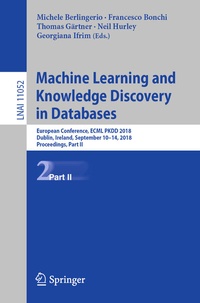
Machine Learning and Knowledge Discovery in Databases
Description

The total of 131 regular papers presented in part I and part II was carefully reviewed and selected from 535 submissions; there are 52 papers in the applied data science, nectar and demo track.
The contributions were organized in topical sections named as follows:
Part I: adversarial learning; anomaly and outlier detection; applications; classification; clustering and unsupervised learning; deep learningensemble methods; and evaluation.
Part II: graphs; kernel methods; learning paradigms; matrix and tensor analysis; online and active learning; pattern and sequence mining; probabilistic models and statistical methods; recommender systems; and transfer learning.
Part III: ADS data science applications; ADS e-commerce; ADS engineering and design; ADS financial and security; ADS health; ADS sensing and positioning; nectar track; and demo track.
More details
Other editions
Additional editions
Content
Graphs.- Temporally Evolving Community Detection and Prediction in Content-Centric Networks.- Local Topological Data Analysis to Uncover the Global Structure of Data Approaching Graph-Structured Topologies.- Similarity Modeling on Heterogeneous Networks via Automatic Path Discovery.- Dynamic hierarchies in temporal directed networks.- Risk-Averse Matchings over Uncertain Graph Databases.- Discovering Urban Travel Demands through Dynamic Zone Correlation in Location-Based Social Networks.- Social-Affiliation Networks: Patterns and the SOAR Model.- ONE-M: Modeling the Co-evolution of Opinions and Network Connections.- Think before You Discard: Accurate Triangle Counting in Graph Streams with Deletions.- Semi-Supervised Blockmodelling with Pairwise Guidance.- Kernel Methods.- Large-scale Nonlinear Variable Selection via Kernel Random Features.- Fast and Provably Effective Multi-view Classification with Landmark-based SVM.- Nyström-SGD: Fast Learning of Kernel-Classifiers with Conditioned Stochastic Gradient Descent.- Learning Paradigms.- Hyperparameter Learning for Conditional Kernel Mean Embeddings with Rademacher Complexity Bounds.- Deep Learning Architecture Search by Neuro-Cell-based Evolution with Function-Preserving Mutations.- VC-Dimension Based Generalization Bounds for Relational Learning.- Robust Super-Level Set Estimation using Gaussian Processes.- Robust Super-Level Set Estimation using Gaussian Processes.- Scalable Nonlinear AUC Maximization Methods.- Matrix and Tensor Analysis.- Lambert Matrix Factorization.- Identifying and Alleviating Concept Drift in Streaming Tensor Decomposition.- MASAGA: A Linearly-Convergent Stochastic First-Order Method for Optimization on Manifolds.- Block CUR: Decomposing Matrices using Groups of Columns.- Online and Active Learning.- SpectralLeader: Online Spectral Learning for Single Topic Models.- Online Learning of Weighted Relational Rules for Complex Event Recognition.- Toward Interpretable Deep Reinforcement Learning with Linear Model U-Trees.- Online Feature Selection by Adaptive Sub-gradient Methods.- Frame-based Optimal Design.- Hierarchical Active Learning with Proportion Feedback on Regions.- Pattern and Sequence Mining.- An Efficient Algorithm for Computing Entropic Measures of Feature Subsets.- Anytime Subgroup Discovery in Numerical Domains with Guarantees.- Discovering Spatio-Temporal Latent Influence in Geographical Attention Dynamics.- Mining Periodic Patterns with a MDL Criterion.- Revisiting Conditional Functional Dependency Discovery: Splitting the "C" from the "FD".- Sqn2Vec: Learning Sequence Representation via Sequential Patterns with a Gap Constraint.- Mining Tree Patterns with Partially Injective Homomorphisms.- Probabilistic Models and Statistical Methods.- Variational Bayes for Mixture Models with Censored Data.- Exploration Enhanced Expected Improvement for Bayesian Optimization.- A Left-to-right Algorithm for Likelihood Estimation in Gamma-Poisson Factor Analysis.- Causal Inference on Multivariate and Mixed-Type Data.- Recommender Systems.- POLAR: Attention-based CNN for One-shot Personalized Article Recommendation.- Learning Multi-granularity Dynamic Network Representations for Social Recommendation.- GeoDCF: Deep Collaborative Filtering with Multifaceted Contextual Information in Location-based Social Networks.- Personalized Thread Recommendation for MOOC Discussion Forums.- Inferring Continuous Latent Preference on Transition Intervals for Next Point-of-Interest Recommendation.- Transfer Learning.- Feature Selection for Unsupervised Domain Adaptation using Optimal Transport.- Towards more Reliable Transfer Learning.- Differentially Private Hypothesis Transfer Learning.- Information-theoretic Transfer Learning framework for Bayesian Optimisation.- A Unified Framework for Domain Adaptation using Metric Learning on Manifolds.
