

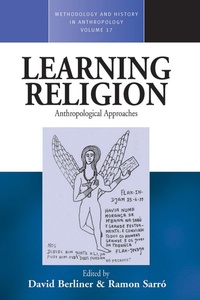
Learning Religion
Anthropological Approaches
1st Edition
Published on 1. October 2007
248 pages
978-1-83695-985-4 (ISBN)
Description

As we enter the 21st century, it becomes increasingly difficult to envisage a world detached from religion or an anthropology blind to its study. Yet, how people become religious is still poorly studied. This volume gathers some of the most distinguished scholars in the field to offer a new perspective for the study of religion, one that examines the works of transmission and innovation through the prism of learning. They argue that religious culture is socially and dynamically constructed by agents who are not mere passive recipients but engaged in active learning processes. Finding a middle way between the social and the cognitive, they see learning religions not as a mechanism of "downloading" but also as a social process with its relational dimension.
Reviews / Votes
"This volume demonstrates that a formidable barrier divides social and the cognitive anthropologists. Sperber, Bloch, Whitehouse, and even the very Durkheimian Mary Douglas have been encouraging a merger between cognitive studies, hermeneutics, and ethnography, while others have been more reticent or antagonistic...Either way, this work has helped to advance the discussion." ? Anthropos"This volume is a valuable contribution to an emergent field of study, and will appeal to scholars who seek new interdisciplinary approaches." ? Social Anthropology/Anthropologie sociale
More details
Series
Edition
1. Auflage
Language
English
Place of publication
Oxford
United Kingdom
Target group
College/higher education
Illustrations
Bibliography; Index
File size
0,63 MB
ISBN-13
978-1-83695-985-4 (9781836959854)
DOI
10.3167/9781845453749
Copyright in bibliographic data and cover images is held by Nielsen Book Services Limited or by the publishers or by their respective licensors: all rights reserved.
Schweitzer Classification
Other editions
Additional editions
Book
11/2008
1st Edition
Berghahn Books
€41.60
Shipment within 3-4 weeks
Book
10/2007
1st Edition
Berghahn Books
€149.80
Shipment within 3-4 weeks
Persons
David Berliner is an Assistant Professor at the Universite Libre de Bruxelles (Belgium). He received his PhD from University of Brussels (2002). In 2001 he was a visiting PhD student at Saint Cross College, Oxford, and in 2003-2005 a post-doctoral fellow at Harvard University.
Content
Acknowledgements
Chapter 1. On Learning Religion: An Introduction
David Berliner and Ramon Sarro
Chapter 2. Learning to Believe: A Preliminary Approach
Carlo Severi
Chapter 3. Menstrual Slaps and First Blood Celebrations: Inference, Simulation and the Learning of Ritual
Michael Houseman
Chapter 4. The Accidental in Religious Instruction: Ideas and Convictions
David Parkin
Chapter 5. On Catching Up With Oneself: Learning to Know That One Means What One Does
Michael Lambek
Chapter 6. How Do You Learn to Know That it is God Who Speaks?
T.M. Luhrmann
Chapter 7. How to Learn in an Afro-Brazilian Spirit Possession Religion: Ontology and Multiplicity in Candomble
Marcio Goldman
Chapter 8. Learning to be a Proper Medium: Middle-Class Womanhood and Spirit Mediumship at Christian Rationalist Seances in Cape Verde
Joao Vasconcelos
Chapter 9. Copyright and Authorship: Ritual Speech and the New Market of Words in Toraja
Aurora Donzelli
Chapter 10. Learning Faith: Young Christians and Catechism
Laurence Herault
Chapter 11. What is Interesting about Chinese Religion
Charles Stafford
Chapter 12. The Sound of Witchcraft: Noise as Mediation in Religious Transmission
Michael Rowlands
Bibliography
Notes on Contributors
Index
Chapter 1. On Learning Religion: An Introduction
David Berliner and Ramon Sarro
Chapter 2. Learning to Believe: A Preliminary Approach
Carlo Severi
Chapter 3. Menstrual Slaps and First Blood Celebrations: Inference, Simulation and the Learning of Ritual
Michael Houseman
Chapter 4. The Accidental in Religious Instruction: Ideas and Convictions
David Parkin
Chapter 5. On Catching Up With Oneself: Learning to Know That One Means What One Does
Michael Lambek
Chapter 6. How Do You Learn to Know That it is God Who Speaks?
T.M. Luhrmann
Chapter 7. How to Learn in an Afro-Brazilian Spirit Possession Religion: Ontology and Multiplicity in Candomble
Marcio Goldman
Chapter 8. Learning to be a Proper Medium: Middle-Class Womanhood and Spirit Mediumship at Christian Rationalist Seances in Cape Verde
Joao Vasconcelos
Chapter 9. Copyright and Authorship: Ritual Speech and the New Market of Words in Toraja
Aurora Donzelli
Chapter 10. Learning Faith: Young Christians and Catechism
Laurence Herault
Chapter 11. What is Interesting about Chinese Religion
Charles Stafford
Chapter 12. The Sound of Witchcraft: Noise as Mediation in Religious Transmission
Michael Rowlands
Bibliography
Notes on Contributors
Index
