


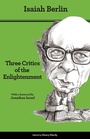
Three Critics of the Enlightenment
Vico, Hamann, Herder - Second Edition
2nd Edition
Published on 24. October 2016
576 pages
978-1-4008-4852-2 (ISBN)
Description

Isaiah Berlin was deeply admired during his life, but his full contribution was perhaps underestimated because of his preference for the long essay form. The efforts of Henry Hardy to edit Berlin's work and reintroduce it to a broad, eager readership have gone far to remedy this. Now, Princeton is pleased to return to print, under one cover, Berlin's essays on these celebrated and captivating intellectual portraits: Vico, Hamann, and Herder. These essays on three relatively uncelebrated thinkers are not marginal ruminations, but rather among Berlin's most important studies in the history of ideas. They are integral to his central project: the critical recovery of the ideas of the Counter-Enlightenment and the explanation of its appeal and consequences--both positive and (often) tragic.
Giambattista Vico was the anachronistic and impoverished Neapolitan philosopher sometimes credited with founding the human sciences. He opposed Enlightenment methods as cold and fallacious. J. G. Hamann was a pious, cranky dilettante in a peripheral German city. But he was brilliant enough to gain the audience of Kant, Goethe, and Moses Mendelssohn. In Hamann's chaotic and long-ignored writings, Berlin finds the first strong attack on Enlightenment rationalism and a wholly original source of the coming swell of romanticism. Johann Gottfried Herder, the progenitor of populism and European nationalism, rejected universalism and rationalism but championed cultural pluralism.
Individually, these fascinating intellectual biographies reveal Berlin's own great intelligence, learning, and generosity, as well as the passionate genius of his subjects. Together, they constitute an arresting interpretation of romanticism's precursors. In Hamann's railings and the more considered writings of Vico and Herder, Berlin finds critics of the Enlightenment worthy of our careful attention. But he identifies much that is misguided in their rejection of universal values, rationalism, and science. With his customary emphasis on the frightening power of ideas, Berlin traces much of the next centuries' irrationalism and suffering to the historicism and particularism they advocated. What Berlin has to say about these long-dead thinkers--in appreciation and dissent--is remarkably timely in a day when Enlightenment beliefs are being challenged not just by academics but by politicians and by powerful nationalist and fundamentalist movements.
The study of J. G. Hamann was originally published under the title The Magus of the North: J. G. Hamann and the Origins of Modern Irrationalism. The essays on Vico and Herder were originally published as Vico and Herder: Two Studies in the History of Ideas. Both are out of print.
This new edition includes a number of previously uncollected pieces on Vico and Herder, two interesting passages excluded from the first edition of the essay on Hamann, and Berlin's thoughtful responses to two reviewers of that same edition.
Giambattista Vico was the anachronistic and impoverished Neapolitan philosopher sometimes credited with founding the human sciences. He opposed Enlightenment methods as cold and fallacious. J. G. Hamann was a pious, cranky dilettante in a peripheral German city. But he was brilliant enough to gain the audience of Kant, Goethe, and Moses Mendelssohn. In Hamann's chaotic and long-ignored writings, Berlin finds the first strong attack on Enlightenment rationalism and a wholly original source of the coming swell of romanticism. Johann Gottfried Herder, the progenitor of populism and European nationalism, rejected universalism and rationalism but championed cultural pluralism.
Individually, these fascinating intellectual biographies reveal Berlin's own great intelligence, learning, and generosity, as well as the passionate genius of his subjects. Together, they constitute an arresting interpretation of romanticism's precursors. In Hamann's railings and the more considered writings of Vico and Herder, Berlin finds critics of the Enlightenment worthy of our careful attention. But he identifies much that is misguided in their rejection of universal values, rationalism, and science. With his customary emphasis on the frightening power of ideas, Berlin traces much of the next centuries' irrationalism and suffering to the historicism and particularism they advocated. What Berlin has to say about these long-dead thinkers--in appreciation and dissent--is remarkably timely in a day when Enlightenment beliefs are being challenged not just by academics but by politicians and by powerful nationalist and fundamentalist movements.
The study of J. G. Hamann was originally published under the title The Magus of the North: J. G. Hamann and the Origins of Modern Irrationalism. The essays on Vico and Herder were originally published as Vico and Herder: Two Studies in the History of Ideas. Both are out of print.
This new edition includes a number of previously uncollected pieces on Vico and Herder, two interesting passages excluded from the first edition of the essay on Hamann, and Berlin's thoughtful responses to two reviewers of that same edition.
More details
Other editions
Additional editions
Book
11/2013
2nd Edition
Princeton University Press
€33.00
Shipment within 10-20 days
Persons
Isaiah Berlin (1909-1997) was one of the leading intellectual historians of the twentieth century and the founding president of Wolfson College, University of Oxford. His many books include The Hedgehog and the Fox, The Crooked Timber of Humanity, The Roots of Romanticism, and Against the Current (all Princeton). Henry Hardy, a Fellow of Wolfson College, Oxford, is one of Isaiah Berlin's literary trustees. He has edited several other volumes by Berlin, and is currently preparing Berlin's letters and remaining unpublished writings for publication.
Content
Foreword by Jonathan Israel ix
Editor's Preface xix
Note on References xxv
VICO AND HERDER 1
Author's Preface 5
Introduction 7
The Philosophical Ideas of Giambattista Vico 26
Vico's Theory of Knowledge and Its Sources 151
Herder and the Enlightenment 208
THE MAGUS OF THE NORTH 301
Editor's Preface 305
Foreword to the German Edition 312
Author's Preface 317
1. Introduction 320
2. Life 324
3. The Central Core 341
4. The Enlightenment 345
5. Knowledge 350
6. Language 390
7. Creative Genius 410
8. Politics 423
9. Conclusion 428
Excursus to Chapter 6 444
Bibliographical Note 449
Appendix to the Second Edition 453
Giambattista Vico: Man of Genius 455
The Reputation of Vico 479
The Workings of Providence 484
Hamann's Origins 486
Letters 489
Index 517
Editor's Preface xix
Note on References xxv
VICO AND HERDER 1
Author's Preface 5
Introduction 7
The Philosophical Ideas of Giambattista Vico 26
Vico's Theory of Knowledge and Its Sources 151
Herder and the Enlightenment 208
THE MAGUS OF THE NORTH 301
Editor's Preface 305
Foreword to the German Edition 312
Author's Preface 317
1. Introduction 320
2. Life 324
3. The Central Core 341
4. The Enlightenment 345
5. Knowledge 350
6. Language 390
7. Creative Genius 410
8. Politics 423
9. Conclusion 428
Excursus to Chapter 6 444
Bibliographical Note 449
Appendix to the Second Edition 453
Giambattista Vico: Man of Genius 455
The Reputation of Vico 479
The Workings of Providence 484
Hamann's Origins 486
Letters 489
Index 517
