

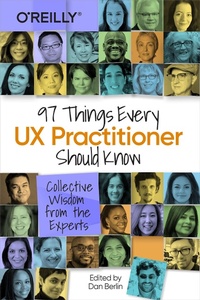
97 Things Every UX Practitioner Should Know
Published on 11. May 2021
298 pages
978-1-4920-8512-6 (ISBN)
Description

Tap into the wisdom of experts to learn what every UX practitioner needs to know. With 97 short and extremely useful articles, you'll discover new approaches to old problems, pick up road-tested best practices, and hone your skills through sound advice.Working in UX involves much more than just creating user interfaces. UX teams struggle with understanding what's important, which practices they should know deeply, and what approaches aren't helpful at all. With these 97 concise articles, editor Dan Berlin presents a wealth of advice and knowledge from experts who have practiced UX throughout their careers.Bring Themes to Exploratory Research--Shanti KanhaiDesign for Content First--Marli MesibovDesign for Universal Usability--Ann Chadwick-DiasBe Wrong on Purpose--Skyler Ray TaylorDiverse Participant Recruiting Is Critical to Authentic User Research--Megan CamposPut On Your InfoSec Hat to Improve Your Designs--Julie MeridianBoost Your Emotional Intelligence to Move from Good to Great UX--Priyama Barua
More details
Other editions
Additional editions
Book
05/2021
O'Reilly
€47.00
Shipment within 15-20 days
Content
- Cover
- Copyright
- Table of Contents
- Preface
- Permissions
- O'Reilly Online Learning
- How to Contact Us
- Acknowledgments
- Part I. Career
- Chapter 1. Boost Your Emotional Intelligence to Move from Good to Great UX
- Priyama Barua
- Chapter 2. Your Worst Job May Be Your Best Learning Experience
- Taylor Kostal-Bergmann
- Start Small and Focus on Building Trust
- Diversify Your Skill Set
- Get Organized and Say No
- Chapter 3. You're Never Done Learning
- Andrew Wirtanen
- Make Time
- Be Selective
- Refine Your Routine
- Share
- Chapter 4. So You Want to Be a UX Consultant
- Eva Kaniasty
- Chapter 5. Master the Art of Storytelling
- Reena Ganga
- Chapter 6. Understand and Speak the Language of Business
- Dwayne Hill
- Chapter 7. Expand Your Network Through Community Involvement
- Jen McGinn
- Chapter 8. Amplify Your Value by Finding Advocates Outside Your Team
- Catherine Dubut
- Chapter 9. Design Mentorship Is a Lifelong Commitment
- Kristian Delacruz
- Remember that Past Experience Is Valuable
- Be a Cheerleader
- Build a Lifelong Relationship
- Reach Out First
- Be Human
- Chapter 10. Create a Design Portfolio that Gets Results
- Shanae Chapman
- Part II. Strategy
- Chapter 11. User Experience Extends Beyond the Digital Realm
- Frances Close
- Chapter 12. Know the Difference Between Experience Mapping and Journey Mapping
- Darren Hood
- Let's Level Set
- Alignment and Challenges
- Takeaways and Reminders
- Chapter 13. Design Customer Experiences, Not Features
- Gail Giacobbe
- Chapter 14. Create a Truly Visible UX Team
- Sonia V. Weaver
- Chapter 15. Thinking About the Future Is Important for Any Design Process
- Liz Possee Corthell
- Chapter 16. Implement Service Design in Your Practice
- Eduardo Ortiz
- Research
- Plan
- Apply
- Part III. Design
- Chapter 17. Don't Forget About Information Architecture
- Joe Sokohl
- Chapter 18. When Prototyping, Consider Both Visual Fidelity and Functional Fidelity
- Chris Callaghan
- Chapter 19. See Beyond the "Average" User
- Hillary Carey
- Chapter 20. Work Together to Create Inclusive Products
- Al Lopez
- Chapter 21. Advocate for Accessibility
- Holly Schroeder
- Chapter 22. Design for Universal Usability
- Ann Chadwick-Dias
- Chapter 23. Inclusive Design Creates Products that Work for Everyone
- Christopher S. LaRoche
- Chapter 24. Define What Your Design Does Not Do
- Georgiy Chernyavsky
- Chapter 25. Use Design Goals to Make Design Decisions Explainable and Defendable
- Helmut Degen
- Chapter 26. Think Synthetically to Design Systematically
- Drew Condon
- Chapter 27. Best and Last Impressions Are Lasting Impressions
- Andrea Mancini
- Chapter 28. Follow These Principles of Gestalt for Better UX Designs
- Erin Malone
- Chapter 29. Use Visual Design to Create an Eye Track
- Kevin Lynn Brown
- Chapter 30. Use Object Mapping to Create Clear and Consistent Interfaces
- Tim Heiler
- References
- Chapter 31. Remember the Four Questions of Critique
- Adam Connor
- Chapter 32. Turn Poorly Constructed Criticism into Actionable Feedback
- Jesse Nichols
- The Big Bad Stakeholder
- A Simple Misunderstanding
- Tips for Success
- Chapter 33. Improve Communication and Encourage Collaboration Using Sketches
- Anna Iurchenko
- Chapter 34. Learn the Difference Between UX and UI from a Bicycle
- Joe Wilson
- UI: User Interface
- UX: User Experience
- Chapter 35. Sell Your Design Ideas with Trust and Insights
- Benson Chan
- Chapter 36. Align Your Team Around Customer Needs via Design Workshops
- Shipra Kayan
- Chapter 37. Embrace a Shared Cadence to Avoid Silos
- Christy Ennis-Kloote
- Chapter 38. Learn to Think like a Missionary, Not a Mercenary
- Scot Briscoe
- Pitfalls of Mercenary Work
- Becoming a Missionary
- Stay on the Path
- Chapter 39. Not All Interfaces Need to Be Simplified
- Morgane Peng
- Get Familiar with Enterprise Products
- Differentiate Business Expertise and Interface Expertise
- Find the Sweet Spot
- Chapter 40. If You Show Something Shiny, They'll Assume It's Done
- John Yesko
- Chapter 41. You Can't Always Help Who You Want
- James McElroy
- Chapter 42. Make Learning a Part of Your Design Process
- Michelle Morgan
- Chapter 43. Design Meaningful International UX
- Yingdi Qi
- Chapter 44. Legacy Product? Imagine You're Restoring an Old Farmhouse
- Christopher Coy
- Chapter 45. Be Your Own Project Manager
- Tripta Kumari
- Chapter 46. Design for Users, Not Usability Studies
- Aaron Parker
- Chapter 47. Frame the Opportunity Before Brainstorming the Solution
- Brian Sullivan
- Chapter 48. Be Wrong on Purpose
- Skyler Ray Taylor
- The Wrong Answer
- The Right Time to Be Wrong
- Don't Stay Wrong for Long
- Chapter 49. Create a Lasting Design System
- Lara Tacito
- Make Your Design System Easy to Use
- Create a Process, Not a Project
- Chapter 50. Your First Idea Is Sometimes Your Worst Idea
- Audrey Bryson
- Chapter 51. Question Your Intuition and Design to Extremes
- Navin Iyengar
- Chapter 52. Design Thinking Workshops Will Change Your Process
- Theo Johnson
- Chapter 53. Visualize Requirements During a Workshop
- Kristina Hoeppner
- Leave the Spreadsheet Behind
- Prepare for and Run the Workshop
- Be Brave and Break Away from the Spreadsheet
- Chapter 54. Put On Your InfoSec Hat to Improve Your Designs
- Julie Meridian
- Chapter 55. On-Brand Whimsy Can Differentiate Your Mobile App
- Martha Valenta
- Chapter 56. Don't Perform a Competitive Analysis Before Ideating
- William Ntim
- Part IV. Content
- Chapter 57. Design for Content First
- Marli Mesibov
- The Content-First Mindset
- Content-First as a Methodology
- Speak to Your Audience
- Chapter 58. Align Your Tone, Voice, and Audiences
- Marino Ivo Lopes Fernandes
- Chapter 59. Mind Your Error Messages
- Jennifer Aldrich
- Chapter 60. A Shared Vocabulary Can Increase Team Efficiency
- Matthias Feit
- Coming to Terms with Terminology
- Chapter 61. Break Your Lorem Ipsum Habit: Sketch with Words!
- Emily Roche
- Why Lorem Ipsum Doesn't Help
- Here's How to Sketch with Words
- Stronger Starts and Smoother Finishes
- Part V. Research
- Chapter 62. Always Go for the Why-the Immutable Basis of Great Design
- Andy Knight
- Chapter 63. The Participant's Well-Being Is Your Responsibility
- Danielle Cooley
- Pay Attention to Physical Needs
- Mental and Emotional Factors Affect the Research, Too
- Don't Be Afraid to Stop the Session If Necessary
- Caring for the Participant Is in Everyone's Best Interest
- Chapter 64. Diverse Participant Recruiting Is Critical to Authentic User Research
- Megan Campos
- Chapter 65. Build a Culturally Reflexive Professional Framework
- Monet Burse Moutinho
- Chapter 66. Know These Warning Signs of Information Architecture Problems
- Kathi Kaiser
- Chapter 67. Bring Themes to Exploratory Research
- Shanti Kanhai
- Degrees of Control
- The Power of Themes
- Define Your Themes
- Chapter 68. Embrace Your Ignorance
- Jon Robinson
- Chapter 69. Get Past Fear with Users and Design Teams
- Julia Choi
- Chapter 70. Data Alone Does Not Create Empathy-Storytelling Is Key
- Kyle Soucy
- Like It or Not, You Must Get Comfortable with Public Speaking
- What's the Secret to Being a Great Presenter and Storyteller?
- A Word of Caution
- Chapter 71. Personas with Emotions and Behaviors Are More Valuable
- Cindy Brummer
- Avoid Weak Personas
- Step 1: Start with Data
- Step 2: Provide Context
- Chapter 72. Educate Your Product Team for Successful User Research
- Rachel Young
- Educate on What Research Can and Cannot Answer
- Explain What Research Is and What It Is Not
- Encourage Observation with Specific Guidelines
- Chapter 73. Design Isn't Just About the Happy Path
- Drew Lepp
- Why Does This Matter?
- Examples of Worst-Case Scenarios
- Practical Advice
- Chapter 74. Deliver Successful Products Through Common Success Metrics
- Martina Borkowsky
- Chapter 75. Bring Rapid User Research Methods to Agile Teams
- Bob Thomas
- Traditional UX Research Methods
- Lean UX Research Methods
- Chapter 76. Scale Research Through Stakeholder Advocacy
- Matt DiGirolamo
- Identify Current UX Maturity
- Foster Awareness
- Set Up Research Frameworks
- Push Maturity Forward with Team Ops and Quantification
- Research Democratization
- Chapter 77. Know When and How to Build a Usability Lab
- Rich Buttiglieri
- When Would I Need a Lab?
- How Expensive Is It to Build?
- Physical Space Considerations
- Chapter 78. Talk to Customer Support to See What's Tripping Up Users
- Dave Connis
- Renaming a Feature
- Practical Application
- Chapter 79. Be Prepared When Practicing Ethnography
- Meena Kothandaraman
- Chapter 80. Always Do a Test of Your Test
- Jacqueline Ouifak
- Chapter 81. Observed Behavior Is the Gold Standard
- Kaaren Hanson
- Chapter 82. Assess Usefulness and Desirability Early in Product Development
- Michael Hawley
- Chapter 83. Know the Core Elements of Usability Research
- Amanda Mattson
- Chapter 84. Don't Underestimate the Power of Coworkers as Usability Participants
- Daniel Diener
- Chapter 85. Include Nonusers in Your User Research
- Becca Kennedy
- Nonusers Can Help Uncover Gaps
- Nonusers Can Supplement User Research
- How to Include Nonusers
- Chapter 86. Plan User Research with the Customer Question Board
- Julia Cowing
- Chapter 87. If Designing Survey Questions Were Easy, There'd Be No Garbage Data
- Annie Persson
- Creating Questions
- Wording Questions
- Creating Response Options
- Chapter 88. The Right Screener Sets Up Your Recruit and Research for Success
- Katelyn Thompson
- Define and Outline Your Criteria
- Determine the Method for Asking Your Questions
- Write the Screener Questions
- Select Your Participants
- Chapter 89. Know Best Practices for Working with a Recruiter
- Ellen Finn
- Timeline Management and Recruiter/Client Communication
- Participant Confirmation
- On-Call Duties
- Study Aftermath
- Chapter 90. You Don't Need a Lot of Money to Recruit Participants
- Thomas Yung
- Representative Users and Screeners
- Sample Size
- Incentives and Compensation
- Posting Ads and Screener
- Build a Panel Yourself
- Final Thoughts
- Chapter 91. You Need Good Planning for a Diary Study
- Mac Hasley
- Align Research Questions with a Diary's Structure
- Set a Timeframe that Gathers Insights Before Participants Lose Interest
- Choose the Right Tool for Your Goals, Budget, and Timeline
- Be Strict in Your Recruit
- Decide How Participants Will Log
- Chapter 92. Improve Usability Testing with Task Cards
- Todd Zazelenchuk
- Chapter 93. Apply the Butterfly Approach to Interviews and Testing
- Stephen Denning
- Chapter 94. Don't Ask Users to Predict the Future
- Ingrid Cruz
- Hypothetical Scenarios Produce Unreliable Feedback
- The Importance of a Good Research Question
- Chapter 95. Ask Participants to Tell You What You Don't Know to Ask
- Amanda Rotondo
- Chapter 96. Leverage Your "Psychologist Voice" for Effective UX Research Moderation
- Dan Berlin
- Chapter 97. Tell the User's Story via Effective Research Reports
- Susan Mercer
- Background
- Goals
- Executive Summary
- Methodology
- Detailed Findings
- Summary
- Recommendations
- Contributors
- Aaron Parker
- Adam Connor
- Al Lopez
- Amanda Mattson
- Amanda Rotondo
- Andrea Mancini
- Andrew Wirtanen
- Andy Knight
- Ann Chadwick-Dias
- Anna Iurchenko
- Annie Persson
- Audrey Bryson
- Becca Kennedy
- Benson Chan
- Bob Thomas
- Brian Sullivan
- Catherine Dubut
- Chris Callaghan
- Christopher Coy
- Christopher S. LaRoche
- Christy Ennis-Kloote
- Cindy Brummer
- Daniel Diener
- Danielle Cooley
- Darren Hood
- Dave Connis
- Drew Condon
- Drew Lepp
- Dwayne Hill
- Eduardo Ortiz
- Ellen Finn
- Emily Roche
- Erin Malone
- Eva Kaniasty
- Frances Close
- Gail Giacobbe
- Georgiy Chernyavsky
- Helmut Degen
- Hillary Carey
- Holly Schroeder
- Ingrid Cruz
- Jacqueline Ouifak
- James McElroy
- Jen McGinn
- Jennifer Aldrich
- Jesse Nichols
- Joe Sokohl
- Joe Wilson
- John Yesko
- Jon Robinson
- Julia Choi
- Julia Cowing
- Julie Meridian
- Kaaren Hanson
- Katelyn Thompson
- Kathi Kaiser
- Kevin Lynn Brown
- Kristian Delacruz
- Kristina Hoeppner
- Kyle Soucy
- Lara Tacito
- Liz Possee Corthell
- Mac Hasley
- Marino Ivo Lopes Fernandes
- Marli Mesibov
- Martha Valenta
- Martina Borkowsky
- Matt DiGirolamo
- Matthias Feit
- Meena Kothandaraman
- Megan Campos
- Michael Hawley
- Michelle Morgan
- Monet Burse Moutinho
- Morgane Peng
- Navin Iyengar
- Priyama Barua
- Rachel Young
- Reena Ganga
- Rich Buttiglieri
- Scot Briscoe
- Shanae Chapman
- Shanti Kanhai
- Shipra Kayan
- Skyler Ray Taylor
- Sonia V. Weaver
- Stephen Denning
- Susan Mercer
- Taylor Kostal-Bergmann
- Theo Johnson
- Thomas Yung
- Tim Heiler
- Todd Zazelenchuk
- Tripta Kumari
- William Ntim
- Yingdi Qi
- Index
- About the Editor
- Dan Berlin
