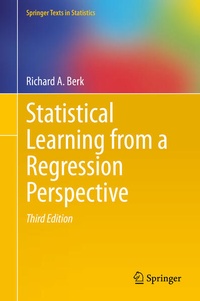
Statistical Learning from a Regression Perspective
Description

This textbook considers statistical learning applications when interest centers on the conditional distribution of a response variable, given a set of predictors, and in the absence of a credible model that can be specified before the data analysis begins. Consistent with modern data analytics, it emphasizes that a proper statistical learning data analysis depends in an integrated fashion on sound data collection, intelligent data management, appropriate statistical procedures, and an accessible interpretation of results. The unifying theme is that supervised learning properly can be seen as a form of regression analysis. Key concepts and procedures are illustrated with a large number of real applications and their associated code in R, with an eye toward practical implications. The growing integration of computer science and statistics is well represented including the occasional, but salient, tensions that result. Throughout, there are links to the big picture.
The third edition considers significant advances in recent years, among which are:
- the development of overarching, conceptual frameworks for statistical learning;
- the impact of "big data" on statistical learning;
- the nature and consequences of post-model selection statistical inference;
- deep learning in various forms;
- the special challenges to statistical inference posed by statistical learning;
- the fundamental connections between data collection and data analysis;
- interdisciplinary ethical and political issues surrounding the application of algorithmic methods in a wide variety of fields, each linked to concerns about transparency, fairness, and accuracy.
Reviews / Votes
"It could readily be a textbook for an applications-focused course at the graduate level as each chapter comes with exercises . . Examples with accompanying code also appear throughout the chapters which provide a scaffold for getting started . . Berk's pragmatic advice will serve a wide audience from practitioners to educators to students." (Sara Stoudt, MAA Reviews, December 12, 2021)More details
Other editions
Additional editions
Previous edition