Battery Management Systems
Description

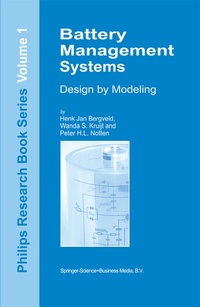
Battery Management Systems - Design by Modelling describes the design of Battery Management Systems (BMS) with the aid of simulation methods. The basic tasks of BMS are to ensure optimum use of the energy stored in the battery (pack) that powers a portable device and to prevent damage inflicted on the battery (pack). This becomes increasingly important due to the larger power consumption associated with added features to portable devices on the one hand and the demand for longer run times on the other hand. In addition to explaining the general principles of BMS tasks such as charging algorithms and State-of-Charge (SoC) indication methods, the book also covers real-life examples of BMS functionality of practical portable devices such as shavers and cellular phones.
Simulations offer the advantage over measurements that less time is needed to gain knowledge of a battery's behaviour in interaction with other parts in a portable device under a wide variety ofconditions. This knowledge can be used to improve the design of a BMS, even before a prototype of the portable device has been built. The battery is the central part of a BMS and good simulation models that can be used to improve the BMS design were previously unavailable. Therefore, a large part of the book is devoted to the construction of simulation models for rechargeable batteries. With the aid of several illustrations it is shown that design improvements can indeed be realized with the presented battery models. Examples include an improved charging algorithm that was elaborated in simulations and verified in practice and a new SoC indication system that was developed showing promising results.
The contents of Battery Management Systems - Design by Modelling is based on years of research performed at the Philips Research Laboratories. The combination of basic and detailed descriptions of battery behaviour both in chemical and electrical terms makes thisbook truly multidisciplinary. It can therefore be read both by people with an (electro)chemical and an electrical engineering background.
More details
Other editions
Additional editions