

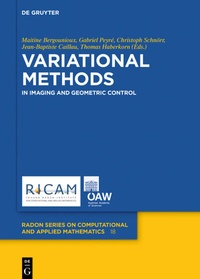
Variational Methods
Description

With a focus on the interplay between mathematics and applications of imaging, the first part covers topics from optimization, inverse problems and shape spaces to computer vision and computational anatomy. The second part is geared towards geometric control and related topics, including Riemannian geometry, celestial mechanics and quantum control.
Contents:
Part I
Second-order decomposition model for image processing: numerical experimentation
Optimizing spatial and tonal data for PDE-based inpainting
Image registration using phase·amplitude separation
Rotation invariance in exemplar-based image inpainting
Convective regularization for optical flow
A variational method for quantitative photoacoustic tomography with piecewise constant coefficients
On optical flow models for variational motion estimation
Bilevel approaches for learning of variational imaging models
Part II
Non-degenerate forms of the generalized Euler·Lagrange condition for state-constrained optimal control problems
The Purcell three-link swimmer: some geometric and numerical aspects related to periodic optimal controls
Controllability of Keplerian motion with low-thrust control systems
Higher variational equation techniques for the integrability of homogeneous potentials
Introduction to KAM theory with a view to celestial mechanics
Invariants of contact sub-pseudo-Riemannian structures and Einstein·Weyl geometry
Time-optimal control for a perturbed Brockett integrator
Twist maps and Arnold diffusion for diffeomorphisms
A Hamiltonian approach to sufficiency in optimal control with minimal regularity conditions: Part I
Index
More details
Other editions
Additional editions
Persons
Content
- Intro
- Contents
- Part I
- 1 Second-order decomposition model for image processing: numerical experimentation
- 1.1 Introduction
- 1.2 Presentation of the model
- 1.3 Numerical aspects
- 1.3.1 Discretized problem and algorithm
- 1.3.2 Examples
- 1.3.3 Initialization process
- 1.3.4 Convergence
- 1.3.5 Sensitivity with respect to sampling and quantification
- 1.3.6 Sensitivity with respect to parameters
- 1.4 Conclusion
- 2 Optimizing spatial and tonal data for PDE-based inpainting
- 2.1 Introduction
- 2.2 A review of PDE-based image compression
- 2.2.1 Data optimization
- 2.2.2 Finding good inpainting operators
- 2.2.3 Storing the data
- 2.2.4 Feature-based methods
- 2.2.5 Fast algorithms and real-time aspects
- 2.2.6 Hybrid image compression methods
- 2.2.7 Modifications, extensions and applications
- 2.2.8 Relations to other methods
- 2.3 Inpainting with homogeneous diffusion
- 2.4 Optimization strategies in 1D
- 2.4.1 Optimal knots for interpolating convex functions
- 2.4.2 Optimal knots for approximating convex functions
- 2.5 Optimization strategies in 2D
- 2.5.1 Optimizing spatial data
- 2.5.2 Optimizing tonal data
- 2.6 Extensions to other inpainting operators
- 2.6.1 Optimizing spatial data
- 2.6.2 Optimizing tonal data
- 2.7 Summary and conclusions
- 3 Image registration using phase-amplitude separation
- 3.1 Introduction
- 3.1.1 Current literature
- 3.1.2 Our approach
- 3.2 Definition of phase-amplitude components
- 3.2.1 q-Map and amplitude distance
- 3.2.2 Relative phase and image registration
- 3.3 Properties of registration framework
- 3.4 Gradient method for optimization over G
- 3.4.1 Basis on T?id (G)
- 3.4.2 Mean image and group-wise registration
- 3.5 Experiments
- 3.5.1 Pairwise image registration
- 3.5.2 Registering multiple images
- 3.5.3 Image classification
- 3.6 Conclusion
- 4 Rotation invariance in exemplar-based image inpainting
- 4.1 Introduction to inpainting
- 4.1.1 The inpainting problem
- 4.1.2 Aims of this work
- 4.1.3 Notation
- 4.2 Rotation invariant image pattern recognition
- 4.2.1 Patch error functions
- 4.2.2 Circular harmonics basis
- 4.2.3 Mutual angle detection algorithms
- 4.2.4 Rotation invariant L2-error using the circular harmonics basis
- 4.2.5 Rotation invariant gradient-based L2-errors and the CH-basis
- 4.3 Rotation invariant exemplar-based inpainting
- 4.3.1 Patch non-local means
- 4.3.2 Patch non-local Poisson
- 4.3.3 Numerical experiments
- 4.4 Discussion and analysis
- 4.4.1 Proof of convergence
- 4.4.2 Analysis of E?,T
- 4.4.3 Conclusion and future perspectives
- 5 Convective regularization for optical flow
- 5.1 Introduction
- 5.2 Model
- 5.2.1 Convective acceleration
- 5.2.2 Convective regularization
- 5.2.3 Data term and contrast invariance
- 5.3 Numerical solution
- 5.4 Experiments
- 5.5 Conclusion
- 6 A variational method for quantitative photoacoustic tomography with piecewise constant coefficients
- 6.1 Quantitative photoacoustic tomography
- 6.1.1 Introduction
- 6.1.2 Contributions of this article
- 6.2 Recovery of piecewise constant coefficients
- 6.3 A Mumford-Shah-like functional for qPAT
- 6.3.1 Existence of minimizers
- 6.3.2 Approximation
- 6.3.3 Minimization
- 6.4 Implementation and numerical results
- A Special functions of bounded variation and the SBV-compactness theorem
- 7 On optical flow models for variational motion estimation
- 7.1 Introduction
- 7.2 Models
- 7.2.1 Variational models with gradient regularization
- 7.2.2 Extension of the regularizer
- 7.2.3 Bregman iterations
- 7.3 Analysis
- 7.3.1 Existence of minimizers
- 7.3.2 Quantitative estimates
- 7.4 Numerical solution
- 7.4.1 Primal-dual algorithm
- 7.4.2 Discretization and parameters
- 7.5 Results
- 7.5.1 Error measures for velocity fields
- 7.6 Conclusion and outlook
- 7.6.1 Mass preservation
- 7.6.2 Higher dimensions
- 7.6.3 Joint models
- 7.6.4 Large displacements
- 8 Bilevel approaches for learning of variational imaging models
- 8.1 Overview of learning in variational imaging
- 8.2 The learning model and its analysis in function space
- 8.2.1 The abstract model
- 8.2.2 Existence and structure: L2-squared cost and fidelity
- 8.2.3 Optimality conditions
- 8.3 Numerical optimization of the learning problem
- 8.3.1 Adjoint-based methods
- 8.3.2 Dynamic sampling
- 8.4 Learning the image model
- 8.4.1 Total variation-type regularization
- 8.4.2 Optimal parameter choice for TV-type regularization
- 8.5 Learning the data model
- 8.5.1 Variational noise models
- 8.5.2 Single noise estimation
- 8.5.3 Multiple noise estimation
- 8.6 Conclusion and outlook
