

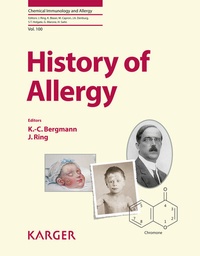
History of Allergy
1st Edition
Published on 27. May 2014
426 pages
978-3-318-02195-0 (ISBN)
Available for download
Description

A Karger 'Publishing Highlights 1890-2015' title The prevalence of allergic diseases has increased dramatically over recent decades, both in terms of the number of sufferers and the number of allergies. This is a trend that has frequently been referred to as 'the epidemic of the 21st century'. As described in ancient texts, allergies have been known for over 2,000 years, but the term 'allergy' was only coined at the beginning of the 20th century when doctors began to understand their pathophysiological basis. This book presents a detailed and varied historical overview of the field of allergology. Beginning with insights on allergy from antiquity to the 20th century and the development of the associated terminology, it compiles historical reflections on the understanding of the most common allergic diseases. Important milestones in the discovery of mechanisms of allergy are described, followed by historical accounts of the detection of allergens such as pollen, dust mites, peanuts and latex, and of environmental influences such as pollution and the relationship between farmers and their environment. Several chapters illustrate the progress made in allergy management to date. Particular highlights of this book are the personal reflections of and interviews with a number of pioneers of allergy, including F. Austen, J. Bienenstock, K. Blaser, A. de Weck, A.W. Frankland, K. Ishizaka, and many more. Concluding with portrayals of allergy societies and collections, as well as being supplemented by two films, this book represents a veritable treasure trove of fascinating and richly illustrated information. Not only researchers, physicians and medical historians, but also students and even non-scientists will find History of Allergy a scientific adventure well worth reading.
More details
Other editions
Additional editions
K.-C. Bergmann | J. Ring
History of Allergy
Book
05/2014
1st Edition
S. Karger
€114.50
Article exhausted; check different version
Persons
Content
- Cover
- Front Matter
- Contents
- Contributors
- Preface
- Allergy through 20 Centuries
- History of Allergy in Antiquity
- Abstract
- Mesopotamia
- Egypt
- Indigenous Populations in America
- China
- Ancient India
- Allergy in the Bible
- Greek-Roman Tradition
- Hay Fever/Rhinitis
- Herodotos
- Marcus Terentius Varro
- Asthma
- Aretaeus from Cappadocia
- Urticaria
- Food Allergy
- Eczema
- Famous Allergic Individuals in Antiquity
- Conclusion
- Acknowledgements
- References
- History of Allergy in the Middle Ages and Renaissance
- Abstract
- History of Medicine in the Middle Ages in the Middle East
- The Period from 1300 to 1700 BC
- The 15th and 16th Centuries
- Rose Fever
- Conclusion
- References
- Landmarks in Allergy during the 19th Century
- Abstract
- Hay Fever and Ragweed Pollinosis
- Anaphylaxis
- Asthma
- Eosinophils and Mast Cells
- References
- Milestones in the 20th Century
- Abstract
- Patients First - The First Patient's Organization for Allergy Sufferers
- Immunotherapy against Pollen and Other Allergens - The 'Backbone of Allergology'
- Anaphylaxis - The Discovery of a New Field in 1902
- The Determining Word Is Born in 1906
- Serum Sickness and the 'Case Langerhans'
- The Idea of Anaphylaxis Received Growing Interest .
- The Word 'Atopy' Has Remained to This Day
- The Transferability of an Allergy by Blood, or the Search for the 'Malefactor'
- The Transferability of an Allergy through Serum Is Proved
- Passive Cutaneous Anaphylaxis Test
- Scientific Allergy Diagnostics
- Scratch Test
- Precursor of the Prick Test
- Intracutaneous Test
- Rub Test
- Conjunctival Provocation
- Nasal Provocation Test
- Inhalation Tests
- Discovery of IgE and Slow Reacting Substances
- Discovery of Leukotrienes
- References
- Terminology of Allergic Phenomena
- Abstract
- Idiosyncrasy
- Antipathy
- Hypersensitivity
- Anaphylaxis
- Allergy
- Atopy
- Conclusion
- References
- Most Common Allergic Diseases: Historical Reflections in Understanding
- Anaphylaxis
- Abstract
- The Voyage on the Yacht Princesse Alice II
- Pathophysiology
- References
- Allergic Rhinitis
- Abstract
- An Allergy Giant in 1873
- Terminology and Definition
- Epidemiology and Natural History
- Allergens
- Histopathology and Pathogenesis
- Symptoms
- Treatment
- References
- Asthma
- Abstract
- The Beginning in the East
- The Beginning in the West
- The Middle Ages
- Modern Times
- Acknowledgments
- References
- Atopic Dermatitis/Atopic Eczema
- Abstract
- Chronological Agenda
- Atopic Dermatitis before 1800
- Atopic Dermatitis in Willanist Dermatology
- Atopic Dermatitis as a Diathetic Prurigo
- Birth of Atopic Dermatitis
- Criteria and Scores in the Contemporary Era
- Will Semantic Discussions End?
- Pathogenic Theories and Their Therapeutic Consequences
- Humoralistic Theories and Reluctance to Treat
- Digestive Theories and Diet
- Parasitic/Bacteriological Dimension of Eczema
- Allergological Theories, Hyposensitization and Allergen Eviction
- Fear of Treatment Side Effects
- Neuropsychological Considerations
- Other Hypotheses
- Dermatological Approach and Topical Therapy
- Conclusion
- References
- Allergic Contact Dermatitis
- Abstract
- Patch Testing - Jadassohn and Bloch
- Important Early Basic Science Discoveries
- Standard Series - Bonnevie
- Contact Dermatitis and Public Health - Ramazzini and Prosser White
- Contact Dermatitis Societies
- Improving Convenience - The TRUE Test
- Moving into the Computer Age - The CARD Database
- The Future of Allergic Contact Dermatitis
- Conclusion
- References
- Urticaria and Angioedema
- Abstract
- Urticaria
- Angioedema
- References
- Allergy and the Eye
- Abstract
- The Contribution of Ocular Allergy to a Better Understanding of Mechanisms of the Immune Reaction
- The Contribution of Ocular Allergy to Clinical Practice in Allergy and Clinical Immunology
- How Ocular Allergy Can Contribute to a Continuing Progress of Allergy and Clinical Immunology
- Conclusions
- References
- History of Food Allergy
- Abstract
- Food Allergy in Antiquity and the Middle Ages: Myth or Reality?
- First Documentation of Food Allergy - Skin Test as Diagnostic Routine Method
- Other Test Methods for Food Allergy Prior to the Discovery of Immunoglobulin E
- Radioallergosorbent Test - Significant Progress in the Diagnosis of Immunoglobulin E-Mediated Food Allergies
- Component-Resolved Diagnostic Techniques
- Double-Blind Placebo-Controlled Food Challenge - The Gold Standard and the Diagnosis of Food Allergy
- Fatal Food Allergies
- Pollen-Associated Food Allergies and the 'Oral Allergy Syndrome'
- 'Derivative Allergy' - A Rare Pathway of Elicitation of Food Allergy
- Food-Induced/Food-Dependent Exercise-Induced Anaphylaxis
- Oral Desensitization - Long Controversial, but Now Established
- Acknowledgement
- References
- Drug Hypersensitivity
- Abstract
- Drug Hypersensitivity - The Emergence of New Disorders
- Terminology - An Ongoing Controversy
- Early History - Poisons and Placebos
- 19th Century - The Dawn of Drug Hypersensitivity
- Drug-Induced Syndromes - The Bad and the Ugly
- Stevens-Johnson Syndrome and Toxic Epidermal Necrolysis
- Ampicillin Rash
- Drug Hypersensitivity Syndrome
- Acute Generalized Exanthematous Pustulosis
- Hoigné Syndrome
- Selected Drugs
- Halogenated Drugs - Iodine and Bromides
- Analgesics
- Salvarsan
- Anticonvulsants
- Sulfonamides
- Penicillin
- p -Amino Benzoic Acid
- Outlook
- References
- Aspirin Hypersensitivity
- Abstract
- The Discovery of Aspirin
- Hypersensitivity Reactions to ASA and NSAIDs
- Conclusions
- References
- Bradykinin-Mediated Diseases
- Abstract
- Inhibition of Bradykinin Degradation by Angiotensin-Converting Enzyme Inhibitors
- Hereditary Angioedema
- C1 Inhibitor as Inhibitor of the Bradykinin-Forming Cascade
- The Myth of C2-Kinin
- Bradykinin Is the Mediator of Hereditary Angioedema
- Treatment of Hereditary Angioedema
- Future Considerations
- References
- Mechanisms of Allergy: Important Discoveries
- The Discovery of Immunoglobulin E and Its Role in Allergy
- Abstract
- The Search for the Elusive Factor
- IgE and the Allergic Inflammation
- Allergy Diagnosis
- Treatment
- The Beneficial Function of IgE
- References
- T Cell Subpopulations
- Abstract
- Effector CD4+ T Cells
- Regulatory CD4+ T Cells
- Role of T Cell Subsets in Allergic Disorders
- Role of Innate Immunity in Allergic Disorders
- Concluding Remarks
- References
- Mast Cell Research
- Abstract
- Discovery of Histamine in Mast Cells/Basophils
- Discovery of IgE Receptors on Mast Cells/Basophils
- Discovery of Mast Cell Origin and the Culture Methods
- Mast Cell Phenotypes
- Discovery of Cytokine Production by Mast Cells
- Future Perspective
- References
- Basophils: Historical Reflections and Perspectives
- Abstract
- The Different Eras of Basophil Biology
- Activating Receptors on Human Basophils
- Inhibitory Receptors on Human Basophils
- Mediators
- Histamine-Releasing Factor
- Basophils as Potential Inducers of Type 2 Immunity
- Basophils as Antigen-Presenting Cells: An Unsettled Controversy
- Human Basophils and Angiogenesis
- Basophils in Immunity against Parasites
- Bidirectional Interactions between Bacteria and Basophils
- Basophils and Viral Infections
- Basophils and Autoimmune Disorders
- Basophils in Allergic Disorders
- Conclusions and Perspectives
- Acknowledgements
- References
- Eosinophils
- Abstract
- The Discovery
- The Origin of the Eosinophil and Its Granules: Different Views over Time
- Eosinophil-Mediated Diseases
- The Functions of the Eosinophil: Different Views over Time
- Conclusions
- References
- The Bradykinin-Forming Cascade: A Historical Perspective
- Abstract
- Factor XII
- Prekallikrein
- Kininogen
- Binding to Endothelial Cells
- A Surprise: Prekallikrein Is an Enzyme
- Concluding Remarks
- References
- Histamine Receptors and Antihistamines: From Discovery to Clinical Applications
- Abstract
- The Discovery of Histamine
- The Synthesis of the First Antihistamines and the Identification of H 1 R
- The Identification of H 2 R and the Synthesis of the First H 2 Blockers
- Histamine in the Brain
- Cloning of H 1 R, H 2 R and H 3 R, and Generation of Histamine Receptor Knockout Mice
- Identification and Cloning of H 4 R
- Closing Thoughts
- Acknowledgements
- References
- Detection of Environmental Influences and Allergens
- Pollen and Pollinosis
- Abstract
- Analysis of Airborne Pollen and Pollen Allergens
- First Descriptions of the Disease
- Monitoring and Monitoring Networks
- Acknowledgements
- References
- Mites and Allergy
- Abstract
- Allergens from House Dust Mites
- Allergens from Storage Mites
- Cross-Reactivity of Mite Allergens
- Effect of Parasitic Infections on Mite Allergy
- Environmental Control
- Mite Immunotherapy
- References
- Mammalian Airborne Allergens
- Abstract
- Mammalian Allergens and the Identification of 'the House Dust Allergen'
- The Postulated Role of Maillard Reaction Products
- Developments in Technologies for the Characterization of Allergens
- Persistent Contaminants and Mind-Boggling Complexities
- The Lipocalin Family
- The Secretoglobin Family
- Perspective: From Dust Back to Dust
- References
- The Latex Story
- Abstract
- Latex as a Rubber and Protein Source
- History of Latex Allergy - When Did the Problems Start?
- Who Were at Risk? Risk Factors and Epidemiology Aspects
- Characterization of Relevant Allergens
- Latex-Fruit/Plant Syndrome - Problems with Cross-Reactivity
- Latex as a Model for Molecular Allergology - How to Improve the Diagnosis?
- Preventive Measures - Successful Avoidance Strategy
- References
- Peanut Allergens
- Abstract
- Prevalence of Peanut Allergy
- Geographical Origin of Peanuts
- Class I Food Allergy
- Class II Food Allergies
- Allergens of Peanut
- Peanut Agglutinin and Cross-Reactive Carbohydrate Determinants
- Conclusion
- Acknowledgements
- References
- Environmental Pollution and Allergy: Historical Aspects
- Abstract
- Epidemiological Studies
- Aerobiological Studies
- In vitro Studies
- Animal Experiments
- Clinical Studies
- The Concept of 'Allergotoxicology'
- References
- Farmers and Their Environment: Protective Influences of the Farming Environment against the Development of Allergies
- Abstract
- Farmers and Their Environment
- Agriculture, the Art of Adaptation
- Drying
- Wrapping
- Mechanical Technology
- Allergology
- References
- Progress in Allergy Management
- History of Catecholamine Research
- Abstract
- Adrenaline in the Adrenal Medulla: Preludes
- Adrenaline in the Adrenal Medulla: Oliver and Schäfer, 1893/1894
- Adrenaline in the Adrenal Medulla: Independent Discoverers
- Chemistry
- Catecholamine Neurotransmitters: Adrenaline
- Formation and Destruction
- Catecholamine Neurotransmitters: Noradrenaline
- Catecholamine Neurotransmitters: Dopamine
- Membrane Passage
- Receptors
- References
- Antihistamines
- Abstract
- The Discovery of Antihistamines
- The Discovery of H2 , H3 and H4 Antihistamines
- First- and Second-Generation H1 Antihistamines
- H1 Antihistamines and the Central Nervous System
- H1 Antihistamines and Cardiotoxicity
- The Anti-Inflammatory Properties of H1 Antihistamines
- H1 Antihistamines Are Not Receptor Antagonists but Are Inverse Agonists
- Conclusions
- References
- Glucocorticoids
- Abstract
- Early Studies with Glucocorticoids
- First Controlled Trial of Glucocorticoid in Asthma
- Inhaled Glucocorticoids
- Combination Inhalers
- Mechanisms of Action
- Future Directions
- References
- Chromones
- Abstract
- Background
- The Chromones
- References
- Characterization and Standardization of Allergen Extracts
- Abstract
- The Beginning
- The First Purified Allergen Molecules
- Standardization Becomes International
- The Nomenclature of Allergens
- New Attempts for Allergen Standardization
- Concluding Remarks
- References
- Allergen-Specific Immunotherapy
- Abstract
- Spread of Immunotherapy
- Proof of Efficacy
- Improvement in Allergen Extracts
- Disease Modification by Immunotherapy
- Immunologic Mechanisms
- Alternative Approaches to Immunotherapy
- Additional Allergic Conditions Treated with Immunotherapy
- References
- Pioneers of Allergy: Personal Reflections
- K. Frank Austen
- Questions about your professional life
- John Bienenstock
- Questions about your professional life
- Kurt Blaser
- Questions about your professional life
- Alain de Weck (1928-2013)
- Questions about your professional life
- Reference
- Alfred William Frankland
- Questions about your professional life
- Oscar L. Frick
- Reflections on my career in allergy immunology
- Kimishige Ishizaka
- Questions about your professional life
- Lothar Jäger
- Questions about your professional life
- Terumasa Miyamoto
- Questions about your professional life
- Harry Morrow Brown (1917-2013)
- One of the last of the independent researchers?
- References
- Albert K. Oehling
- Questions about your professional life
- Heimo Reulecke
- Questions about your professional life
- Václav Spicák
- Questions about your professional life
- Allergy Societies and Collections
- American Academy of Allergy, Asthma & Immunology (AAAAI)
- Asia Pacific Association of Allergy, Asthmaand Clinical Immunology
- Collegium Internationale Allergologicum
- The Concept
- Symposia
- Reference
- European Academy ofAllergy and Clinical Immunology
- Japanese Society of Allergology
- Sociedad Latinoamericana de Alergia, Asma e Inmunología
- World Allergy Organization
- AAAAI Archives
- The Ilya Mechnikov Collection in Riga
- References
- Online Supplementary Material
- Movie 1: Anaphylaxie et Allergie
- Movie 2: World Allergy: The Disease of Civilization
- List of Illustrations / Figure Credits
- Subject Index
- Cover

