

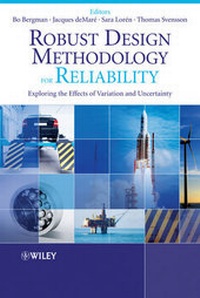
Robust Design Methodology for Reliability
Description

More details
Other editions
Additional editions
Persons
Bo Bergman has held the post of SKF professor at the Department of Quality Sciences at Chalmers University of Technology, Sweden since 1999. From 1983 to 1999 he was Professor of Quality Technology and Management at Linköping University, where he was responsible for the creation of education and research in the quality field, and previous to this he held varying engineering and managerial positions in the fields of reliability, quality and statistics at Saab Aerospace. His research interests cover wide areas of quality of both a quantitative and a qualitative nature. He has authored more than 50 papers in international scientific journals and has authored and co-authored a number of books - including new, completely revised English versions of Quality from Customer Needs to Customer Satisfaction and Six Sigma; the Pragmatic Approach.
Jacques Demaré has held the post of Professor of Mathematical Statistics at Chalmers University of Technology since 1999. The focus of his work has been on both chemical and mechanical applications and he is currently working with statistical methods for material fatigue in co-operation with the Swedish National Testing and Research Institute. At Chalmers he has also worked in different ways to bring the mathematical and engineering disciplines closer together.
Thomas Svensson is a research engineer at the Technical Research Institute of Sweden (SP). He obtained his PhD in Fatigue Life Prediction in Service - A Statistical Approach in 1996, and is a member of the editorial board of Fatigue and Fracture of Engineering Materials and Structures.
Content
Acknowledgements
About the Editors
Contributors
PART One METHODOLOGY
1 Introduction
Bo Bergman and Martin Arvidsson
1.1 Background
1.2 Failure Mode Avoidance
1.3 Robust Design
1.4 Comments and Suggestions for Further Reading
References
2 Evolution of Reliability Thinking - Countermeasures for Some Technical Issues
Åke Lönnqvist
2.1 Introduction
2.2 Method
2.3 An Overview of the Initial Development of Reliability Engineering
2.4 Examples of Technical Issues and Reliability Countermeasures
2.5 Discussion and Future Research
2.6 Summary and Conclusions
References
3 Principles of Robust Design Methodology
Martin Arvidsson and Ida Gremyr
3.1 Introduction
3.2 Method
3.3 Results and Analysis
3.4 Discussion
3.5 Conclusions
References
PART Two METHODS
4 Including Noise Factors in Design Failure Mode and Effect Analysis (D-FMEA) - A
Case Study at Volvo Car Corporation
Åke Lönnqvist
4.1 Introduction
4.2 Background
4.3 Method
4.4 Result
4.5 Discussion and Further Research
4.6 Summary
References
5 Robust Product Development Using Variation Mode and Effect Analysis
Alexander Chakhunashvili, Stefano Barone, Per Johansson and Bo Bergman
5.1 Introduction
5.2 Overview of the VMEA Method
5.3 The Basic VMEA
5.4 The Enhanced VMEA
5.5 The Probabilistic VMEA
5.6 An Illustrative Example
5.7 Discussion and Concluding Remarks
Appendix: Formal Justification of the VMEA Method
References
6 Variation Mode and Effect Analysis: An Application to Fatigue Life Prediction
Pär Johannesson, Thomas Svensson, Leif Samuelsson, Bo Bergman and Jacques de Maré
6.1 Introduction
6.2 Scatter and Uncertainty
6.3 A Simple Approach to Probabilistic VMEA
6.4 Estimation of Prediction Uncertainty
6.5 Reliability Assessment
6.6 Updating the Reliability Calculation
6.7 Conclusions and Discussion
References
7 Predictive Safety Index for Variable Amplitude Fatigue Life
Thomas Svensson, Jacques de Maré and Pär Johannesson
7.1 Introduction
7.2 The Load-Strength Reliability Method
7.3 The Equivalent Load and Strength Variables
7.4 Reliability Indices
7.5 The Gauss Approximation Formula
7.6 The Uncertainty Due to the Estimated Exponent ß
7.7 The Uncertainty Measure of Strength
7.8 The Uncertainty Measure of Load
7.9 The Predictive Safety Index
7.10 Discussion
Appendix
References
8 Monte Carlo Simulation versus Sensitivity Analysis
Sara Lorén, Pär Johannesson and Jacques de Mar¿e
8.1 Introduction
8.2 Transfer Function
8.3 Example from an Industrial Context
8.4 Highly Nonlinear Transfer Function
8.5 Total Variation for Logarithmic Life
8.6 Conclusions
References
PART Three MODELLING
9 Model Complexity Versus Scatter in Fatigue
Thomas Svensson
9.1 Introduction
9.2 A Statistical Model
9.3 Design Concepts
9.4 A Crack Growth Model
9.5 Partly Measurable Variables
9.6 Conclusions
References
10 Choice of Complexity in Constitutive Modelling of Fatigue Mechanisms
Erland Johnson and Thomas Svensson
10.1 Background
10.2 Questions
10.3 Method
10.4 Empirical Modelling
10.5 A Polynomial Example
10.6 A General Linear Formulation
10.7 A Fatigue Example
References
11 Interpretation of Dispersion Effects in a Robust Design Context
Martin Arvidsson, Ida Gremyr and Bo Bergman
11.1 Introduction
11.2 Dispersion Effects
11.3 Discussion
References
12 Fatigue Damage Uncertainty
Anders Bengtsson, Klas Bogsjöand Igor Rychlik
12.1 Introduction
12.2 Fatigue Review
12.3 Probability for Fatigue Failure - Safety Index
12.4 Computation of E [D(T )|k] and V [D(T )|k]
12.5 Non Gaussian Loads - Examples
References
13 Widening the Perspectives
Bo Bergman and Jacques de Maré
13.1 Background
13.2 Additional Engineering Perspectives on Reliability
13.3 Organizational Perspectives on Reliability
13.4 Industrialization of Robust Design Methodology
13.5 Adoptions of Fatigue Reliability Methodology
13.6 Learning for the Future
References
List of Abbreviations
Index
