

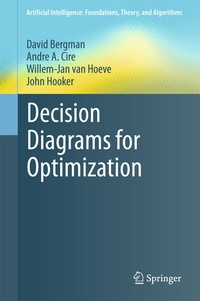
Decision Diagrams for Optimization
Description

This book introduces a novel approach to discrete optimization, providing both theoretical insights and algorithmic developments that lead to improvements over state-of-the-art technology. The authors present chapters on the use of decision diagrams for combinatorial optimization and constraint programming, with attention to general-purpose solution methods as well as problem-specific techniques.
The book will be useful for researchers and practitioners in discrete optimization and constraint programming.
"
Decision Diagrams for Optimization is one of the most exciting developments emerging from constraint programming in recent years. This book is a compelling summary of existing results in this space and a must-read for optimizers around the world.
" [Pascal Van Hentenryck]
Reviews / Votes
"This book goes far beyond answering natural questions about how to use Decision Diagrams in Discrete Optimization: it rigorously defines a comprehensive methodology, shows impressive potential from the computational standpoint and highlights unexpected and exciting research venues. A great and inspiring read!" (Andrea Lodi, École Polytechnique de Montréal)
"Decision Diagrams for Optimization is one of the most exciting developments emerging from constraint programming in recent years. This book is a compelling summary of existing results in this space and a must-read for optimizers around the world." (Pascal Van Hentenryck, University of Michigan)
"This book provides an excellent demonstration of how the concepts and tools of one research community can cross into another, yielding powerful insights and ideas ... The authors show how the main strategies used in discrete optimization, including problem relaxation, branching search, constraint propagation, primal solving, and problem-specific modeling, can be adapted and cast into a decision diagram framework." (Randal E. Bryant, Carnegie Mellon University)
More details
Other editions
Additional editions
Content
Introduction.- Historical Overview.- Exact Decision Diagrams.- Relaxed Decision Diagrams.- Restricted Decision Diagrams.- Branch-and-Bound Based on Decision Diagrams.- Variable Ordering.- Recursive Modeling.- MDD-Based Constraint Programming.- MDD Propagation for Sequence Constraints.- Sequencing and Single-Machine Scheduling.- Index.
