

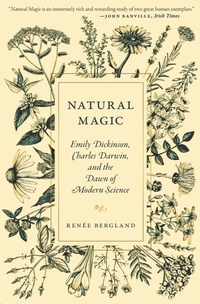
Natural Magic
Emily Dickinson, Charles Darwin, and the Dawn of Modern Science
1st Edition
Published on 24. April 2024
440 pages
978-0-691-23529-5 (ISBN)
Description

A captivating portrait of the poet and the scientist who shared an enchanted view of nature
Emily Dickinson and Charles Darwin were born at a time when the science of studying the natural world was known as natural philosophy, a pastime for poets, priests, and schoolgirls. The world began to change in the 1830s, while Darwin was a young naturalist aboard the Beagle and Dickinson was a student in Amherst, Massachusetts. Poetry and science started to grow apart, and modern thinkers challenged the old orthodoxies, offering thrilling new perspectives that suddenly felt radical-and too dangerous for women.
Natural Magic intertwines the stories of these two luminary nineteenth-century minds whose thought and writings captured the awesome possibilities of the new sciences and at the same time strove to preserve the magic of nature. Just as Darwin's work was informed by his roots in natural philosophy and his belief in the interconnectedness of all life, Dickinson's poetry was shaped by her education in botany, astronomy, and chemistry, and by her fascination with the enchanting possibilities of Darwinian science. Casting their two very different careers in an entirely fresh light, Renée Bergland brings to life a time when ideas about science were rapidly evolving, reshaped by poets, scientists, philosophers, and theologians alike. She paints a colorful portrait of a remarkable century that transformed how we see the natural world.
Illuminating and insightful, Natural Magic explores how Dickinson and Darwin refused to accept the separation of art and science. Today, more than ever, we need to reclaim their shared sense of ecological wonder.
Emily Dickinson and Charles Darwin were born at a time when the science of studying the natural world was known as natural philosophy, a pastime for poets, priests, and schoolgirls. The world began to change in the 1830s, while Darwin was a young naturalist aboard the Beagle and Dickinson was a student in Amherst, Massachusetts. Poetry and science started to grow apart, and modern thinkers challenged the old orthodoxies, offering thrilling new perspectives that suddenly felt radical-and too dangerous for women.
Natural Magic intertwines the stories of these two luminary nineteenth-century minds whose thought and writings captured the awesome possibilities of the new sciences and at the same time strove to preserve the magic of nature. Just as Darwin's work was informed by his roots in natural philosophy and his belief in the interconnectedness of all life, Dickinson's poetry was shaped by her education in botany, astronomy, and chemistry, and by her fascination with the enchanting possibilities of Darwinian science. Casting their two very different careers in an entirely fresh light, Renée Bergland brings to life a time when ideas about science were rapidly evolving, reshaped by poets, scientists, philosophers, and theologians alike. She paints a colorful portrait of a remarkable century that transformed how we see the natural world.
Illuminating and insightful, Natural Magic explores how Dickinson and Darwin refused to accept the separation of art and science. Today, more than ever, we need to reclaim their shared sense of ecological wonder.
More details
Other editions
Additional editions
Book
02/2026
Princeton University Press
€24.00
Shipment within 10-20 days
Book
04/2024
Princeton University Press
€35.00
Shipment within 10-20 days
Person
Renée Bergland is professor of literature and creative writing at Simmons University. She is the author of Maria Mitchell and the Sexing of Science: An Astronomer among the American Romantics and The National Uncanny: Indian Ghosts and American Subjects.
Content
- Cover
- Contents
- Preface: An Orchis' Heart
- Introduction: An Enchanted World
- Chapter 1. Darwin and Dickinson, Childhood Portraits
- Chapter 2. Darwin the Naturalist: Shropshire, Edinburgh, Cambridge, 1809-1831
- Darwin, to Age 22
- Chapter 3. Nature's People: Scientific Amherst: Amherst, 1830-1836
- Dickinson, to Age 6
- Chapter 4. Juggler, Geologist, Dark Horse: Aboard the Beagle, 1832-1836
- Darwin, Age 23-27
- Chapter 5. Dickinson the Bold: Amherst, 1836-1847
- Dickinson, Age 6-16
- Chapter 6. The Leading Scientific Men: London and Amherst, 1836-1845
- Chapter 7. Religion of Geology: South Hadley, Amherst, 1847-1851
- Dickinson, Age 16-20
- Chapter 8. A Slow-Sailing Ship: Downe, Great Malvern, 1842-1851
- Darwin, Age 33-42
- Chapter 9. Excitement in the Village: Amherst, 1851-1857
- Dickinson, Age 20-26
- Chapter 10. On the Origin of Species: Downe, 1858-1860
- Darwin, Age 49-51
- Chapter 11. If You Saw a Bullet: Amherst, 1857-1861
- Dickinson, Age 26-31
- Chapter 12. Wild Experiment: Downe and Amherst, 1860-1862
- Chapter 13. Melody or Witchcraft?: Amherst, 1862-1866
- Chapter 14. Mutual Friends: Downe and Amherst, 1866-1882
- Chapter 15. Perfectly Disinterested: Darwin's Last Days
- Chapter 16. Nature Is a Haunted House: Dickinson Faces Death
- Afterword: Hope Is a Strange Invention: Darwin and Dickinson in the Twenty-First Century
- Acknowledgments
- Notes
- Bibliographic Note
- Bibliography
- Index
