

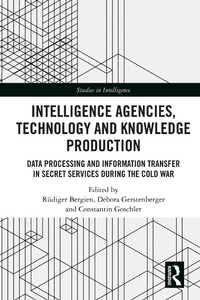
Intelligence Agencies, Technology and Knowledge Production
Data Processing and Information Transfer in Secret Services during the Cold War
1st Edition
Published on 17. February 2022
308 pages
978-1-000-54319-3 (ISBN)
Description

This volume examines intelligence services since 1945 in their role as knowledge producers.
Intelligence agencies are producers and providers of arcane information. However, little is known about the social, cultural and material dimensions of their knowledge production, processing and distribution. This volume starts from the assumption that during the Cold War, these core activities of information services underwent decisive changes, of which scientization and computerisation are essential. With a focus on the emerging alliances between intelligence agencies, science and (computer) technology, the chapters empirically explore these transformations and are characterised by innovative combinations of intelligence history with theoretical considerations from the history of science and technology and the history of knowledge.
At the same time, the book challenges the bipolarity of Cold War history in general and of intelligence history in particular in favour of comparative and transnational perspectives. The focus is not only the Soviet Union and the United States, but also Poland, Turkey, the two German states and Brazil. This approach reveals surprising commonalities across systems: time and again, the expansion and use of intelligence knowledge came up against the limits that resulted from intelligence culture itself. The book enriches our global understanding of knowledge of the state and contributes to a historical framework for the past decade of debates about the societal consequences of intelligence data processing.
This book will be of much interest to students of intelligence studies, science and technology studies, security studies and International Relations.
Intelligence agencies are producers and providers of arcane information. However, little is known about the social, cultural and material dimensions of their knowledge production, processing and distribution. This volume starts from the assumption that during the Cold War, these core activities of information services underwent decisive changes, of which scientization and computerisation are essential. With a focus on the emerging alliances between intelligence agencies, science and (computer) technology, the chapters empirically explore these transformations and are characterised by innovative combinations of intelligence history with theoretical considerations from the history of science and technology and the history of knowledge.
At the same time, the book challenges the bipolarity of Cold War history in general and of intelligence history in particular in favour of comparative and transnational perspectives. The focus is not only the Soviet Union and the United States, but also Poland, Turkey, the two German states and Brazil. This approach reveals surprising commonalities across systems: time and again, the expansion and use of intelligence knowledge came up against the limits that resulted from intelligence culture itself. The book enriches our global understanding of knowledge of the state and contributes to a historical framework for the past decade of debates about the societal consequences of intelligence data processing.
This book will be of much interest to students of intelligence studies, science and technology studies, security studies and International Relations.
More details
Series
Edition
1. Auflage
Language
English
Place of publication
London
United Kingdom
Publishing group
Taylor & Francis Ltd
Target group
College/higher education
Professional and scholarly
Product notice
Reflowable
Illustrations
14 Halftones, black and white; 14 Illustrations, black and white
ISBN-13
978-1-000-54319-3 (9781000543193)
Copyright in bibliographic data and cover images is held by Nielsen Book Services Limited or by the publishers or by their respective licensors: all rights reserved.
Schweitzer Classification
Other editions
Additional editions
Ruediger Bergien | Debora Gerstenberger | Constantin Goschler
Intelligence Agencies, Technology and Knowledge Production
Data Processing and Information Transfer in Secret Services during the Cold War
Book
09/2023
1st Edition
Routledge
€65.80
Shipment within 15-20 days
Ruediger Bergien | Debora Gerstenberger | Constantin Goschler
Intelligence Agencies, Technology and Knowledge Production
Data Processing and Information Transfer in Secret Services during the Cold War
Book
02/2022
1st Edition
Routledge
€206.90
Shipment within 15-20 days
Persons
Ruediger Bergien is a Professor of Intelligence History at the Federal University for Applied Administrative Sciences, Germany.
Debora Gerstenberger is Assistant Professor for Latin American History at the Institute for Latin American Studies, Freie Universitaet Berlin, Germany.
Constantin Goschler is Professor for Contemporary History at the Ruhr-University Bochum, Germany, and is currently directing a research group on 'Security, Democracy and Transparency'.
Debora Gerstenberger is Assistant Professor for Latin American History at the Institute for Latin American Studies, Freie Universitaet Berlin, Germany.
Constantin Goschler is Professor for Contemporary History at the Ruhr-University Bochum, Germany, and is currently directing a research group on 'Security, Democracy and Transparency'.
Content
The Knowledge of Intelligence Agencies in the Cold War World: An Introduction Ruediger Bergien, Debora Gerstenberger, and Constantin Goschler 1. Compromised Cooperation: Researchers on Eastern Europe in the Service of Intelligence in West Germany after 1945 Thomas Wolf 2. Dogma versus Progress: KGB's Scientific and Technological Surveillance (In-) Capacities from the 1960s to the 1980s Evgenia Lezina 3. Mission Impossible: The Difficult Consolidation of Strategic Intelligence in the United States During the Cold War Andreas Lutsch 4. American Security Databases and the Production of Space, 1967-1974: Enhancing or Obscuring Patterns? Jens Wegener 5. Knowledge Transfer and Technopolitics: The CIA, the West German Intelligence Service, and the Digitization of Information Processing in the 1960s Ruediger Bergien 6. Information Technology is Power: The Intelligence Service's Grab for the Digital Computing Sector in Brazil Marcelo Vianna 7. The Computer as Document Shredder: Video Terminals and the Dawn of a New Era of Knowledge Production in Brazil's Servico Nacional de Informacoes (SNI) Debora Gerstenberger 8. Turkish Intelligence, Surveillance and the Secrets of the Cold War: Blocked Modernization? Egemen Bezci 9. Solid Modernity: Data Storage and Information Circuits in the Communist Security Police in Poland Franciszek Dabrowski 10. Perceptions of Digital Computers at the German Domestic Intelligence Service: Eliminating the Human Factor? Christopher Kirchberg 11. Global Intelligence Academies: Information Schools during the Civil-Military Dictatorship in Brazil Samantha Viz Quadrat 12. Intelligence Public Relations: The Annual Reports on the Protection of the Constitution in West Germany Marcel Schmeer Conclusion Ruediger Bergien, Debora Gerstenberger, and Constantin Goschler
