

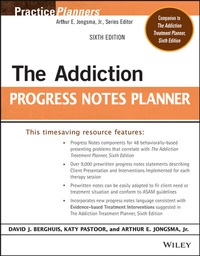
The Addiction Progress Notes Planner
Description

An invaluable practice resource for practitioners engaged in addictions treatment
In The Addiction Progress Notes Planner, Sixth Edition, a team of distinguished mental health professionals delivers complete, pre-written session and patient presentation descriptions for every behavioral problem in the Addictions Treatment Planner, Sixth Edition. Each note can be simply and quickly adapted to fit a real-world client need or treatment situation while remaining completely unified with the client's treatment plan.
This new edition offers new and revised evidence-based objectives and interventions organized around 46 behavior-based presentations, including alcoholism, nicotine dependence, substance abuse, problem gambling, eating disorders, and sexual addictions. The resource also offers:
- A wide array of treatment approaches that correspond to the behavioral problems and DSM-V diagnostic categories included in the Addiction Treatment Planner, Sixth Edition
- Sample progress notes conforming to the requirements of most third-party payors and accrediting agencies, including CARF, TJC, COA, and the NCQA
- Brand-new chapters on Opioid Use Disorder, Panic/Agoraphobia, and Vocational Stress
The Addiction Progress Notes Planner is an indispensable practice aid for addictions counselors, mental health counselors, social workers, psychologists, psychiatrists, and anyone else treating clients suffering from addictions.
DAVID J. BERGHUIS, MA, LLP, is President and Clinical Director for Berghuis Psychological Services, a leading provider of treatment for individuals with sexual behavior problems. He is President of the Michigan Chapter of the Association for Treatment of Sexual Abusers.
KATY PASTOOR is a Limited Licensed Psychologist at Berghuis Psychological Services, working with patients with demonstrated sexual behavior problems. Her work includes the completion of risk assessments, the running of treatment groups, and conducting individual therapy with clients.
ARTHUR E. JONGSMA, JR., PHD, is Series Editor for the bestselling Practice Planners. He has provided professional mental health services to both inpatient and outpatient clients for approximately 50 years. He was the Founder and Director of Psychological Consultants, a group private practice in Michigan for 25 years. He consulted to numerous addiction treatment facilities that provided outpatient, intensive outpatient, residential, and inpatient care.
More details
Other editions
Additional editions
Previous edition
Content
- Cover
- Title Page
- Copyright Page
- Contents
- Practiceplanners® Series Preface
- Progress Notes Introduction
- About Practiceplanners® Progress Notes
- How to Use This Progress Notes Planner
- A Final Note About Progress Notes and Hipaa
- Chapter 1 Adult-Child-of-an-Alcoholic (ACA) Traits
- Client Presentation
- Interventions Implemented
- Chapter 2 Anger
- Client Presentation
- Interventions Implemented
- Chapter 3 Antisocial Behavior
- Client Presentation
- Interventions Implemented*
- Chapter 4 Anxiety
- Client Presentation
- Interventions Implemented
- Chapter 5 Attention-Deficit/Hyperactivity Disorder (ADHD)-Adolescent
- Client Presentation
- Interventions Implemented
- Chapter 6 Attention-Deficit/Hyperactivity Disorder (ADHD)-Adult
- Client Presentation
- Interventions Implemented
- Chapter 7 Bipolar Disorder
- Client Presentation
- Interventions Implemented
- Chapter 8 Borderline Traits
- Client Presentation
- Interventions Implemented
- Chapter 9 Childhood Trauma
- Client Presentation
- Interventions Implemented
- Chapter 10 Chronic Pain
- Client Presentation
- Interventions Implemented
- Chapter 11 Conduct Disorder/Delinquency
- Client Presentation
- Interventions Implemented
- Chapter 12 Dangerousness/Lethality
- Client Presentation
- Interventions Implemented
- Chapter 13 Dependent Traits
- Client Presentation
- Interventions Implemented
- Chapter 14 Depression-unipolar
- Client Presentation
- Interventions Implemented
- Chapter 15 Eating Disorders and Obesity
- Client Presentation
- Interventions Implemented
- Chapter 16 Family Conflicts
- Client Presentation
- Interventions Implemented
- Chapter 17 Gambling
- Client Presentation
- Interventions Implemented
- Chapter 18 Grief/Loss Unresolved
- Client Presentation
- Interventions Implemented
- Chapter 19 Impulsivity
- Client Presentation
- Interventions Implemented
- Chapter 20 Legal Problems
- Client Presentation
- Interventions Implemented
- Chapter 21 Living Environment Deficiency
- Client Presentation
- Interventions Implemented
- Chapter 22 Medical Issues
- Client Presentation
- Interventions Implemented
- Chapter 23 Narcissistic Traits
- Client Presentation
- Interventions Implemented
- Chapter 24 Nicotine Abuse/Dependence
- Client Presentation
- Interventions Implemented
- Chapter 25 Obsessive Compulsive Disorder (OCD)
- Client Presentation
- Interventions Implemented
- Chapter 26 Occupational Problems
- Client Presentation
- Interventions Implemented
- Chapter 27 Opioid Use Disorder
- Client Presentation
- Interventions Implemented
- Chapter 28 Oppositional Defiant Behavior
- Client Presentation
- Interventions Implemented
- Chapter 29 Panic Disorder/Agoraphobia
- Client Presentation
- Interventions Implemented
- Chapter 30 Parent-Child Relational Problem
- Client Presentation
- Interventions Implemented
- Chapter 31 Partner Relational Conflicts
- Client Presentation
- Interventions Implemented
- Chapter 32 Peer Group Negativity
- Client Presentation
- Interventions Implemented
- Chapter 33 Posttraumatic Stress Disorder (PTSD)
- Client Presentation
- Interventions Implemented
- Chapter 34 Psychosis
- Client Presentation
- Interventions Implemented
- Chapter 35 Readiness to Change
- Client Presentation
- Interventions Implemented
- Chapter 36 Relapse Proneness
- Client Presentation
- Interventions Implemented
- Chapter 37 Self-Harm
- Client Presentation
- Interventions Implemented
- Chapter 38 Self-care Deficits-Primary
- Client Presentation
- Interventions Implemented
- Chapter 39 Self-care Deficits-Secondary
- Client Presentation
- Interventions Implemented
- Chapter 40 Sexual Abuse
- Client Presentation
- Interventions Implemented
- Chapter 41 Sexual Promiscuity
- Client Presentation
- Interventions Implemented
- Chapter 42 Sleep Disturbance
- Client Presentation
- Interventions Implemented
- Chapter 43 Social Anxiety/Skills Deficit
- Client Presentation
- Interventions Implemented
- Chapter 44 Spiritual Confusion
- Client Presentation
- Interventions Implemented
- Chapter 45 Substance-Induced Disorders
- Client Presentation
- Interventions Implemented
- Chapter 46 Substance Intoxication/Withdrawal
- Client Presentation
- Interventions Implemented
- Chapter 47 Substance Use Disorders
- Client Presentation
- Interventions Implemented
- Chapter 48 Suicidal Ideation
- Client Presentation
- Interventions Implemented
- EULA
ADULT-CHILD-OF-AN-ALCOHOLIC (ACA) TRAITS
CLIENT PRESENTATION
- Raised in an Alcoholic Home (1)*
- The client described a history of being raised in an alcoholic home but denied any effects of such an upbringing.
- The client described a history of being raised in an alcoholic home but was uncertain about how this affected their emotions.
- The client described a history of being raised in an alcoholic home and identified effects, including emotional abandonment, role confusion, abuse, and a chaotic, unpredictable environment.
- The client processed issues related to being raised in an alcoholic home, including emotional abandonment, role confusion, abuse, and a chaotic, unpredictable environment.
- Unresolved Childhood Trauma (2)
- The client described a history of childhood trauma caused by family addiction but denied any effects of this behavior.
- The client described a history of childhood trauma caused by family addiction but was unsure of any effects of this behavior.
- The client described a history of unresolved childhood trauma caused by family addiction.
- The client resolved the feelings associated with the childhood trauma caused by family addiction.
- Inability to Trust and Share Feelings (3)
- The client revealed a pattern of extreme difficulty in trusting others, sharing feelings, or talking openly about self.
- When sharing openly with others, the client experiences feelings of anxiety and uncertainty.
- As the client has begun to work through adult-child-of-an-alcoholic (ACA) concerns, they have reported feeling less anxiety or uncertainty when sharing emotional concerns.
- The client no longer experiences anxiety or uncertainty while sharing emotions.
- Overconcern With Others (4)
- The client described a pattern of consistently being overly concerned with taking care of others, resulting in failure to care for self.
- The client identified a need to reduce focus on others' functioning and to replace this with a focus on their own functioning.
- The client has been able to balance the focus on others' functioning with a focus on their own functioning.
- Passive Submission (5)
- The client described a history of being passively submissive to the wishes of others, in an effort to please them.
- The client tries to ingratiate self to others by being submissive to their wishes.
- The client acknowledged the need to become more assertive but has struggled to implement the assertiveness.
- The client is being self-assertive and setting healthy limits.
- Clings to Destructive Relationships (6)
- The client described a pattern of clinging to destructive relationships in order to avoid interpersonal abandonment.
- Hypersensitivity to abandonment has caused the client to maintain relationships that are destructive.
- The client has acknowledged interpersonal abandonment as a significant issue.
- The client accepts interpersonal conflict and is changing destructive relationships.
- Tells Others What They Want to Hear (7)
- The client described a pattern of disregarding reality in order to present information so that others will be pleased.
- The client identifies situations in which the client has been able to be more truthful.
- The client described the acceptance of others in response to the client's increased truthfulness.
- Feels Worthless (8)
- The client verbalized seeing self as being worthless and that disrespectful treatment by others was normal and expected.
- The client has begun to develop a more positive image of self-worth and is more expectant of positive treatment from others.
- The client clearly identifies improved self-image and insists on being treated in a respectful manner.
- Experiences of Abandonment and Abuse (9)
- The client described feeling unwanted, unimportant, and unloved because of experiences of abandonment and abuse.
- The client has reduced feelings of being unwanted, unimportant, or unloved.
- The client verbalized feeling wanted, important, and loved in relationships with others.
- Panic When Relationships End (10)
- The client described a pattern of strong feelings of panic and helplessness when faced with being alone as a close relationship ends.
- The client described a chronic pattern of precipitating problems in a relationship because of feelings of panic and helplessness when faced with the possibility of friction in a close relationship.
- The client has become more at peace with the natural process of relationships beginning and ending.
- Sublimates Own Needs to Attempt to Fix Others (11)
- The client described situations in which the client has attempted to "fix" other people.
- The client identified that they often sublimate their own needs in attempts to "fix" others.
- The client identified several examples of how they sublimate needs in order to try to "fix" others.
- As the client has gained insight into the tendency to prioritize their own needs below fixing others, the client has decreased this pattern.
- The client indicated a decreased need to "fix" others and is able to appropriately concentrate on their own needs.
- Parental Role (12)
- The client described a consistent pattern of selecting relationships with immature individuals.
- The client described a strong tendency to take on a parental role in a relationship, allowing the partner to continue in a pattern of immaturity.
- The client is beginning to accept responsibility for taking on a parental role in relationships.
- The client describes a pattern of replacing the parental role with a more equal relationship with peers.
- Feels Less Worthy (13)
- The client described self as having less worth, especially when compared with individuals who did not grow up in an alcoholic family.
- The client has begun to develop a more positive self-image and has terminated verbalizing negative comments about self.
- The client has begun to make positive comments about self and the positive aspects of their family.
INTERVENTIONS IMPLEMENTED
- Build Trust and Establish Rapport (1)*
- Caring was conveyed to the client through support, warmth, and empathy.
- The client was provided with nonjudgmental support and a level of trust was developed.
- The client was urged to feel safe in expressing experiences as an ACA.
- The client began to express feelings more freely as rapport and trust level have increased.
- The client has continued to experience difficulty being open and direct about the expression of painful feelings; the client was encouraged to use the safe haven of therapy to express these difficult issues.
- Focus on Strengthening Therapeutic Relationship (2)
- The relationship with the client was strengthened using empirically supported factors.
- The relationship with client was strengthened through the implementation of a collaborative approach, agreement on goals, demonstration of empathy, verbalization of positive regard, and collection of client feedback.
- The client reacted positively to the relationship-strengthening measures taken.
- The client verbalized feeling supported and understood during therapy sessions.
- Despite attempts to strengthen the therapeutic relationship the client reports feeling distant and misunderstood.
- The client has indicated that sessions are not helpful and will be terminating therapy.
- Explore Feelings of Powerlessness (3)
- The client was probed for childhood experiences of powerlessness while growing up in an alcoholic home.
- The client was asked to explore similarities between feelings of childhood powerlessness and feelings when abusing chemicals.
- The client was assigned to complete the Step 1 exercise in The Alcoholism and Drug Abuse Client Workbook (Perkinson).
- The client was assisted in comparing and contrasting adult feelings of powerlessness connected to substance abuse with historical feelings of powerlessness associated with growing up in an alcoholic home.
- The client was probed for childhood experiences of powerlessness but denied any concerns in this area.
- Teach Connection Between Childhood and Addiction (4)
- The client was taught about the increased likelihood to repeat addictive behavior because of growing up in an addictive family.
- The client was taught specific syndromes of thought and behavior that often repeat from one addictive generation to another.
- The client was provided with specific examples of the repetition of addiction from one generation to another.
- The client was encouraged to identify the connection between childhood experiences and the likelihood of repeating behavior.
- The client denied any connection between childhood experiences and the likelihood of repeating those types of behaviors; the client was reminded to be aware of this connection.
- Administer Assessment for ACA Traits (5)
- The client was administered psychological...
