

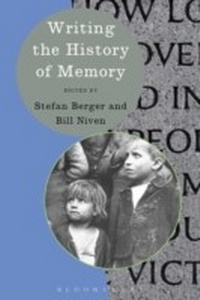
Writing the History of Memory
1st Edition
Published on 13. February 2014
224 pages
978-1-84966-673-2 (ISBN)
Description

How objective are our history books? This addition to the Writing History series examines the critical role that memory plays in the writing of history.
This book includes:
- Essays from an international team of historians, bringing together analysis of forms of public history such as museums, exhibitions, memorials and speeches
- Coverage of the ancient world to the present, on topics such as oral history and generational and collective memory
- Two key case studies on Holocaust memorialisation and the memory of Communism
This book includes:
- Essays from an international team of historians, bringing together analysis of forms of public history such as museums, exhibitions, memorials and speeches
- Coverage of the ancient world to the present, on topics such as oral history and generational and collective memory
- Two key case studies on Holocaust memorialisation and the memory of Communism
More details
Series
Edition
1. Auflage
Language
English
Place of publication
London
United Kingdom
Publishing group
Bloomsbury Publishing PLC
Target group
College/higher education
Professional and scholarly
ISBN-13
978-1-84966-673-2 (9781849666732)
Copyright in bibliographic data and cover images is held by Nielsen Book Services Limited or by the publishers or by their respective licensors: all rights reserved.
Schweitzer Classification
Other editions
Additional editions
Stefan Berger | Bill Niven
Writing the History of Memory
Book
02/2014
Bloomsbury Academic
€35.00
Shipment within 10-20 days
Persons
Stefan Berger is Professor of Social History and Director of the Institute of Social Movements and the House for the History of the Ruhr at the Ruhr University Bochum, Germany.
Bill Niven is Professor of Contemporary German History at Nottingham Trent University, UK. He is author (with JKA Thomaneck) of Dividing and Uniting Germany (2000), and of Facing the Nazi Past (2001) and The Buchenwald Child (2007). He is also the editor of Germans as Victims and has published widely on many areas of post-1918 German history.
Bill Niven is Professor of Contemporary German History at Nottingham Trent University, UK. He is author (with JKA Thomaneck) of Dividing and Uniting Germany (2000), and of Facing the Nazi Past (2001) and The Buchenwald Child (2007). He is also the editor of Germans as Victims and has published widely on many areas of post-1918 German history.
Content
Introduction - Bill Niven (Nottingham Trent University, UK) and Stefan Berger (Ruhr-Universitaet Bochum, Germany)
1. Memory and History in the Ancient World - Gordon Shrimpton (Professor Emeritus, University of Victoria, Canada)
2. Memory and History in the Middle Ages - Kimberly Rivers (University of Wisconsin Oshkosh, USA)
3. History-writing and 'Collective Memory' - Mary Fulbrook (UCL, UK)
4. Memory as both Source and Subject of Study: The Transformations of Oral History - Lynn Abrams (University of Glasgow, UK)
5. Generation and Memory: A Critique of the Ethical and Ideological Implications of Generational Narration - Wulf Kansteiner (Binghamton University, USA)
6. Writing the History of National Memory - Stefan Berger and Bill Niven
7. Lieux de mémoire - A European Transfer Story - Benoît Majerus (University of Luxembourg, Luxembourg)
8. On the Memory of Communism in Eastern and Central Europe - Attila Pok (Resarch Centre for Humanities of the Hungarian Academy of Sciences, Hungary)
9. Holocaust Memoriography and the Impact of Memory on the Historiography of the Holocaust - Peter Carrier (Georg Eckert Institute for International Textbook Research, Germany)
10. History and Memorialisation - Richard Crownshaw (Goldsmiths, University of London, UK)
1. Memory and History in the Ancient World - Gordon Shrimpton (Professor Emeritus, University of Victoria, Canada)
2. Memory and History in the Middle Ages - Kimberly Rivers (University of Wisconsin Oshkosh, USA)
3. History-writing and 'Collective Memory' - Mary Fulbrook (UCL, UK)
4. Memory as both Source and Subject of Study: The Transformations of Oral History - Lynn Abrams (University of Glasgow, UK)
5. Generation and Memory: A Critique of the Ethical and Ideological Implications of Generational Narration - Wulf Kansteiner (Binghamton University, USA)
6. Writing the History of National Memory - Stefan Berger and Bill Niven
7. Lieux de mémoire - A European Transfer Story - Benoît Majerus (University of Luxembourg, Luxembourg)
8. On the Memory of Communism in Eastern and Central Europe - Attila Pok (Resarch Centre for Humanities of the Hungarian Academy of Sciences, Hungary)
9. Holocaust Memoriography and the Impact of Memory on the Historiography of the Holocaust - Peter Carrier (Georg Eckert Institute for International Textbook Research, Germany)
10. History and Memorialisation - Richard Crownshaw (Goldsmiths, University of London, UK)
