

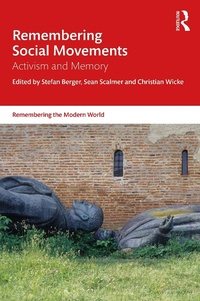
Remembering Social Movements
Activism and Memory
1st Edition
Published on 12. May 2021
334 pages
978-1-000-39015-5 (ISBN)
Description

Remembering Social Movements offers a comparative historical examination of the relations between social movements and collective memory.
A detailed historiographical and theoretical review of the field introduces the reader to five key concepts to help guide analysis: repertoires of contention, historical events, generations, collective identities, and emotions. The book examines how social movements act to shape public memory as well as how memory plays an important role within social movements through 15 historical case studies, spanning labour, feminist, peace, anti-nuclear, and urban movements, as well as specific examples of 'memory activism' from the 19th century to the 21st century. These include transnational and explicitly comparative case studies, in addition to cases rooted in German, Australian, Indian, and American history, ensuring that the reader gains a real insight into the remembrance of social activism across the globe and in different contexts. The book concludes with an epilogue from a prominent Memory Studies scholar.
Bringing together the previously disparate fields of Memory Studies and Social Movement Studies, this book systematically scrutinises the two-way relationship between memory and activism and uses case studies to ground students while offering analytical tools for the reader.
A detailed historiographical and theoretical review of the field introduces the reader to five key concepts to help guide analysis: repertoires of contention, historical events, generations, collective identities, and emotions. The book examines how social movements act to shape public memory as well as how memory plays an important role within social movements through 15 historical case studies, spanning labour, feminist, peace, anti-nuclear, and urban movements, as well as specific examples of 'memory activism' from the 19th century to the 21st century. These include transnational and explicitly comparative case studies, in addition to cases rooted in German, Australian, Indian, and American history, ensuring that the reader gains a real insight into the remembrance of social activism across the globe and in different contexts. The book concludes with an epilogue from a prominent Memory Studies scholar.
Bringing together the previously disparate fields of Memory Studies and Social Movement Studies, this book systematically scrutinises the two-way relationship between memory and activism and uses case studies to ground students while offering analytical tools for the reader.
More details
Series
Edition
1. Auflage
Language
English
Place of publication
London
United Kingdom
Publishing group
Taylor & Francis Ltd
Target group
College/higher education
Illustrations
8 Halftones, black and white; 8 Illustrations, black and white
ISBN-13
978-1-000-39015-5 (9781000390155)
Copyright in bibliographic data and cover images is held by Nielsen Book Services Limited or by the publishers or by their respective licensors: all rights reserved.
Schweitzer Classification
Other editions
Additional editions
Book
05/2021
1st Edition
Routledge
€61.90
Shipment within 15-20 days
Book
05/2021
1st Edition
Routledge
€206.30
Shipment within 15-20 days
Persons
Stefan Berger is Professor of Social History and Director of the Institute for Social Movements at Ruhr-Universitat Bochum, Germany. He is also executive chair of the Foundation History of the Ruhr, and an honorary professor at Cardiff University in theUK. His books on social movements include (with Holger Nehring) The History of Social Movement in Global Perspective (2017).
Sean Scalmer is Professor of History at the University of Melbourne, Australia. His books on social movements and politics include Dissent Events (2002), Activist Wisdom (2006), Gandhi in the West (2011), On the Stump (2017), and Democratic Adventurer (2020).
Christian Wicke is Assistant Professor of Political History at Utrecht University, the Netherlands. He wrote Helmut Kohl's Quest for Normality (2015). He recently edited (with Ulf Teichmann) an issue of Arbeit-Bewegung-Geschichte on the relationship between 'old' and 'new' social movements (2018/III).
Sean Scalmer is Professor of History at the University of Melbourne, Australia. His books on social movements and politics include Dissent Events (2002), Activist Wisdom (2006), Gandhi in the West (2011), On the Stump (2017), and Democratic Adventurer (2020).
Christian Wicke is Assistant Professor of Political History at Utrecht University, the Netherlands. He wrote Helmut Kohl's Quest for Normality (2015). He recently edited (with Ulf Teichmann) an issue of Arbeit-Bewegung-Geschichte on the relationship between 'old' and 'new' social movements (2018/III).
Content
1 Memory and social movements: an introduction 1
Stefan Berger, Sean Scalmer and Christian Wicke
2 The ascension of 'comfort women' in South Korean colonial memory 26
Lauren Richardson
3 The past in the present: memory and Indian women's politics 41
Devleena Ghosh and Heather Goodall
4 History as strategy. Imagining universal feminism in the women's movement 60
Sophie van den Elzen and Berteke Waaldijk
5 'The memory of history as a leitmotif for nonviolent resistance' - peaceful protests against nuclear missiles in Mutlangen, 1983-7 83
Richard Rohrmoser
6 Atomic testing in Australia: memories, mobilizations and mistrust 95
David Lowe
7 'The FBI Stole My Fiddle': song and memory in US radical environmentalism, 1980-95 113
Iain McIntyre
8 Memory 'within', 'of' and 'by' urban movements 133
Christian Wicke
9 Memory as a strategy? - dealing with the past in political proceedings against communists in 1950/60s
West Germany 156
Sarah Langwald
10 'We believe to have good reason to regard these comrades, who died in March, to be ours.' The remembrance of the Maerzgefallenen by workers' organizations during the Weimar Republic 180
Jule Ehms
11 Memory as political intervention: labor movement life narration in Australia, Jack Holloway and
May Brodney 199
Liam Byrne
12 Remembering the movement for eight hours: commemoration and mobilization in Australia 219
Sean Scalmer
13 The memory of trade unionism in Germany 240
Stefan Berger
14 Protest cycles and contentious moments in memory activism: insights from postwar Germany 260
Jenny Wuestenberg
15 Social movements, white and black: memory struggles in the United States South since the Civil War 280
W. Fitzhugh Brundage
16 Afterword: the multiple entanglements of memory and activism 299
Ann Rigney
Stefan Berger, Sean Scalmer and Christian Wicke
2 The ascension of 'comfort women' in South Korean colonial memory 26
Lauren Richardson
3 The past in the present: memory and Indian women's politics 41
Devleena Ghosh and Heather Goodall
4 History as strategy. Imagining universal feminism in the women's movement 60
Sophie van den Elzen and Berteke Waaldijk
5 'The memory of history as a leitmotif for nonviolent resistance' - peaceful protests against nuclear missiles in Mutlangen, 1983-7 83
Richard Rohrmoser
6 Atomic testing in Australia: memories, mobilizations and mistrust 95
David Lowe
7 'The FBI Stole My Fiddle': song and memory in US radical environmentalism, 1980-95 113
Iain McIntyre
8 Memory 'within', 'of' and 'by' urban movements 133
Christian Wicke
9 Memory as a strategy? - dealing with the past in political proceedings against communists in 1950/60s
West Germany 156
Sarah Langwald
10 'We believe to have good reason to regard these comrades, who died in March, to be ours.' The remembrance of the Maerzgefallenen by workers' organizations during the Weimar Republic 180
Jule Ehms
11 Memory as political intervention: labor movement life narration in Australia, Jack Holloway and
May Brodney 199
Liam Byrne
12 Remembering the movement for eight hours: commemoration and mobilization in Australia 219
Sean Scalmer
13 The memory of trade unionism in Germany 240
Stefan Berger
14 Protest cycles and contentious moments in memory activism: insights from postwar Germany 260
Jenny Wuestenberg
15 Social movements, white and black: memory struggles in the United States South since the Civil War 280
W. Fitzhugh Brundage
16 Afterword: the multiple entanglements of memory and activism 299
Ann Rigney
