

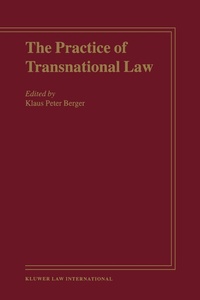
The Practice of Transnational Law
Published on 1. March 2002
244 pages
978-90-411-7432-1 (ISBN)
Description

It has been clear for some time that commercial law has been undergoing a "transnationalization" process, with various sets of rules (often referred to collectively as Lex Mematoria or the New Law Merchant) supplanting national and local laws governing the mechanisms by which cross-border agreements are entered into and disputes settled. In order to clarify the nature and extent of this process, a scientific survey, sponsored by the Volkswagen Foundation and using empirical methodology, was designed by a Research Team from the Center for Transnational Law (CENTRAL) of Münster University, Germany. A questionnaire was sent out to more than 2,700 practitioners from major companies and international law firms in 78 countries asking for the addressees' experience with transnational law in international contract negotiations, contract drafting and international commercial arbitration. The results of this unique enquiry, along with analysis and commentary from several well-known authorities in the fields of international commercial arbitration and private international law, were presented at a conference in Münster on May 4 and 5, 2000. This book is a record of that conference.
The Practice of Transnational Law provides, for the first time, a comprehensive and realistic evaluation of how transnational commercial law is used in international legal practice today. The contributions of the speakers - including Yves Derains on the ICC Arbitration Rules and Michael Joachim Bone11 on the UNIDROIT Principles, as well as commentary by Emmanuel Gaillard, Friedrich K. Juenger, Norbert Horn and Klaus Peter Berger - and a summary of the discussions add an insightful and lively dimension to the empirical data presented in the annexes. Commercial law practitioners and business people all over the world will appreciate the new level of discussion initiated by this important book.
The Practice of Transnational Law provides, for the first time, a comprehensive and realistic evaluation of how transnational commercial law is used in international legal practice today. The contributions of the speakers - including Yves Derains on the ICC Arbitration Rules and Michael Joachim Bone11 on the UNIDROIT Principles, as well as commentary by Emmanuel Gaillard, Friedrich K. Juenger, Norbert Horn and Klaus Peter Berger - and a summary of the discussions add an insightful and lively dimension to the empirical data presented in the annexes. Commercial law practitioners and business people all over the world will appreciate the new level of discussion initiated by this important book.
More details
Other editions
Additional editions
Center for Transnational Law Central Staff
The Practice of Translational Law
Book
03/2002
1st Edition
Kluwer Law International
€89.88
Shipment within 10-20 days
Content
- Cover
- Half Title Page
- Title Page
- Copyright Page
- Table of Contents
- PREFACE
- LIST OF ABBREVIATIONS
- SPEAKERS AND PARTICIPANTS OF THE CONFERENCE ON THE PRACTICE OF TRANSNATIONAL LAW
- THE NEW LAW MERCHANT AND THE GLOBAL MARKET PLACE
- INTRODUCTION
- I. THE 'MILESTONES' OF THE LEX MERCATORIA DOCTRINE
- 1. Malynes and Blackstone: From the Ancient Law Merchant to the Codification Wave
- 2. Zitelmann: The Vision of a 'World Law'
- 3. Goldman, Fouchard and Kahn: The Rebirth of the Lex Mercatoria by the French School
- 4. Clive Schmitthoff: The Power of International Arbitrators and International Formulating Agencies
- 5. UNIDROIT: The Report on the 'Progressive Codification of the Law of International Trade'
- 6. Dezalay, Garth and Teubner: The Sociological Approach
- 7. UNIDROIT, Lando-Commission, CENTRAL: The New Phenomenon of the 'Creeping Codification' of Transnational Law
- II. THE PRESENT STATE OF THE DOCTRINE OF TRANSNATIONAL LAW
- 1. The Evolution of a 'Global Market Place' and a 'Global Civil Society'
- 2. The Decreasing Significance of State Sovereignty in the Traditional Theory of Legal Sources
- 3. The Modern Law Merchant in the Global Market Place
- CONCLUSION
- THE UNIDROIT PRINCIPLES AND TRANSNATIONAL LAW
- I. INTRODUCTION
- II. THE PARTIES' EXPRESS CHOICE OF THE UNIDROIT PRINCIPLES AS THE LAW GOVERNING THEIR CONTRACT
- 1. Application of the UNIDROIT Principles by Domestic Courts
- 2. Application of the UNIDROIT Principles by Arbitral Tribunals
- III. APPLICATION OF THE UNIDROIT PRINCIPLES IN THE ABSENCE OF AN EXPRESS REFERENCE BY THE PARTIES
- 1. The UNIDROIT Principles as a Source of 'General Principles of Law', 'Lex Mercatoria' or the like
- 2. The UNIDROIT Principles as a Means of Interpreting and Supplementing International Uniform Law
- 3. The UNIDROIT Principles as a Means of Interpreting and Supplementing Domestic Law
- IV. CONCLUSIONS
- TRANSNATIONAL LAW IN ICC ARBITRATION
- INTRODUCTION
- I. THE APPLICABILITY OF TRANSNATIONAL LAW UNDER THE ICC RULES - THE DEVELOPMENT SINCE 1955
- 1. The 1998 ICC Rules
- 2. The 1975 and the 1955 ICC Rules
- II. ENFORCEABILITY OF THE AWARD AS THE KEY ISSUE
- III. APPLICATION OF TRANSNATIONAL LAW IN ICC AWARDS
- 1. First Situation: The Parties Have Not Selected the Applicable Law
- 2. Second Situation: The Parties Have Selected a National Law
- CONCLUSION
- TRANSNATIONAL LAW: A LEGAL SYSTEM OR A METHOD OF DECISION-MAKING?
- I. THE RENEWED DEBATE ON LEX MERCATORIA
- 1. Is Lex Mercatoria Defined by its Content or by its Sources?
- 2. Is Lex Mercatoria a List or a Method?
- II. THE ISSUE OF LEX MERCATORIA AS A DISTINCT LEGAL SYSTEM REVISITED
- 1. Completeness
- 2. Structured Character
- 3. Evolving Character
- 4. Predictability
- THE USE OF TRANSNATIONAL LAW IN THE CONTRACT LAW OF INTERNATIONAL TRADE AND FINANCE
- I. INTRODUCTION: DEFINITIONS
- 1. Transnational Sources of Law
- 2. Modes of Application of Transnational Law
- II. THE APPLICATION OF CODIFIED TRANSNATIONAL LAW
- 1. The Rule of Internationally Uniform Interpretation
- 2. The Interpretation of the CISG in National Courts
- III. EUROPEAN COMMUNITY LAW
- 1. EU Treaties and Conventions
- 2. The Interpretation of National Law Enacted in Conformity with EU Directives
- IV. THE UNIDROIT PRINCIPLES
- 1. Significance and Modes of Application
- 2. Choice of UNIDROIT Principles
- 3. The Principles Used to Aid in the Interpretation of the CISG
- 4. The UNIDROIT Principles and the Interpretation of Domestic Law
- 5. The UNIDROIT Principles as Trade Usage
- V. OTHER UNOFFICIAL SOURCES OF TRANSNATIONAL LAW OF COMMERCIAL AND FINANCIAL CONTRACTS
- 1. Types of Sources
- 2. Modes of Application
- 3. The Uniform Customs and Practice for Documentary Credits
- 4. The UN Convention on Independent Guarantees and Stand-by Letters of Credit
- 5. FIDIC Standard Forms of Contract
- VI. CONCLUDING REMARKS
- SOME RANDOM REMARKS FROM OVERSEAS
- INTRODUCTION
- I. THE LEX MERCATORIA'S DECLINE AND APPARENT FALL
- II. CURRENT DISCUSSIONS ABOUT THE LEX MERCATORIA
- III. DOES THE US REALLY NEED A LEX MERCATORIA?
- 1. The Common Law: A Supranational Legal Culture
- 2. American Pragmatism
- IV. WHAT ABOUT THE FUTURE?
- THE CENTRAL ENQUIRY ON THE USE OF TRANSNATIONAL LAW IN INTERNATIONAL CONTRACT LAW AND ARBITRATION
- INTRODUCTION
- I. PREVIOUS ENQUIRIES ON THE USE OF TRANSNATIONAL LAW IN LEGAL PRACTICE
- 1. The Selden Enquiry
- 2. The UNIDROIT Enquiry
- 3. The Gordon Enquiry
- 4. The Value of These Studies
- II. THE CENTRAL RESEARCH PROJECT ON TRANSNATIONAL COMMERCIAL LAW
- III. THE PREPARATION OF THE CENTRAL ENQUIRY
- 1. Selection of Addressees
- 2. Anonymity
- 3. Design of the Questionnaire
- 4. Language of the Questionnaire
- IV. THE PROCEDURE OF THE ENQUIRY
- 1. The Letters
- 2. The Answers Received
- V. THE DATA ENTRY PHASE
- 1. Categorizing the Questionnaires
- 2. Data Entry Procedure
- VI. SELECTED RESULTS OF THE CENTRAL ENQUIRY
- 1. Regional Distribution and Types of Contracts
- 2. Positive Responses
- 3. Negative Responses
- CONCLUSION
- SUMMARY OF DISCUSSIONS
- I. FIRST DAY
- 1. Discussion Following the Presentation of Professor Berger
- 2. Discussion Following the Presentation of Professor Bonell
- II. SECOND DAY
- 1. Discussion Following the Presentation of Yves Derains
- 2. Discussion Following the Presentation of Professor Gaillard
- 3. Discussion Following the Presentation of Professor Horn
- 4. Discussion Following the Presentation of Professor Juenger
- ANNEX I The Questionnaire
- QUESTIONNAIRE
- A. Use of Transnational Law in Contract Negotiations
- B. Use of Transnational Law in Contract Drafting
- C. Use of Transnational Law in Dispute Settlement
- D. General Evaluation of the Use of Transnational Law
- E. Additional Information
- ANNEX II Categories Defined by the Research Team
- ANNEX III Selected Results
- Annex III - Chart A/01
- Annex III - Chart A/02
- Annex III - Chart A/03
- Annex III - Chart A/04
- Annex III - Chart A/05
- Annex III - Chart B/01
- Annex III - Chart C/01
- Annex III - Chart D/01
- Annex III - Chart E/01
- Annex III - Chart E/02
- Annex III - Chart F/01
- Annex III - Chart G/01
- Annex III - Chart H/01
- Annex III - Chart H/02
- Annex III - Chart H/03
- Annex III -Chart H/04
- Annex III -Chart H/05
- Annex III - Chart H/06
- Annex III - Chart H/07
- Annex III - Chart H/08
- Annex III - Chart H/09
- Annex III - Chart H/10
- Annex III - Chart I/01
- Annex III - Chart I/02
- Annex III - Chart I/03
- Annex III - Chart I/04
- Annex III - Chart I/05
- Annex III - Chart J/01
- Annex III - Chart J/02
- Annex III - Chart J/03
- Annex III - Chart J/04
- Annex III - Chart J/05
- Annex III - Chart J/06
- Annex III - Chart J/07
- Annex III - Chart J/08
- Annex III - Chart J/09
- Annex III - Chart J/10
- Annex III - Chart J/11
- Annex III - Chart J/12
- Annex III - Chart J/13
- Annex III - Chart K/01
- Annex III - Chart K/02
- Annex III - Chart L/01
- Annex III - Chart M/01
- Annex III - Chart M/02
- Annex III - Chart M/03
- Annex III - Chart M/04
- Annex III - Chart M/05
- Annex III - Chart M/06
- Annex III - Chart M/07
- Annex III - Chart M/08
- Annex III - Chart M/09
- Annex III - Chart N/01
- Annex III - Chart N/02
- Annex III - Chart N/03
- Annex III - Chart N/04
- Annex III - Chart N/05
- Annex III - Chart N/06
- Annex III - Chart N/07
- Annex III - Chart N/08
- Annex III - Chart O/01
- Annex III - Chart P/01
- Annex III - Chart P/02
- Annex III - Chart P/03
- Annex III - Chart P/04
- Annex III - Chart P/05
- Annex III - Chart P/06
- Annex III - Chart Q/01
- Annex III - Chart Q/02
- Annex III - Chart R/01
- Annex III - Chart R/02
- Annex III - Chart R/03
- Annex III - Chart R/04
- ANNEX IV Examples for the Practical Application of Transnational Law
- EXAMPLES FOR THE PRACTICAL APPLICATION OF TRANSNATIONAL LAW
- 1. Railway contract between Turkey and the 'Compagnie générale pour l'exploitation des chemins de fer de la Turquie Europe' (1872)
- 2. Concession Agreement between Government of Iran and National Iranian Oil Company (1957)
- 3. LIAMCO Concession Agreement (1955)
- 4. TOPCO Concession Agreement (1963)
- 5. AMINOIL Concession Agreement (1979)
- 6. Channel Tunnel Construction Contract (1987)
- 7. ICC Award No. 7375 (1995)
- 8. ICC Arbitral Award No. 8385 (1995)
- Back Cover
