

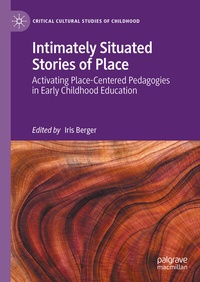
Intimately Situated Stories of Place
Description

This edited volume illuminates how intimate relations with place can transform early childhood pedagogy by presenting a diverse range of situated place stories. The book begins to answer big questions facing the early childhood education community, including: "What is situated, locally responsive education?", at a time when both researchers and educators grapple with their responsibility (and response-ability) to initiate and inspire alternative environmental ethics and anticolonial approaches that invite active participation from children. Chapters will include work from Indigenous and non-Indigenous researchers and educators who center the role of place in cultural identity, community building, and anticolonial projects throughout their work and teaching.
More details
Other editions
Additional editions
Person
Iris Berger is Assistant Professor of Teaching in the Department of Language and Literacy at the University of British Columbia, Canada.
Content
1. Introduction: Activating Intimate Place Pedagogies in Early Childhood Education.- 2. Care-Full Practices: The Intricacies and Intimate Events of More-than-Human Touching in Early Childhood.- 3. Place Stories: Provoking Pedagogies.- 4. How Does Play Construct Children's Sense of Place and Belonging in the Everyday Life of Pre-Primary School Education.- 5. Play/ground(ing): Design (of a Playground) as an Ecological Collaboratory.- 6. Aesthetically Emplacing ECEC Sensitivity and Slowness in the Forest: Toward Learning Together with the World.- 7. Embracing Vietnamese Ontology in Understanding a Child's Connection with Nature.- 8. Place-Conscious Indigenous Storywork.- 9. Exploring Innovation within an Indigenous (Anishnaabek) Early Learning Context: The Resurgence of Indigenous Knowledge, Perspective, and Pedagogies within an IECE Framework.- 10. (Re)Connecting Bodies and Beings with Country through an Indigenous Australian Early Childhood Outdoor Program.- 11. Diffractive Narratives of Sand: Place Pedagogy of Intimacy and Intimation.- 12. Professional Conversations which Lead to Professional Learning: Provoking Change in Teacher Education (and Beyond) through Te Tiriti o Waitangi and Mana Whenua Relationships.- 13. What Does Place Do in Bicultural Teaching and Learning in an ECE Setting in Aotearoa New Zealand? An Exploration with Posthumanist Theories and Te Ao Maori.- 14. Here I Am a Daughter: Using Platicas and Feminisms of Color to Understand Place and Identity during the COVID-19 Pandemic and Beyond.- 15. The Place of Memory in Reconceptualizing Childhood.
