

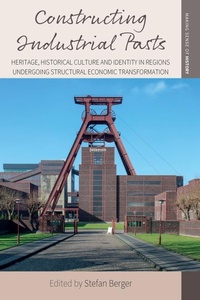
Constructing Industrial Pasts
Heritage, Historical Culture and Identity in Regions Undergoing Structural Economic Transformation
1st Edition
Published on 1. September 2019
329 pages
978-1-83695-206-0 (ISBN)
Description

Since the 1960s, nations across the "developed world" have been profoundly shaped by deindustrialization. In regions in which previously dominant industries faced crises or have disappeared altogether, industrial heritage offers a fascinating window into the phenomenon's cultural dimensions. As the contributions to this volume demonstrate, even as forms of industrial heritage provide anchors of identity for local populations, their meanings remain deeply contested, as both radical and conservative varieties of nostalgia intermingle with critical approaches and straightforward apologias for a past that was often full of pain, exploitation and struggle.
Reviews / Votes
"The 15 case studies are written to a uniformly high standard and provide a consistent approach to investigating each context's local cultural identity, which is increasingly important to maintain and acknowledge in this age of rapid globalization and homogenization of identity and economics. This analysis of specific regional examples of post-industrial history and the remembrance of an often romanticized, yet harsh, industrial identity will be of wide academic and regional interest...Recommended." * Choice"This collection of well-focused essays takes an original approach to a subject of very wide interest. It has substantial cross-disciplinary appeal." * Chris Wrigley, Nottingham University
"Constructing Industrial Pasts is a timely volume on post-industrial history and the processes and politics of remembrance. It covers a richly detailed set of case studies and makes an invaluable contribution to the field." * Denis Byrne, Western Sydney University
More details
Series
Edition
1. Auflage
Language
English
Place of publication
Oxford
United Kingdom
Target group
Professional and scholarly
Illustrations
Bibliography; Index; 5 Tables, unspecified; 20 Illustrations
File size
10,94 MB
ISBN-13
978-1-83695-206-0 (9781836952060)
DOI
10.3167/9781789202908
Copyright in bibliographic data and cover images is held by Nielsen Book Services Limited or by the publishers or by their respective licensors: all rights reserved.
Schweitzer Classification
Other editions
Additional editions
Stefan Berger
Constructing Industrial Pasts
Heritage, Historical Culture and Identity in Regions Undergoing Structural Economic Transformation
Book
07/2025
Berghahn Books
€42.20
Shipment within 3-4 weeks
Person
Stefan Berger is Professor of Social History and directs the Institute for Social Movements at the Ruhr University Bochum. He is also Chairman of the Foundation History of the Ruhr and Honorary Professor at Cardiff University in the UK. Before taking up his current position in Germany in 2011, he held the position of Professor of Modern German and Comparative European History at the University of Manchester.
Content
List of Figures, Maps, and Tables
Introduction: Preconditions for the Making of an Industrial Past - Comparative Perspectives
Stefan Berger
Chapter 1. 'Sooty Manchester'- (Re)Presenting an Urban-Industrial Landscape
Paul Pickering
Chapter 2. Where is 'Red Clydeside'? Industrial Heritage, Working Class Culture and Memory in the Glasgow Region
Arthur McIvor
Chapter 3. Industrial Heritage as Place-making: The Case of Wales
Bella Dicks
Chapter 4. The Steel Industry in Welsh History and Heritage
Louise Miskell
Chapter 5. Cornish Mining Heritage and Cornish Identity: Images, Representations and Narratives
Hilary Orange
Chapter 6. Industrial Heritage and the Remaking of Class Identity - Are We All Middle Class Now?
Laurajane Smith
Chapter 7. The Agents of Industrial Heritage in the Midst of Structural Transformation of the Latrobe Valley, Australia'
Erik Eklund
Chapter 8. 'Hardly a Cause for Tears': Job Insecurity and Occupational Psychology Culture in Italy - Oral Narratives from the Falck Steelworks in Sesto San Giovanni (Milan)
Roberta Garruccio
Chapter 9. Between Dream and Nightmare: Political Conventions of the Industrial Past in the North of France
Marion Fontaine
Chapter 10. Memory Culture and Identity Constructions in the Ruhr Valley in Germany
Stefan Berger and Jana Golombek
Chapter 11. Sounds of Decline. Industrial Echoes in Asturian Music
Ruben Vega
Chapter 12. The Coal-Environment Nexus: How Nostalgic Identity Burdens Heritage in Romania's Jiu Valley
David A. Kideckel
Chapter 13. A Special Kind of Cultural Heritage - The Remembrance of Workers' Life in Contemporary Hungary - Case Study of Ozd
Tibor Valuch
Chapter 14. Ruins for Politics: Selling Industrial Heritage in Postsocialist China's Rustbelt
Tong Lam
Chapter 15. The Heritage of the Chinese Eastern Railway: Symbol of Colonization and International Cooperation
Zhao Xin and Qu Xiaofan
Conclusion: Narrativisations of an Industrial Past - Labour, the Environment and the Construction of Space in Comparative Perspective
Stefan Berger
Index
Introduction: Preconditions for the Making of an Industrial Past - Comparative Perspectives
Stefan Berger
Chapter 1. 'Sooty Manchester'- (Re)Presenting an Urban-Industrial Landscape
Paul Pickering
Chapter 2. Where is 'Red Clydeside'? Industrial Heritage, Working Class Culture and Memory in the Glasgow Region
Arthur McIvor
Chapter 3. Industrial Heritage as Place-making: The Case of Wales
Bella Dicks
Chapter 4. The Steel Industry in Welsh History and Heritage
Louise Miskell
Chapter 5. Cornish Mining Heritage and Cornish Identity: Images, Representations and Narratives
Hilary Orange
Chapter 6. Industrial Heritage and the Remaking of Class Identity - Are We All Middle Class Now?
Laurajane Smith
Chapter 7. The Agents of Industrial Heritage in the Midst of Structural Transformation of the Latrobe Valley, Australia'
Erik Eklund
Chapter 8. 'Hardly a Cause for Tears': Job Insecurity and Occupational Psychology Culture in Italy - Oral Narratives from the Falck Steelworks in Sesto San Giovanni (Milan)
Roberta Garruccio
Chapter 9. Between Dream and Nightmare: Political Conventions of the Industrial Past in the North of France
Marion Fontaine
Chapter 10. Memory Culture and Identity Constructions in the Ruhr Valley in Germany
Stefan Berger and Jana Golombek
Chapter 11. Sounds of Decline. Industrial Echoes in Asturian Music
Ruben Vega
Chapter 12. The Coal-Environment Nexus: How Nostalgic Identity Burdens Heritage in Romania's Jiu Valley
David A. Kideckel
Chapter 13. A Special Kind of Cultural Heritage - The Remembrance of Workers' Life in Contemporary Hungary - Case Study of Ozd
Tibor Valuch
Chapter 14. Ruins for Politics: Selling Industrial Heritage in Postsocialist China's Rustbelt
Tong Lam
Chapter 15. The Heritage of the Chinese Eastern Railway: Symbol of Colonization and International Cooperation
Zhao Xin and Qu Xiaofan
Conclusion: Narrativisations of an Industrial Past - Labour, the Environment and the Construction of Space in Comparative Perspective
Stefan Berger
Index
