

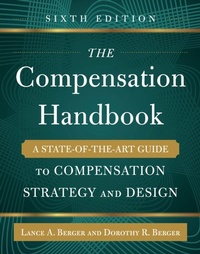
Compensation Handbook, Sixth Edition: A State-of-the-Art Guide to Compensation Strategy and Design
1st Edition
Published on 6. July 2015
713 pages
978-0-07-183823-8 (ISBN)
Available for download
Description

The definitive guide for HR and compensation professionals revised to help you achieve a sustainable competitive advantage for your company The theme of the sixth edition of the classic compensation guide aligns with business s number-one goal today: achieving a sustainable competitive advantage. The Compensation Handbook shows you how to deal effectively with five strategic human capital issues: innovation, attracting talent and retention, big data, workforce changes, business advantage through compensation programs.
More details
Other editions
Additional editions
Lance Berger | Dorothy Berger
The Compensation Handbook, Sixth Edition: A State-of-the-Art Guide to Compensation Strategy and Design
A State-of-the-Art Guide to Compensation Strategy and Design
Book
07/2015
6th Edition
McGraw-Hill Professional
€123.20
Shipment within 15-20 days
Content
- Cover
- Title Page
- Copyright Page
- Contents
- Preface
- Part I Introduction
- 1 The State of the Compensation Practice
- 2 Using a Total Rewards Strategy to Achieve Competitive Advantage
- 3 Aligning Total Compensation Programs with Organization Values and Strategy
- 4 Winning Compensation Strategies for Organizational Sustainability
- 5 Excelling as a Compensation Professional
- 6 Emerging Compensation Issues
- Part II Base Salary
- 7 Positioning Salary Structures within the Total Rewards Context
- 8 Selecting and Developing a Salary Structure
- 9 Making Merit Pay and Bonuses Matter
- 10 The Purpose and Nature of Job Evaluation
- 11 Optimizing the Use of Salary Surveys
- 12 Rationale for and Approaches to Benchmarking
- 13 Paying for Skills, Knowledge, and Competencies
- 14 Using Nonmonetary Awards to Support Behaviors that Drive Business Results
- Part III Variable Compensation
- 15 Choosing the Incentive Compensation Program that Best Promotes Performance
- 16 Designing and Implementing Effective Variable Pay Programs
- 17 Aligning Sales Compensation Plan Design with Talent Retention Strategy
- 18 Developing and Applying a Return-on-Investment Methodology to Drive Sales Force Performance
- 19 Creating a Culture of Collaboration, Innovation, and Performance through Team-Based Incentives
- 20 Revolutionizing Workplace Culture through Scanlon Gain Sharing
- Part IV Executive Compensation
- 21 Formulating and Implementing an Executive Compensation Strategy
- 22 Designing and Executing Long-Term Incentive Plans
- 23 Regulating Executive Compensation
- 24 Formulating Executive Employment Agreements
- 25 Cracking the Secret Code of Long-Term Incentives in Private Companies
- Part V Compensation and the Board
- 26 The Compensation Committee and Executive Pay
- 27 Dynamics of CEO Pay
- 28 Board Compensation
- 29 Structuring Board and Executive Pay
- 30 Compensation Committee of the Board
- 31 Creating an Effective CEO Succession-Planning Process
- Part VI Performance and Compensation
- 32 A Framework for Designing a Performance-Management Process
- 33 Choosing a Performance-Appraisal System
- 34 Linking Compensation to Competitive Business Value
- 35 Using Financial Rewards to Drive Productivity
- 36 New Developments and Issues in Pay for Performance
- 37 Making Calibration an Integral Part of a Performance-Appraisal System
- 38 Guidelines for Effective Executive Performance Appraisals
- Part VII Talent Management and Compensation
- 39 Employing Novel Ways to Use Compensation to Win the Talent Wars
- 40 Strengthening the Link between Compensation and Return on Investment
- 41 Incorporating Work/Life Effectiveness into a Total Rewards Strategy
- 42 A Methodology for Effectively Communicating Compensation Programs
- Part VIII Global Compensation
- 43 Critical Expatriate Compensation Issues and Practices
- 44 Global Local National Compensation Issues and Practices
- 45 Employing Novel Compensation Approaches to Compete for Expatriate Talent
- Part IX Big Data
- 46 A Guide to Realizing the Value of Big Data
- 47 Using Workforce Analytics to Make Effective Compensation Decisions
- 48 Making Better Compensation Decisions in the Age of Big Data
- 49 Using Big Data to Enhance the Value of Compensation Programs
- 50 Turning Data into Compensation Information
- 51 Exploring New Technologies that Enhance Compensation Programs
- Contributors
- Index
- About the Editors

