

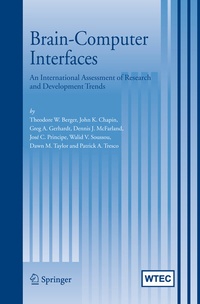
Brain-Computer Interfaces
Description

Reviews / Votes
From the reviews:
"Brain-Computer Interfaces is an interesting and unique book . . The authors attempt not only to review the most important aspects of BCIs but also discuss future trends in BCIs and give an overview of the research of many leading laboratories in North America, Europe, Japan, and China. . Overall, this easy-to-follow book is written in a concise and reader-friendly style. I recommend this book to all researchers and students who have an interest in research related to BCIs." (Andrzej Cichocki, The Lancet, Vol. 8, September, 2009)
More details
Other editions
Additional editions
Persons
Dr. Theodore W. Berger (Panel Chair) is the David Packard Professor of Engineering, Professor of Biomedical Engineering and Neuroscience, and Director of the Center for Neural Engineering at the University of Southern California. He received his PhD from Harvard University in 1976; his thesis work received the James McKeen Cattell Award from the New York Academy of Sciences. He conducted postdoctoral research at the University of California, Irvine, from 1977-1978 and was an Alfred P. Sloan Foundation Fellow at the Salk Institute from 1978-1979. Dr. Berger joined the Departments of Neuroscience and Psychiatry at the University of Pittsburgh in 1979, being promoted to full professor in 1987. During that time, he received a McKnight Foundation Scholar Award, twice received an NIMH Research Scientist Development Award, and was elected a Fellow of the American Association for the Advancement of Science. Since 1992, he has been Professor of Biomedical Engineering and Neurobiology at the University of Southern California, and was appointed the David Packard Chair of Engineering in 2003.
While at USC, Dr. Berger has received an NIMH Senior Scientist Award, was elected a Fellow of the American Institute for Medical and Biological Engineering in 1998, received a Person of the Year "Impact Award" by the AARP in 2004 for his work on neural prostheses, was a National Academy of Sciences International Scientist Lecturer in 2003, and an IEEE Distinguished Lecturer in 2004-2005. Dr. Berger was elected a Senior Member of the IEEE in 2005, and received a "Great Minds, Great Ideas" award from the EE Times in the same year. Dr. Berger is currently chair of an NIH study section that evaluates grants related to clinical neurophysiological, medical devices, and neural prosthetics. Dr. Berger became Director of the Center for Neural Engineering in 1997, an organization that helps to unite USC faculty with cross-disciplinary interests in neuroscience, engineering, andmedicine. He has published over 200 journal articles and book chapters, and is the coeditor of a book recently published by the MIT Press: Toward Replacement Parts for the Brain: Implantable Biomimetic Electronics as Neural Prostheses.
Dr. Berger's research focuses on electrophysiological and theoretical studies of hippocampal neurons and circuits for the purpose of developing neural prostheses and biological-based pattern recognizers.
